
Two Independences
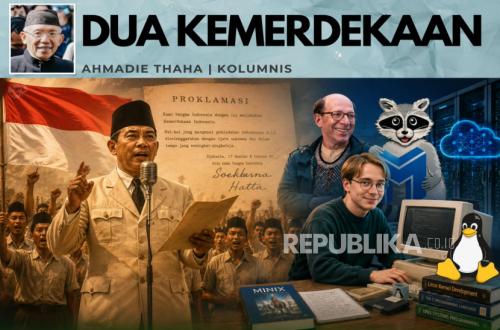
For me, the month of August has two defining birthdays. The first is the birthday of the Republic of Indonesia on 17 August 1945. On that day of independence, which fell on a sacred Friday, our nation shouted loudly to the world, “We want to manage our own lives!” We celebrate it with ceremonies and various competitions.
The second August birthday involves no ceremony. It happened in the world of computers. On 25 August 1991, a Finnish student named Linus Torvalds wrote a message on the internet. He announced that he was making a computer system. The system later took an acronym of his name, Linux. Millions of people use it lawfully.
So for me, the August festivities carry two stories of independence. Indonesia became independent from colonialists. Meanwhile, Linux became a symbol of independence in the computer world, freeing me from Windows, which requires payment. Linux, including its derivative Android, is free for us to use. The Windows operating system, on the other hand, must be paid for.
Indonesia began its independence from Jalan Pegangsaan Timur, Jakarta. Linus began his computer independence from a short message on the internet. Both teach us one thing: that major change does not have to start from a grand building. Change starts from a person who dares to say, “I want to try another way!”
The story of Linux is actually very simple, very far from the story of the Indonesian nation. No rich company funded the project. There were no hundreds of brilliant engineers. There were no meetings of big bosses. There was only a student at the University of Helsinki, one 386-type computer, enormous curiosity, and perseverance.
In 1991, do not imagine computers as sophisticated as today’s. A computer powered by an Intel-made processor, the PC 386, was very cool for a student who could afford it. The machine was clever. Linus bought the computer not to found a rich company or to rule the world. He simply wanted to learn how the inner workings of his machine functioned.
Linus learned to use an operating system called MINIX, made by Professor Andrew Tanenbaum. Andrew created MINIX as a teaching tool in his class. It was good but very simple. At home, Linus used MINIX to try new things. But over time, Linus felt that MINIX’s features did not sufficiently meet his needs.
In his head, Linus had many new ideas. He began making a small terminal programme. This programme connected the computer at his home with the large computer on campus via telephone cable and modem. From initially being intended only as a toy, Linus kept improving it. The programme then turned into a powerful messaging tool.
This story is close to my own experience. In the late 1980s, I had already bought an XT 386 computer to help my work as a TEMPO journalist. Then in 1993, when Indonesians did not yet know the internet, I used BBS (Bulletin Board System) software.
I chose BBS to make it easier to send news from Republika newspaper’s news bureaus in various cities. In the past, to send news text, we had to use a telephone connection and a modem. The sound was a very noisy “kriik-kriik”. But for us at that time, the computer screen was like a magical window for seeing the outside world.
I understand very well how Linus felt at that time. At home there was a computer, a modem, a telephone cable, and a distant campus computer. The difference is that Linus did not only want to use the campus computer. Linus asked himself, “What if I make my own system to control this computer?”
This small question was tremendous! Almost all great discoveries in the world begin with a simple question like this. Linus then began writing the application package that we know as the kernel. This is the most central brain of the computer. This brain is tasked with managing memory, the machine, and all programmes.
Linus first typed his code in April 1991. Five months later, on 25 August — the birth date of Linux — he sent a message to his friends on the internet. The message is very famous to this day. He said he was making a free computer system. “Just a hobby,” he said. He said the system would not become a big project.
But history proved otherwise! Something that Linus called “just a hobby” has now become the brain for millions of computers in the world. Linux now works inside internet servers, giant computers, network devices, and the Android phones we use every day. Without us realising it, Linux is everywhere!