
Two former LPEI officials request acquittal in corruption case
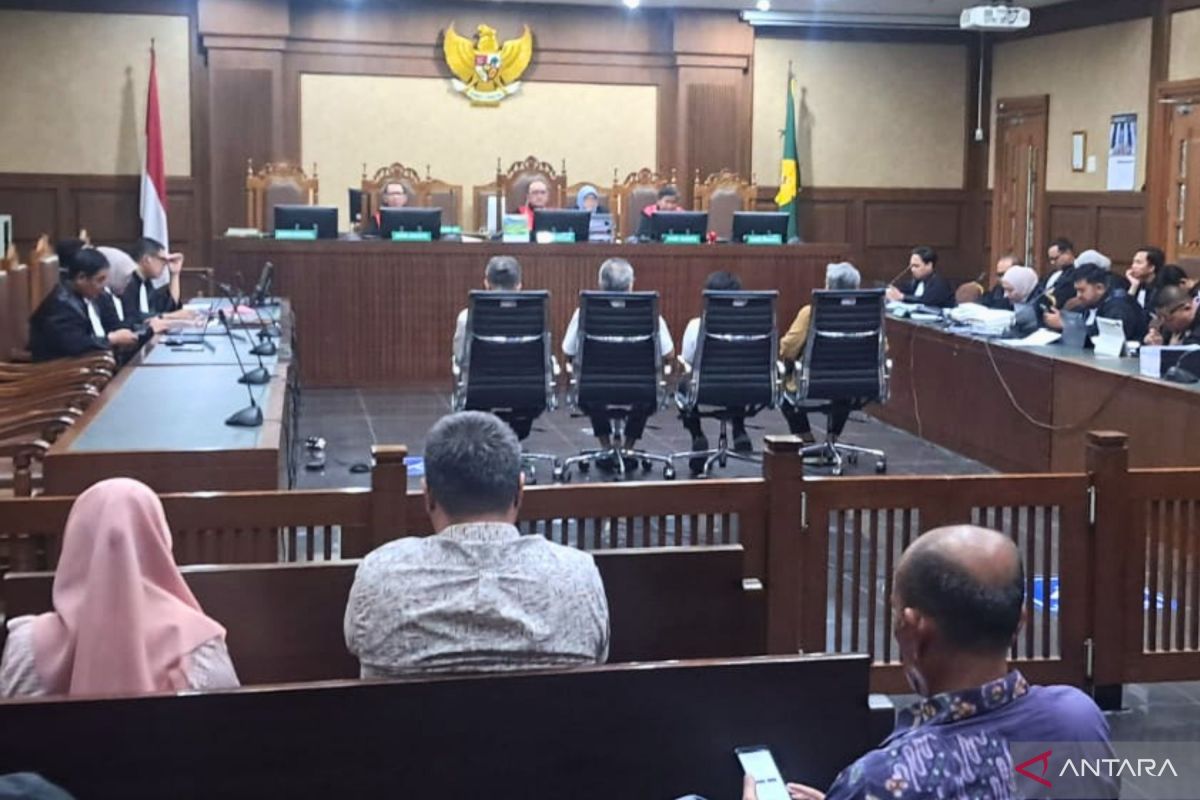
Two former officials of the Indonesian Eximbank (LPEI), Andi Maulana Adjie and Intan Apriadi, have requested to be acquitted of alleged corruption in LPEI’s national export financing for the 2015–2020 period.
Their advocate, Kores Tambunan, in a defence statement at the Corruption Court at the Central Jakarta District Court on Friday, denied that his clients were involved in criminal acts of corruption.
“The facts in the trial show that the process of proposing financing for PT Tebo Indah (TI) had undergone careful analytical review,” Kores said while reading the defence statement (pleidoi).
According to Kores, based on the business profile and technical calculations, PT TI at that time was eligible to be proposed to receive financing facilities from LPEI.
He said Andi and Intan had carried out their duties as financing proposers correctly and in accordance with the provisions in the disbursement of financing worth Rp263 billion in 2016.
Kores said a feasibility study for the development of an oil palm plantation and the construction of a factory with a capacity of 30 tonnes of fresh fruit bunches (TBS) per hour owned by PT TI had been carried out.
According to him, the process also took into account the precautionary principle in providing financing.
He assessed that there was no evidence showing that his two clients obtained personal benefits from the financing process.
Kores also questioned the fulfilment of the element of state financial loss because the obligation to pay instalments by PT TI and PT PAS is still being carried out to this day.
The request for acquittal was also submitted by the advocate team for two other defendants, namely Gamaginta and Komaruzzaman.
In the case there are eight defendants who are demanded prison sentences ranging from 8 years and 6 months to 13 years.
Six defendants were each sentenced to 8 years and 6 months in prison, namely Andi Maulana Adjie, Intan Apriadi, Komaruzzaman, Gamaginta, Dwi Wahyudi, and Ryan Wahyudi.
Komaruzzaman served as Head of the Sharia Financing Division II Department of LPEI for the 2011–2016 period, while Gamaginta was Head of the Sharia Financing Division I Department of LPEI for the 2017–2018 period.
Dwi Wahyudi was Managing Director I of LPEI for the 2009–2018 period, while Ryan Wahyudi served as Sharia Financing I Relation Manager at the Sharia Financing I Department of the Sharia Financing Division of LPEI for the 2015–2018 period.
Meanwhile, the beneficial owner of PT TI and PT PAS, Handoko Limaho, was sentenced to 11 years in prison, while PT TI Director Liu Raymond was sentenced to 13 years in prison.
The eight defendants were also demanded to pay a fine of Rp1 billion each, with the provision that if not paid it would be replaced by imprisonment for 190 days.
Specifically for Handoko and Liu, the prosecutor demanded additional penalties in the form of payment of replacement money of Rp346.47 billion and Rp646.35 billion respectively.
If the replacement money is not paid, Handoko is demanded a substitute sentence of 5 years and 6 months in prison, while Liu is demanded 6 years and 6 months.
The defendants were charged with participating in a number of interconnected criminal acts so that they were considered as one continuous act that was unlawful and enriched Handoko Limaho and Liu Raymond.
The act began when Handoko and Liu applied for financing facilities using feasibility study documents and asset valuation reports from the Public Appraisal Service Office (KJPP) which stated that the area of land planted with oil palm did not match the actual conditions.
Handoko and Liu were also charged with using fiduciary deed documents for inventory and trade receivables that did not match the audited financial statements and applying for disbursement of financing facilities using supporting documents in the form of fictitious invoices and contracts.
For their actions, the eight defendants were charged with violating Article 603 or Article 604 in conjunction with Article 20 letter c of the National Criminal Code in conjunction with Article 8 of Law Number 31 of 1999 concerning the Eradication of Criminal Acts of Corruption as amended by Law Number 20 of 2001.