
Two Faces of Indonesia's Economy: Machinery Industry Accelerates, Tobacco Struggles
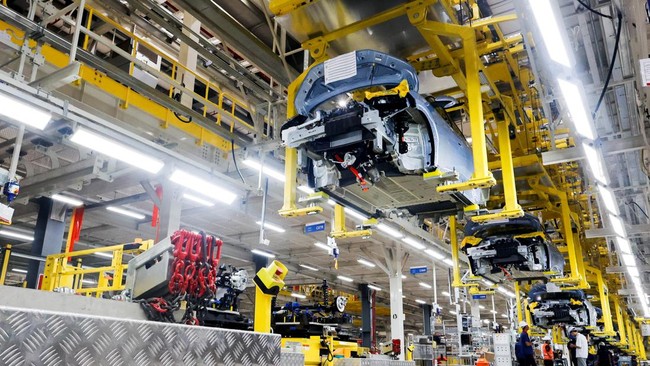
Indonesia’s processing industry has once again become one of the main pillars of the Indonesian economy in early 2026.
The Central Statistics Agency recorded that the processing industry grew 5.04% year-on-year (yoy) in the first quarter of 2026. This figure is indeed lower than the 5.40% yoy in the fourth quarter of 2025, but it is still higher than the 4.55% yoy in the first quarter of 2025.
This improvement is more evident when viewed since mid-2025. The processing industry grew 5.68% yoy in the second quarter of 2025, then remained solid at 5.54% yoy in the third quarter of 2025 and 5.40% yoy in the fourth quarter of 2025.
With the achievement in the first quarter of 2026, this sector has now grown above 5% for four consecutive quarters.
Recovery is also evident in the non-oil and gas processing industry. In the first quarter of 2026, the non-oil and gas processing industry grew 5.14% yoy, higher than the 4.31% yoy in the first quarter of 2025.
Meanwhile, the coal and oil refining industry grew 3.88% yoy in the first quarter of 2026. Its performance slowed compared to the 8.72% yoy in the fourth quarter of 2025, but it remains in positive territory.
In terms of contribution to the economy, the processing industry continues to play a major role. In the first quarter of 2026, the processing industry’s share of GDP reached 19.07%, making it the largest sector in the national economic structure.
The largest contribution comes from the non-oil and gas processing industry, which accounts for 17.41% of GDP, while the coal and oil refining industry contributes 1.66%.
This significant contribution makes the processing industry a crucial sector.
The processing industry is an economic activity that transforms raw materials into semi-finished or finished goods. Its scope is broad, ranging from food and beverages, textiles, tobacco, furniture, basic metals, vehicles, electronics, to machinery and equipment.
Because its chain is long, movements in the processing industry do not only impact factories.
This sector is also linked to labour, demand for raw materials, logistics, investment, exports, and public consumption.
Many Subsectors Strengthen, Furniture Begins to Recover
The improvement in the processing industry is not only seen from the main figures but also from several subsectors that recorded positive growth in the first quarter of 2026.
The highest growth was recorded by the machinery and equipment industry, which surged 21.93% yoy.
This subsector covers the production of various machines and tools supporting business activities, from factory machines, agriculture, construction, mining, to other industrial equipment. The sharp rise in this subsector could signal increasing demand for production tools and business capacity expansion.
Strong performance is also seen in the non-metallic mineral goods industry, which grew 9.12% yoy, the chemical, pharmaceutical, and traditional medicine industry at 7.41% yoy, and the food and beverage industry at 7.04% yoy.
In terms of distribution, the food and beverage industry remains the largest subsector in the processing industry. In the first quarter of 2026, its contribution reached 7.31% of GDP.
This subsector’s performance is also still strong. The food and beverage industry grew 7.04% yoy in the first quarter of 2026, higher than the 6.81% yoy in the fourth quarter of 2025 and the 6.04% yoy in the first quarter of 2025.
This means the food and beverage subsector is not only large in terms of contribution but also continues to serve as a growth engine.
Positive developments also come from the furniture industry. This subsector grew 4.32% yoy in the first quarter of 2026, with a distribution of 0.20% to GDP. Its contribution is not as large as food and beverages, but the direction of its recovery is interesting because the furniture industry was hit hard in 2025.
In the first quarter of 2025, the furniture industry still grew highly at 9.86% yoy. However, pressure began to appear after the escalation of the US trade war in 2025. Furniture industry growth dropped sharply to -0.05% yoy in the second quarter of 2025, then deepened to -4.34% yoy in the third quarter of 2025.
Pressure on the furniture industry began to be felt after the US implemented reciprocal tariffs in early April 2025.
This policy burdened many Indonesian exporters, including furniture industry players, with additional costs from tariffs, expenses, and demand uncertainty.
As a result, export-based industries like furniture were temporarily pressured as global buyers tended to hold back orders or renegotiate prices.
However, positive growth in the last two quarters shows that the pressure is starting to ease.
Tobacco Industry Still Pressured, Contraction Continues
Although the processing industry is generally improving, its recovery is not even. One subsector still under pressure is the tobacco processing industry.
In the first quarter of 2026, this subsector contracted 4.05% yoy, continuing the 4.97% yoy contraction in the previous quarter.
This pressure indicates that tobacco’s recovery is not yet strong. Throughout 2025, its performance improved in the second quarter with 4.59% yoy growth, but weakened again in the third and fourth quarters of 2025, at -0.93% yoy and -4.97% yoy respectively.
In terms of distribution, the tobacco processing industry contributes 0.59% to GDP in the first quarter of 2026. This figure is much smaller than other processing industry subsectors, but tobacco has an economic chain that cannot be ignored.
This industry is directly linked to tobacco farmers, factory labour, distribution, retail trade, and state revenues through excise taxes.
Therefore, contraction in the tobacco industry does not only depict pressure at the factory level but also has the potential to affect a broader economic ecosystem.
Pressure on the tobacco industry also needs to be read differently from other subsectors that are starting to strengthen.
When the food and beverage, chemical-pharmaceutical, metals, and machinery and equipment industries are able to grow solidly, the tobacco industry still faces challenges from the demand side.
Source: jawawa.id (https://jawawa.id/newsitem/two-faces-of-indonesias-economy-machinery-industry-accelerates-tobacco-struggles-1778054948)
Originally published by CNBC Indonesia (https://www.cnbcindonesia.com/research/20260506100738-128-732659/2-wajah-ekonomi-ri-industri-mesin-melaju-kencang-tembakau-terpuruk), translated from Indonesian