
Two Decades of the Worst Record! IHSG Becomes the World's Weakest Stock Exchange
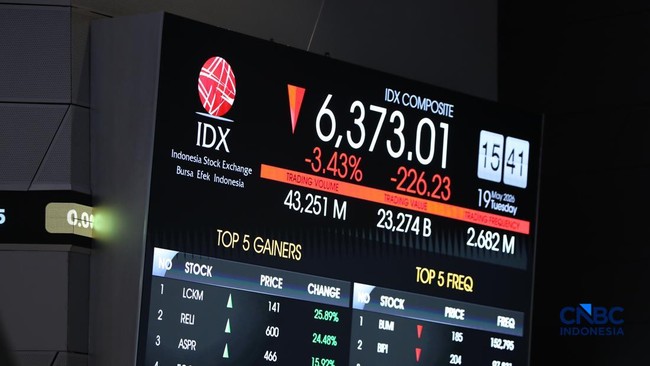
Jakarta — The Jakarta Composite Index (IHSG) faced a sharp sell-off this week, recording several grim milestones. On Friday, 22 May 2026, IHSG finished the session up 1.10% at 6,162.05, but the week still saw an 8.35% decline, marking a two-week drop. The index has fallen for eight straight sessions from 5–21 May 2026, for a total retreat of 15.04%. This eight-day slide is the longest run since August 2005, and notably longer than the pandemic-period streaks, when declines lasted seven days at the end of February 2020 and early January 2021. Over the week, the average daily value traded rose 16% to Rp21.8 trillion, while volume traded climbed 2.5% to 36.67 billion shares, although the number of trades fell by 6.5% to 2.4 million. The data suggest that large-scale selling remains dominant in the domestic market. Year to date, the IHSG is down 28.74%. The slide has left the index with a market capitalisation erosion of Rp5,214 trillion. From the peak reached on 19 January 2026 (9,133.87), the IHSG has declined by 32.5% and market capitalisation by Rp6,005 trillion. Foreign investors have recorded a net sell of Rp37.5 trillion so far this year. Why is IHSG so weak? The index has faced heavy pressure this week from a string of negative sentiment, including MSCI rebalancing and a government policy to establish a single-state export enterprise for strategic commodities. Last week’s trading data showed a 16% jump in average daily value traded to Rp21.8 trillion, with volumes up 2.5% to 36.67 billion shares, even as trading frequency fell 6.5% to 2.4 million trades. A key concern is a government plan to centralise exports of strategic commodities via PT Danantara Sumberdaya Indonesia (DSI) starting 1 January 2027. Global rating agencies have taken note. S&P Global Ratings warned that the policy could pose risks to exports, state revenue, and Indonesia’s balance of payments. The agency noted that such significant rule changes could undermine business confidence and dampen investment sentiment, Reuters reported. Moody’s echoed that while the policy could help bolster foreign exchange inflows, it could also distort markets and weigh on investor psychology. In addition to export policy concerns, market participants worry about oil prices staying elevated, which could fuel inflation. Bank Indonesia’s decision to raise the policy rate by 50 basis points to 5.25% on Thursday also weighs on the IHSG, as tighter monetary conditions threaten domestic growth.