
Two Decades of Safeguarding Minangkabau Islamic Manuscripts
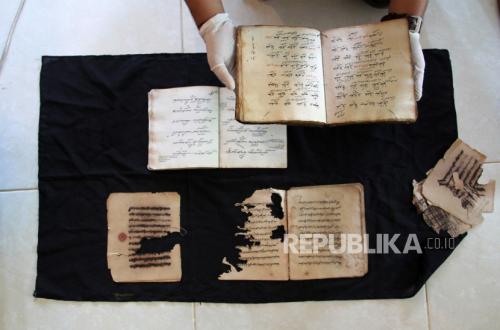
Around 2006, within the Faculty of Humanities at Andalas University—now the Faculty of Cultural Sciences—a simple motto emerged that would become the rescue movement for the Minangkabau Islamic manuscript patrimony: search and save. The motto did not arise from a comfortable meeting room or a glittering project, but from the anxiety after directly seeing the condition of Minangkabau manuscripts on the ground: fragile paper, ink swelling due to corrosion, pages eaten by termites, even fragments barely touchable.
Behind the motto stood names that today deserve to be remembered as guardians of Minangkabau memory: M Yusuf, Yusriwal (late), Zuriati (late), and Adriyetti Amir (late). They were a generation who worked when manuscript issues had not yet roused widespread discussion. When attention to ancient texts was still minimal, they already entered old suraus, visited ancestral homes, opened old chests, and noted one by one the traces of Minangkabau Islamic intellectual tradition scattered in various places.
The movement was subsequently continued by the younger generation: Pramono, Donny Eros, and Bahren. They continued the lengthy, exhausting fieldwork—traversing villages, digitising manuscripts, documenting scribal houses, while building public awareness that manuscripts are not merely old objects, but a heritage of knowledge that is vital for present and future life.
Two decades of the “search and save” journey reveal an important reality: the khazanah naskah Islam Minangkabau is actually still widely spread across old suraus in West Sumatra.
The manuscripts were found mainly in suraus of the tarekat orders Syattariyah, Naqsyabandiyah, and Sammaniyah. From the outside, some suraus appear simple and almost overlooked. Yet inside they hold a treasure of manuscripts that testify to how Islam was taught, debated, and transmitted in Minangkabau over hundreds of years.
There are manuscripts written very neatly with Arabic script and Arabic rubrics. There are also Arab-Malay texts using Malay language mixed with Minangkabau. The contents vary: Qur’anic exegesis (tafsir), fiqh, Sufism, astronomy (ilmu falak), prayers, tarekat chants, hikayat, poetry, charms, and personal notes by ulama about the social conditions of their times.
All of this shows that the suraus in Minangkabau were not merely places of worship in the past. Suraus were centres of intellectual culture, centres of Islamic education, spaces for the transmission of knowledge, places for students to copy books, and, at the same time, hubs of manuscript production. It is there that syaikh (scholars) taught, wrote, and built broad networks of Islamic intellectuals.
The two-decade search also gradually dispelled old doubts about Minangkabau writing traditions. The region has long been known for its oral traditions—kaba, rabab, indang, dendang, and salawat dulang. Yet the manuscripts found in old suraus prove that the writing tradition in Minangkabau was in fact very alive and strong.
A significant milestone occurred with the publication of the Catalogus Manuskrip dan Skriptorium Minangkabau in 2006 by the Tokyo University of Foreign Studies. Since then, preservation work has broadened through support from the British Library via the Endangered Archives Programme. The names Zuriati and M. Yusuf are recorded as central in the 2008 manuscript digitisation project for Minangkabau surau manuscripts. Irina Katkova, together with Pramono, then continued manuscript exploration in West Sumatra and Jambi in 2009 and 2011.
To this day, the work of digitising the khazanah Minangkabau manuscript heritage continues; principally through the Digital Repository of Endangered and Affected Manuscripts in Southeast Asia (DREAMSEA) programme since 2019, which has proved significant. To date, around 1,300 bundles of Minangkabau manuscripts have had their contents successfully saved through digitisation.
Yet the more manuscripts are discovered, the larger the threat that becomes apparent.
Most Minangkabau manuscripts were written from the 17th century to the early 20th century on paper that has now become fragile with age. A humid tropical climate accelerates deterioration. Many texts are stored in improper places: piled with household goods, placed in damp wooden chests, or left unopened for years.
In several places, termites have long consumed more pages than readers.
Another issue is attitudes. Some communities still regard manuscripts as sacred objects that should be kept tightly guarded, but not read any more. Others see them as economically valuable items. The practice of selling manuscripts to foreign collectors has long been a real threat. Many heirs are tempted to sell a manuscript for a sum of money.
In the midst of this, the “search and save” movement becomes important. It is not merely an academic project. It is a job of safeguarding collective memory.
For those manuscripts are not just piles of old paper. Within them lies the trace of how Minangkabau ulama thought, wrote, taught, and built an intellectual Islamic tradition that once lived so vividly in the tarekat suraus of West Sumatra.
These two decades of endeavour reveal a reality that is both heartening and worrying: the khazanah of Minangkabau Islamic manuscripts is still widely spread in old suraus and among the community, but at the same time most are under threat of ongoing deterioration every day. So far, salvation has largely focused on the contents through digitisation and documentation, while physical preservation of the manuscripts
Source: jawawa.id (https://jawawa.id/newsitem/two-decades-of-safeguarding-minangkabau-islamic-manuscripts-1779541964)
Originally published by Republika (https://analisis.republika.co.id/berita/tffw8u393/dua-dasawarsa-menyelamatkan-manuskrip-islam-minangkabau), translated from Indonesian