
Two Business Leaders Reveal Greatest Fears Over Rupiah Depreciation
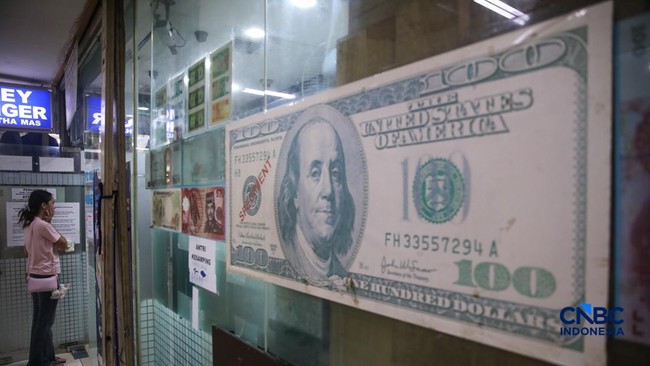
The exchange rate of the Rupiah against the US Dollar faced further pressure in today’s trading, Monday (18/5/2026). The weakening of the Garuda currency has deepened, breaching a new psychological level above Rp17,600 per US Dollar.
Responding to this condition, the business community has collectively voiced concerns regarding the impact of the Rupiah’s weakness on the business world. The General Chairwoman of the Indonesian Employers Association (Apindo), Shinta Widjelle Kamdani, stated that the current pressure on the Rupiah is not merely a temporary fluctuation but part of a larger global dynamic.
“The weakening of the Rupiah exchange rate, which has now touched a new psychological level above Rp17,500 per US Dollar, is certainly a concern for the business world and needs to be responded to seriously and in a coordinated manner,” Shinta told CNBC Indonesia.
According to her, the pressure on the Rupiah is occurring alongside rising US Treasury yields—the returns obtained from holding US government debt—due to US fiscal financing needs and escalating geopolitical conflicts, which are driving global capital reallocation towards US Dollar assets. She noted that this pressure is not isolated but part of a broader global dynamic that affects almost all developing nations, including Indonesia, through exchange rate pressure and increased capital outflow.
From a business perspective, the weakening exchange rate directly hits the cost structure of national industries that remain highly dependent on imported raw materials. “For the business world, we see this situation as an external shock that strengthens pressure on cost structures and corporate cash flows. The weakening Rupiah directly increases import costs, particularly because the national industrial structure is still very dependent on foreign raw materials,” Shifter said.
She revealed that approximately 70% of manufacturing raw materials are still imported, with raw materials contributing about 55% to the production cost structure. Consequently, every depreciation of the Rupiah is directly reflected in increased input costs in Rupiah terms. The sectors most vulnerable to this impact include industries with high import dependency, such as petrochemicals, plastics, food and beverage, pharmaceuticals, and energy-based manufacturing.
“For example, the rise in the price of naphtha, which is a primary raw material for the plastics industry, has increased significantly and driven resin prices up by tens of percent, which then has a chain reaction on the packaging industry and other downstream sectors,” she noted. This condition indicates cost-push inflation spreading through industrial supply chains.
Beyond production, corporations are also feeling the pressure from a financial aspect. The strengthening US Dollar makes foreign currency debt obligations heavier. “The strengthening US Dollar increases the burden of foreign currency obligations, both in terms of interest payments and principal debt. This impacts cash flow management and increases the company’s risk profile,” Shinta explained.
Amidst consumer purchasing power that has not yet fully recovered, the business world is also deemed to have limited room to raise selling prices. “In a condition where purchasing power has not fully recovered, the room for price adjustments is also limited, so part of the cost pressure must be absorbed by businesses. This subsequently pressures margins and affects decisions regarding expansion and labour absorption,” she said.
As a result, business players are beginning to take more cautious steps in executing business expansions. “In response to this condition, the business world is essentially adjusting strategies towards a more prudent and risk-adjusted approach. The approach currently being taken is ‘selective growth,’ where expansion is still carried out but more selectively,” she said.
She stated that speculative investments or those highly dependent on external conditions tend to be postponed. At the same time, companies are strengthening hedging strategies, restructuring debt, and implementing operational efficiencies. “The use of hedging instruments against exchange rate fluctuations is being increased, accompanied by the restructuring of debt structures to ensure a better balance between Rupiah and foreign currency,” she added.
Furthermore, companies are beginning to diversify suppliers and attempt import substitution, although domestic industrial capacity remains limited in many sectors. Looking ahead, Apindo believes that policy synergy is key to maintaining economic stability amidst global pressure. “In the future, in a situation where external pressure remains quite strong and the space for policy easing is relatively limited, synergy between monetary, fiscal, and the real sector is crucial.”
As information, the weakening of the Rupiah exchange rate against the US Dollar deepened in today’s trading. According to Refinitiv data, at 10:20 WIB, the Rupiah weakened by 1.15% to the level of Rp17,660/US.Thispressurewasdeeperthanthemorningopeningposition, whentheRupiahopenedweakerby0.97.