
Two Babaranjang Coal Trains Collide Head-On in South Sumatra: How Could It Happen?
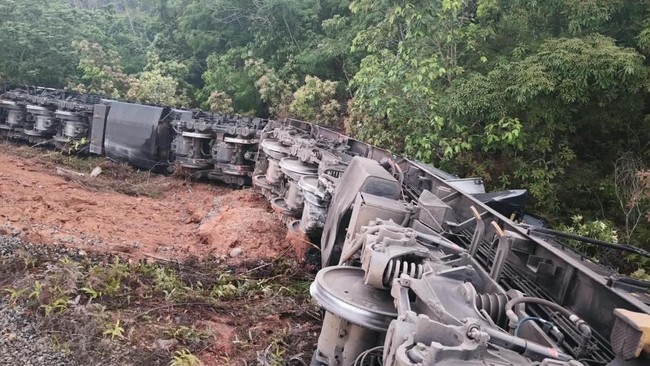
Two coal trains, known as Babaranjang, collided in Ogan Komering Ulu regency, South Sumatra. The train driver and assistant driver were injured.
The accident occurred on Track I in the Talang Baru station yard, Talang Baru village, Peninjauan district, Ogan Komering Ulu regency, within the operational area of KAI’s Tanjungkarang Division IV, at around 2.36am on Thursday (15 October 2026). The trains involved were KA 4045, travelling from Tanjung Enim Baru station to Tarahan, and KA 4136, travelling from Tarahan to Tanjung Enim Baru station.
The collision caused a locomotive and several carriages to overturn or derail. All train services to and from Tanjungkarang were completely suspended, including the cancellation of the Rajabasa passenger service between Tanjungkarang and Kertapati, Palembang, in both directions.
According to the incident report, KA 4045 entered Track I at Talang Baru station and struck KA 4136, which was in the process of stopping on the same track. The impact caused damage to both trains.
Railway observer Joni Martinus said trains in a station yard should be in a very safe position, as stations are equipped with various safety measures, including signalling systems, station controllers (PPKA) and staff at central control centres. However, a collision had still occurred. Joni said several factors could potentially have caused it.
First, the driver may have passed a red signal, an incident known as Signal Passed at Danger (SPAD). The driver and assistant driver may also have fallen asleep.
“Loss of concentration can reduce vigilance in monitoring the track ahead,” he told CNBC Indonesia on Friday (16 October 2026).
Other possibilities include a signalling failure that displayed an incorrect aspect, known as a wrong-side failure, or a procedural breach that allowed a train to enter a track that was already occupied.
Joni added that a technical problem, such as brake failure, could have prevented the train from stopping in time even if the signal was visible. Extreme weather, including thick fog or haze from forest and land fires, could also have reduced visibility.
Joni, who is also head of the railways division of the Indonesian Transportation Society (MTI) in South Sumatra, expressed concern and sympathy over an incident that caused frustration and inconvenience for hundreds of passengers, as well as damage to railway equipment and infrastructure.
He said the incident should prompt KAI and other relevant parties to review and improve their operations to prevent a recurrence. He also urged the National Transportation Safety Committee (KNKT) to investigate promptly and establish the cause carefully to help make transport safer.
“A comprehensive review and improvements are needed, including strengthening staff development, enforcing strict operating procedures, and ensuring the reliability of rolling stock and infrastructure,” Joni said.
Source: jawawa.id (https://jawawa.id/newsitem/two-babaranjang-coal-trains-collide-head-on-in-south-sumatra-how-could-it-happen-1792126241)
Originally published by CNBC Indonesia (https://www.cnbcindonesia.com/news/20261016105921-4-776763/2-kereta-api-babaranjang-tabrakan-adu-banteng-di-sumsel-kok-bisa), translated from Indonesian