
Turning Waste into Value: The Economic Potential of Industrial Waste
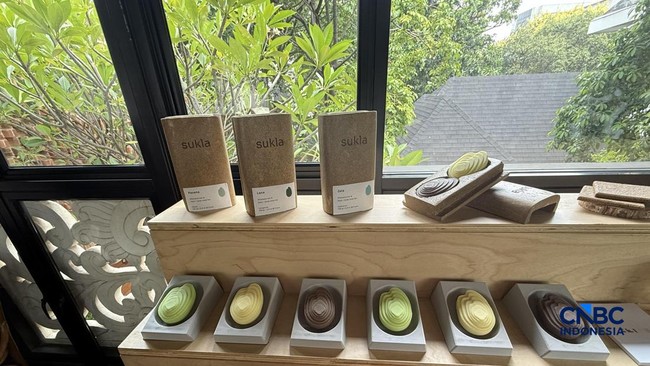
Jakarta, CNBC Indonesia – Rice husks, coffee skins and cosmetic production residues have generally been regarded as waste materials with no further use. Yet, with the right processing and design, they could be repurposed as new materials for everyday needs.
Upcycling, or reusing materials, is one approach within the circular economy. Unlike linear production and consumption patterns that end in disposal, the circular economy seeks to extend the useful life of materials so that they do not immediately become waste.
This approach can be applied across a range of sectors, from agriculture and the beauty industry to interior design. For example, rice husks and coffee skins are being explored as packaging materials, while cosmetic production residues are being tested for use in furniture.
ParagonCorp has explored the use of such materials through three design projects: Y.Lab, SUKLA and Complexion.
Aldin Meidani Algatia, creative director of Y.Lab, SUKLA and Complexion, said the exploration was prompted by an effort to change perceptions of materials often considered to have outlived their usefulness.
“For us, a material that has been used does not necessarily lose all its potential. Each leftover material offers an opportunity to discover a new function, value and story through design. We want to show that sustainability is not only about reducing waste, but also about daring to imagine other possibilities for what already exists,” Aldin said when interviewed in South Jakarta on Wednesday (11 November 2026).
In one experiment, coffee skins were used to develop a packaging concept designed to be compostable. Meanwhile, perfume bottle caps were designed so that several units could be connected to one another and explored as a potential medium for coral growth.
Agricultural materials have also been considered in design development. Rice husks, for instance, are being tested for use in outer packaging. Other inspiration comes from the traditional use of rice-washing water for hair care and the form of terraced rice fields, which have been incorporated into prototypes for shampoo and soap bars.
In the beauty industry, cosmetic production residues are also being explored as an alternative material for furniture. The material, which has a soil-like texture, was processed through a series of trials to produce composite tiles for a furniture prototype.
Aldin said the experiments showed that local materials and production residues could be used for purposes beyond their original functions.
“Indonesia has a wealth of materials and traditions that are already closely connected to our daily lives. Through SUKLA, we want to bring that value back and translate it into a more modern design approach. We hope people will see that even simple materials can have the potential to deliver wider benefits,” he said.
However, turning leftover materials into new products is not always straightforward. Each material requires processing and testing to ensure its safety, durability and suitability for its new function.
The coffee-skin and rice-husk packaging concepts, for example, still need testing to determine the right composting conditions. Likewise, using perfume caps as a medium for coral growth requires further research into their effects on marine ecosystems.
Furniture materials made from cosmetic production residues will also need to undergo safety and durability tests before they can be used more widely.
This shows that design creativity alone is not enough to turn waste into an alternative material. Technical feasibility, processing costs, safety and environmental impact remain important factors in determining whether an innovation can be implemented on an industrial scale.
The challenge for the circular economy, therefore, is not only to find new ways to use waste, but also to ensure that reuse genuinely delivers environmental and economic benefits.
Source: jawawa.id (https://jawawa.id/newsitem/turning-waste-into-value-the-economic-potential-of-industrial-waste-1794394325)
Originally published by CNBC Indonesia (https://www.cnbcindonesia.com/lifestyle/20261111155918-33-784339/dari-sampah-jadi-bernilai-ini-potensi-ekonomi-limbah-industri), translated from Indonesian