
Turning Rice Straw Waste into Organic Fertiliser
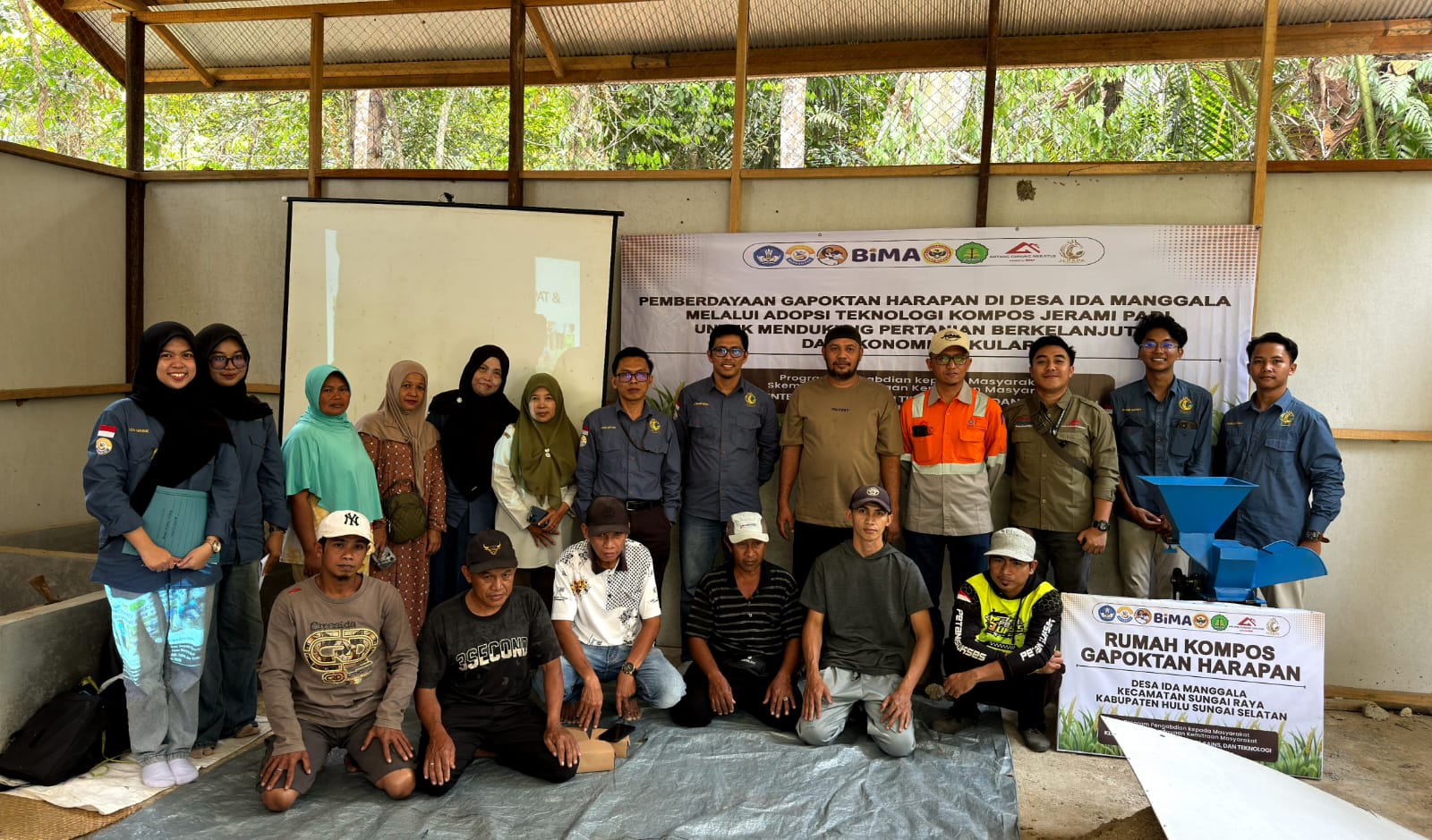
Thick smoke from post-harvest rice straw burning that usually blankets the rice fields of Ida Manggala Village, Sungai Raya District, Hulu Sungai Selatan Regency, is now being replaced by productive activity. Hundreds of farmers under the Harapan Farmers Group Association (Gapoktan) are pioneering a path towards organic fertiliser self-sufficiency through appropriate, environmentally friendly technology.
For years, farmers in this area have been trapped in dependence on synthetic chemical fertilisers, with soaring operational costs for their farming businesses. At the same time, the abundant potential of post-harvest biomass in the form of rice straw, reaching 525 tonnes per harvest season, has been wasted and mostly destroyed through open burning. This practice triggers soil nutrient degradation and contributes to air pollution.
Responding to this challenge, a cross-university team of lecturers from Lambung Mangkurat University (ULM) and the Amuntai College of Agricultural Sciences (STIPER) has brought a concrete solution through a circular economy approach (waste to wealth). The programme is fully funded by the Directorate of Research and Community Service, Directorate General of Research and Development, Ministry of Higher Education, Science and Technology (Kemdiktisaintek) of the Republic of Indonesia for the 2026 funding year.
“We are not merely bringing physical assistance, but transferring rapid decomposition technology so that farmers have independent capacity in managing their local resources,” said Riza Adrianoor Saputra, an academic from Lambung Mangkurat University who serves as the community service team leader.
Dr. Untung Santoso, an organic farming expert from ULM, oversaw technical training on rapid compost production using a portable straw chopper with a capacity of 600 kg per hour. This mechanical innovation cuts straw to less than 5 cm in size to accelerate natural decomposition.
The results are remarkable; straw that usually takes months to break down in the field can now be transformed into stable, mature compost in just a matter of weeks. Meanwhile, Heldawati, a socio-economic agriculture expert from STIPER Amuntai, focused on strengthening institutional management and introducing circular economy principles.
Farmers were trained to keep administrative records of farming costs in order to calculate real efficiency savings on fertiliser expenditure. This intensive intervention has proven to significantly boost partner empowerment levels.
Based on quantitative measurements by the implementing team, farmers’ understanding of the dangers of straw burning and nutrient management techniques rose sharply, from an average of only 40% before training (pre-test) to 92% after mentoring (post-test).
Economically, the use of mature straw compost is projected to replace part of the external chemical fertiliser needs that have burdened farmers’ pockets by up to Rp4.5 million per hectare. Utilising this technology is also a concrete step in mitigating greenhouse gas emissions in the suboptimal agricultural sector of South Kalimantan.
The success of this collaboration, which also involves the active participation of five Agroecotechnology students from ULM, is part of the commitment to downstreaming national research. This community service activity is carried out under the Community-Based Empowerment Programme with the Community Partnership Empowerment (PKM) scheme.
As a sustainability measure, the proposing team together with the Harapan Gapoktan management are currently formulating governance for a Village Compost Business Unit. It is hoped that the permanent Compost House that has been firmly established in Ida Manggala Village will not only function as a collective organic fertiliser production centre, but also grow into a field laboratory for sustainable environmentally friendly farming learning in South Kalimantan.