
Türkiye Develops AI Weapons Dome That Shoots Down Drones with a ‘Metal Cloud’
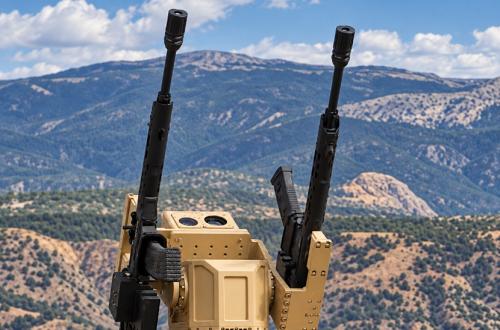
BAMAKO — Türkiye’s defence industry has introduced an autonomous drone-hunting technology designed to detect and destroy unmanned aircraft without an operator directly controlling the firing process. The system, called Drone Kalkanı, or Drone Shield, was showcased to African defence delegates at the BAMEX 2026 exhibition in Bamako, Mali, as part of efforts to expand the market for short-range air-defence technology.
The system, developed by a Turkish defence industry consortium, is said to be capable of detecting and tracking drones from 600 to 800 metres away. It is designed to disable targets at a range of about 150 metres using software- and artificial intelligence-controlled automatic firing.
Anadolu Agency reported on Wednesday (11 November 2026) that Drone Kalkanı was among the products to attract attention at the international defence exhibition. It was presented by Turkish ammunition company Turaç alongside technology partners working on weapons systems, robotics, sensors and artificial intelligence.
However, Drone Kalkanı is not yet a fully operationally ready defence system. Turaç Director General Fatih Altunbaş said development was about 95 per cent complete, although the company had previously demonstrated the system’s capabilities in tests.
BAMEX runs from 9 to 13 November 2026 with support from Mali’s Ministry of Defence and Turkish company The Peak Defense. The forum brings international arms manufacturers together with African military delegations and security authorities seeking technology to address a range of security threats.
Autonomous system combines weapons and sensors
Unlike interceptor drones that fly after their targets, Drone Kalkanı is a robotic gun-turret defence system that can be mounted on vehicles or at fixed facilities.
The system combines two semi-automatic 12-gauge weapons with detection sensors and control software. Its components are housed in a single installation designed to detect small aerial threats and respond automatically.
According to Turaç, the equipment uses multiple sensors to identify and track drone movements. Artificial intelligence algorithms then help the system identify targets and determine a response based on pre-set parameters.
When a threat enters engagement range, the system is designed to fire simultaneously, creating a spread of projectiles that the company calls a “metal cloud”. The approach is intended to increase the likelihood of hitting small, fast-moving drones that are difficult to counter with conventional weapons.
Turaç says the use of specialised ammunition enables the system to deal with mini and micro drones, as well as first-person-view (FPV) unmanned aircraft often used in military operations.
FPV technology allows an operator to see live footage transmitted by a drone’s camera. In modern armed conflicts, such devices are increasingly used for reconnaissance and attacks because they are relatively small and less expensive to procure than larger military unmanned aircraft systems.
Drone Kalkanı is being developed as one option for countering such threats. However, the detection and engagement figures announced by the company should not be treated as a guarantee of success across all terrain, weather conditions and types of attack.
Developed by five Turkish organisations
Development of Drone Kalkanı involves four defence industry companies and one university research institution.
Turaç leads the project and is developing the specialised ammunition. Derya Arms supplies weapons components, while Lasersan contributes to the development of the robotic turret and sensor technology.
Urban Savunma is involved in mechanical work and system integration on vehicle platforms. The Istanbul Technical University Research and Application Centre for Aeronautics and Astronautics, or İTÜ ARC, is supporting the development of artificial intelligence algorithms.
The collaboration illustrates the Turkish industry’s approach of combining private companies’ capabilities with university research. This model allows technologies with different functions to be brought together in a more complex defence product.
In its official explanation, Turaç described the use of artificial intelligence algorithms as a key element in developing the system. The software is designed to support target identification and automatic responses without requiring an operator at every stage of engagement.
Nonetheless, the use of autonomous weapons also creates a need for close oversight. The system must be able to distinguish threats from objects or aircraft that must not be attacked, while remaining within the limits set by its operator.
The system’s performance therefore cannot be assessed solely on its ability to detect and destroy targets. Safe use, accurate identification, control of automated actions and emergency-stop mechanisms are all important considerations before the technology can be deployed widely.