
Turkish Tayfun, Russia’s Iskander and America’s PrSM: Which Is More Capable?
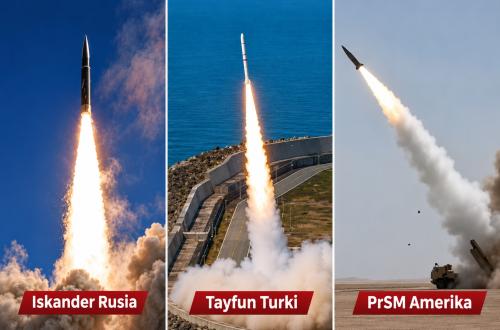
JAKARTA — The competition to develop short-range ballistic missiles involving Turkey, Russia and the United States has entered a new phase. Turkey officially received additional Tayfun Block-2 missiles in November 2026, while the United States is speeding up production of its Precision Strike Missile (PrSM) and Russia continues to rely on the Iskander-M as one of its main weapons in the war against Ukraine.
The latest development came from Ankara on Thursday (5 November 2026). Turkey’s Ministry of National Defence announced that the Army had completed the inspection and acceptance process for a number of Tayfun Block-2 ballistic missiles produced by defence company Roketsan.
The announcement confirmed that Tayfun had moved beyond testing and into military procurement. Turkey first received missiles from the same family in May 2026, then accepted additional units over the following months.
The United States is also strengthening its tactical missile arsenal. On 21 September 2026, the US Army awarded Lockheed Martin a contract worth up to US$1.2 billion to produce PrSM Increment 2, a new variant designed to strike moving targets on land and at sea.
On 29 September, the Pentagon announced that it had selected five companies to develop PrSM Increment 4. The next generation is intended to have a range of at least 1,000 kilometres, almost twice the publicly cited range commonly attributed to Russia’s Iskander-M.
Meanwhile, Russia continues to maintain Iskander-M production in support of its military operations. According to Ukrainian intelligence information published on 5 November, Russia’s defence industry is estimated to be capable of producing around 65 Iskander-M missiles a month, although this figure has not been independently verified.
The three missiles reflect different approaches to modern weapons development. Turkey emphasises industrial independence and precision-strike capability; Russia relies on combat experience and a range of warhead options; while the United States is strengthening integration between missiles, mobile launchers and modern reconnaissance systems.
So, when range, accuracy, warhead power, ability to evade air defences and combat experience are compared, which of the Tayfun, Iskander-M and PrSM has the advantage?
Tayfun strengthens the Turkish Army
Tayfun is a surface-to-surface ballistic missile developed by Roketsan to strengthen Turkey’s military long-range strike capability. It is designed to hit important targets, including command centres, air-defence facilities, aircraft hangars and military infrastructure.
According to Roketsan’s official specifications, Tayfun is 6.5 metres long, has a diameter of 610 millimetres and weighs around 2,300 kilograms at launch. The missile uses a Go-Onto-Location In-Space (GOLIS) guidance system and a fragmentation warhead designed to produce effects against specific targets.
Roketsan lists its range as more than 280 kilometres in its public catalogue. This is the range published by the company and should not necessarily be understood as the maximum capability of every Tayfun variant.
In November 2022, Turkish President Recep Tayyip Erdogan said Tayfun had a range of 561 kilometres. The statement reflected Turkey’s ambition to develop a ballistic missile capable of striking targets much farther away than conventional artillery rockets can reach.
Defence publication Janes later reported that Roketsan conducted a Tayfun test launch in February 2025 in the Black Sea region. An analysis of maritime hazard zones indicated a distance of up to around 750 kilometres from the launch site, but that distance cannot be treated as official confirmation of the tested missile’s range.
Tayfun’s capabilities should therefore be distinguished between catalogue specifications, government officials’ statements and estimates based on analysis of the test. As of November 2026, Roketsan had not fully published the maximum operational range of the Tayfun Block-2 newly accepted by the Turkish Army.
In terms of accuracy, Roketsan has announced a circular error probable (CEP) of around 10 metres or less. CEP is a statistical measure indicating the radius within which approximately half of the impacts are expected to fall, assuming the test conditions meet the relevant criteria.
That figure represents the manufacturer’s claimed level of precision. However, there is not enough independent test data to establish that Tayfun consistently achieves this level of accuracy in varying combat conditions.
Roketsan also says Tayfun is resistant to electronic-warfare interference and jamming of satellite navigation systems. This capability is important because positioning and communications systems can be targeted for disruption in modern conflicts.
One of Tayfun’s advantages is its use of vehicle-based mobile launchers. This enables the missile to be moved and repositioned, giving ground forces flexibility in operating long-range weapons.
The development of Turkey’s defence industry is also evident in the emergence of Tayfun Block-4. Roketsan unveiled the much larger missile at the IDEF 2025 exhibition, with a length of around 10 metres and a weight of 7.2 tonnes.
Block-4, however, is a different development from the Block-2 accepted by the military in November 2026. The fact that a model has been presented publicly is not grounds for saying that Block-4 is already part of the Turkish Army’s operational inventory.
Iskander-M tested in war
Unlike Tayfun, which has only recently begun entering the inventory, Russia’s Iskander-M is a tactical ballistic missile system that has been in service since 2006. It was developed to attack high-value targets, including command centres, military facilities, air defences and infrastructure supporting troop operations.
According to the Missile Threat Project at the Center for Strategic and International Studies (CSIS), the Iskander-M uses the 9M723 ballistic missile, with a publicly reported range of around 400 to 500 kilometres. The missile is approximately 7.3 metres long and carries a warhead weighing between 480 and 700 kilograms, depending on its configuration.
Its ability to carry a relatively large warhead is one of the Iskander-M’s defining characteristics. The system can use several types of conventional warhead, including high-explosive, submunitions and warheads designed for particular targets.
A study by the Royal United Services Institute (RUSI) also describes Iskander-M as part of Russia’s non-strategic nuclear weapons capability. This distinguishes it from Tayfun and PrSM, which, according to publicly available information, have been developed as conventional strike systems.
In terms of flight path, Iskander-M is designed to use a quasi-ballistic trajectory, which does not follow a simple ballistic path in full. The missile can manoeuvre during flight to make it harder for an adversary’s defence system to predict its course.
According to CSIS, the Iskander-M launcher is a mobile vehicle capable of carrying two missiles. It is supported by transport and reloading vehicles, as well as command and communications elements.
Iskander-M also has navigation and guidance systems that can use inertial information, satellite data and, in certain configurations, image matching. However, accuracy figures reported by different sources vary according to the variant and guidance system used.
A major advantage of Iskander-M is its operational track record. Russia has used it in the war against Ukraine, providing more evidence of its use in combat conditions than is available for Tayfun.
Combat experience provides information on launcher operation, supply continuity, vulnerability to enemy attacks and the effectiveness of air defences. However, use in war does not automatically prove that every Iskander-M strike has hit its target.
Ukraine’s Ministry of Defence reported on 4 November 2026 that its forces had intercepted 11 ballistic missiles grouped as Iskander-M or KN-23 during October. As the report combines two missile types, the figure of 11 cannot be treated as the number of Iskander-M missiles specifically shot down.
Another development was announced by Ukrainian military intelligence in early November. The agency estimated that Russia had around 115 9M723 Iskander-M missiles in its stockpile in October 2026 and could produce about 65 a month.
Ukrainian intelligence also said Russia was developing an enhanced Iskander capability with a target range of 550 to 700 kilometres. However, this remains an estimate of the system under development, not evidence that all Iskander-M missiles currently used by Russia have reached that range.
The production and stockpile figures come from Ukraine, which is at war with Russia. As comprehensive independent verification is not available, they should be treated as intelligence estimates rather than audited official Russian production records.
Source: jawawa.id (https://jawawa.id/newsitem/turkish-tayfun-russias-iskander-and-americas-prsm-which-is-more-capable-1794023488)
Originally published by Republika (https://news.republika.co.id/berita/to4397451/tayfun-turki-iskander-rusia-dan-prsm-amerika-mana-yang-lebih-unggul), translated from Indonesian