
Turkish Frigate Considered by US Navy as Indonesia Orders Similar Vessels
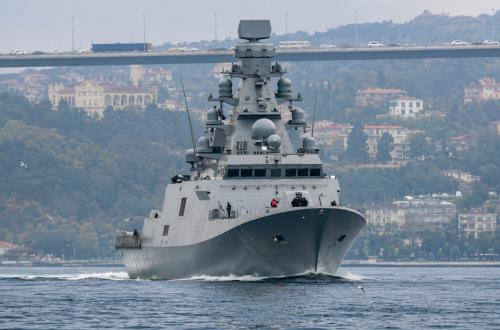
JAKARTA — Turkey’s Istanbul-class frigate is among the warships being considered by the US Navy as part of a review of options for its next-generation surface combatants. The development is notable because Indonesia has already signed a contract to acquire two frigates of the same class to strengthen the Indonesian Navy’s fleet.
The US review is due to reach an important stage on 12 November 2026, when the US Department of Defence must submit a surface combatant procurement plan to the White House. Turkey’s Istanbul-class design is being considered alongside Japan’s Mogami-class and South Korea’s Chungnam-class ships.
A USNI News report on 1 September 2026 said the White House and US Navy were considering warship designs from several allied countries. Information about the candidates came from three industry sources familiar with discussions on the US warship procurement programme.
However, the US government has not announced a design selection or a decision to buy Istanbul-class frigates. The 12 November deadline is for submitting the review and procurement plan, not a date set for announcing a contract winner.
Another recent development came on 23 October 2026, when the US defence research organisation Center for Naval Analyses (CNA) published an analysis of Japanese and South Korean frigates. The study identified weapons capacity, production speed, systems-integration capabilities and operational compatibility with the US fleet as important considerations.
While Washington continues to assess its options, Indonesia has made further progress on acquiring Turkish warships. Indonesia’s Ministry of Defence signed a contract with the TAIS Shipyards consortium for two İstif- or Istanbul-class frigates on 26 July 2025.
The Indonesian deal saw a further development in January 2026 with the involvement of Qatari defence company Barzan Holdings. However, details of the financing arrangements and the final configuration of the two ships have not been fully disclosed publicly.
Trump opens the door to acquiring foreign warships
The US consideration of the Istanbul-class frigate is part of a shift in its approach to building up the fleet. The US government is seeking ways to speed up warship procurement after delays and cost increases affected several domestic programmes.
President Donald Trump signed a memorandum on 13 August 2026 entitled ‘Rebuilding the United States Navy and America’s Shipbuilding Industrial Base’. It directs the government to strengthen the national shipbuilding industry by drawing on the designs, technology and production capacity of partner countries.
In the memorandum, Trump introduced an approach known as the Finland Model. It allows cooperation with foreign shipyards to build a number of initial vessels, with production then continuing in the United States.
Under its terms, foreign shipyards may build no more than the first two ships in a class using this arrangement. Subsequent vessels must be built in the United States after the partner company meets requirements for investment, workforce development and technology transfer.
Foreign suppliers are required to build a new shipyard or acquire ownership or a majority stake in an existing US facility. They must also train American workers and develop domestic supply chains to support ship construction and maintenance.
The policy does not automatically remove all legal restrictions on building US warships abroad. Any contract must still meet national security requirements, congressional notification rules and applicable budget provisions.
The White House memorandum also set a 90-day deadline for submitting a new procurement plan for surface combatants. USNI News reported that the review, coordinated by the US Navy, is scheduled to be completed on 12 November 2026.
Why is the Istanbul-class frigate under consideration?
The Istanbul-class frigate is one of the principal products of Turkey’s national warship programme, known as MİLGEM. It was developed as a larger successor to the Ada-class corvette, with expanded weapons capabilities.
The Istanbul programme forms part of Turkey’s strategy to increase the independence of its maritime defence industry. It involves the company STM, national shipyards and several Turkish manufacturers of radar, missiles and electronic systems.
The first ship in the class is TCG Istanbul, pennant number F-515. According to STM, it was delivered to the Turkish Navy on 19 January 2024 after completing construction and testing.
Unlike the Ada-class corvette, the Istanbul-class frigate is designed to provide air defence using missiles launched from a vertical launch system. It can also conduct surface warfare, anti-submarine operations, maritime surveillance and the protection of shipping lanes.
According to STM specifications, the Istanbul-class frigate is 113.2 metres long and has a maximum beam of 14.4 metres. Its displacement is about 3,150 tonnes and its maximum speed exceeds 29 knots.
The ship has a range of about 5,700 nautical miles at a cruising speed of 14 knots, according to the manufacturer. This allows it to undertake long-range operations, although its actual endurance depends on sea conditions, fuel supplies and mission requirements.
The frigate’s propulsion system uses a combined diesel and gas (CODAG) configuration. The combination of diesel engines and a gas turbine is designed to match power requirements to speed and operating conditions.
The ship also has a flight deck and hangar to support helicopter operations. A helicopter extends surveillance capabilities and helps locate targets beyond the ship’s direct field of view.
ATMACA missiles and the MİDLAS air-defence system
Weapons capability is a key aspect of the Istanbul-class frigate’s development. Turkey has integrated ATMACA anti-ship missiles, the MİDLAS vertical launch system, naval guns and a close-in defence system into the design.
ATMACA is an anti-ship missile developed by Turkish defence company Roketsan. In the TCG Istanbul configuration, the ship carries 16 ATMACA missiles in four launcher groups.
For air defence, Turkey has developed MİDLAS as a national vertical missile launch system. The first Istanbul-class ship has 16 launch cells configured to support the HİSAR-D family of air-defence missiles.
STM announced the successful test firing of an HİSAR-D RF missile through MİDLAS in March 2024. The test was an important milestone, demonstrating the integration of a Turkish-built launcher, radar and combat management system on a national warship.
The Istanbul-class frigate is also equipped with the GÖKDENİZ close-in defence system, produced by Aselsan. It uses an automatic 35-millimetre cannon to counter certain threats approaching the ship.
Other weapons include a 76-millimetre main gun, two 25-millimetre automatic weapon systems and light torpedo launchers. This combination is intended to support the ship’s operations across a range of maritime defence scenarios.
However, the performance of each weapons system depends on its configuration, ammunition, targeting equipment and operating conditions. The number of missiles or the calibre of a gun alone is therefore not enough to determine a frigate’s overall effectiveness.
Source: jawawa.id (https://jawawa.id/newsitem/turkish-frigate-considered-by-us-navy-as-indonesia-orders-similar-vessels-1793955093)
Originally published by Republika (https://news.republika.co.id/berita/to2ftd451/fregat-turki-masuk-kajian-angkatan-laut-as-indonesia-juga-pesan-kapal-sejenis), translated from Indonesian