
Turkish Drone Tests Bomb Capable of Selecting Its Own Targets: How Advanced Is It?
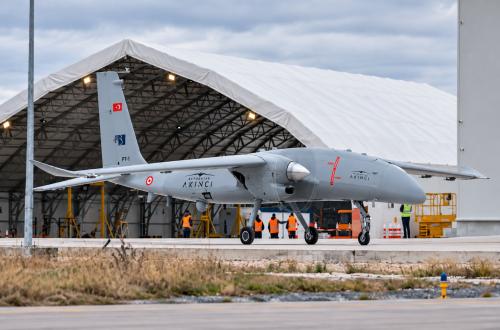
Turkey’s defence industry has again demonstrated advances in modern weapons technology, after the Bayraktar AKINCI combat drone successfully tested a munition capable of autonomously selecting a target. The weapon, called LACIN TV, was developed by defence company Roketsan and uses an imaging seeker to support the targeting process.
In a test announced on Wednesday (21 October 2026), the AKINCI released three munitions: two MAM-Ls and one Autonomous LACIN TV. According to reports by Anadolu Agency and TRT Haber, all three hit their respective targets in the test, which was conducted jointly by drone manufacturer Baykar and Roketsan.
Baykar chair Selcuk Bayraktar shared footage of the test on his social media account. Roketsan chief executive Murat Ikinci later explained the capabilities demonstrated.
“Precision strikes from the air, hitting the targets exactly. In a firing test from the Bayraktar AKINCI platform, the MAM-L hit its target accurately, while LACIN, for the first time, demonstrated autonomous target-selection capability using a TV seeker,” Ikinci said, as quoted by Anadolu Agency on Wednesday (21 October 2026).
That claim was the most significant aspect of the latest test: autonomously selecting a target represents a technological development beyond simply directing a munition towards specified coordinates. Image-based targeting allows the seeker mounted on the weapon to carry out some of the observation and object-selection process.
The success also demonstrates Turkey’s efforts to expand its weapons capabilities by integrating combat drones, sensors, software and precision munitions. This is significant in modern warfare, where the ability to process information and respond quickly to changing battlefield conditions is increasingly important.
What Makes LACIN TV Different?
LACIN is a family of guidance kits developed by Roketsan to improve the precision of attacks on ground targets. The products are designed to convert conventional bombs into guided weapons capable of correcting their course in flight.
In previously publicised LACIN configurations, Roketsan has used an infrared seeker, inertial navigation and satellite navigation. The guidance kit is compatible with the MK-82 general-purpose bomb, which is used in various airborne weapons systems.
Roketsan has also developed a data-link device called L-POD to support the system’s operation. It allows images captured by the munition’s sensor to be sent to an operator, while also providing a channel for transmitting control commands.
This configuration uses a man-in-the-loop approach, meaning a human remains involved in operating the weapon. In practice, the communication link between the operator and the munition allows sensor information to be monitored and supports control during flight.
The 21 October 2026 test showed a different development with the use of a configuration called Autonomous LACIN TV. Roketsan said the TV seeker in this configuration had demonstrated autonomous target-selection capability for the first time.
A TV seeker uses visual images captured by its sensor to provide information about observed objects. The targeting system then processes that information to support target search, selection and tracking, according to the capabilities of its software.
The fundamental difference lies in the information used to guide the weapon. Infrared sensors use an object’s infrared radiation, whereas a TV seeker uses visual imagery captured by an electro-optical system.
The two approaches have different characteristics when dealing with environmental conditions and different types of target. Developing a range of seeker technologies gives the military options for tailoring weapons capabilities to operational requirements.
How Do Guided Weapons Select Targets?
Attacking a target with a guided weapon can involve several connected stages: gathering information, locating the object, tracking it and adjusting the munition’s flight path until it reaches the intended point.
In coordinate-guided systems, information about the target’s location is generally used to determine the weapon’s flight direction. Navigation equipment then helps the munition adjust its course according to its position and designated destination.
Laser-guided systems work differently: a sensor on the munition detects laser energy reflected from the target. This enables the weapon to be directed towards an object marked with a laser designator.
Image-based seekers, meanwhile, use visual information gathered during targeting. Software can compare the observed object’s characteristics against specified parameters to help select or track a target.
Image-processing capabilities are becoming increasingly important as modern weapons systems must contend with targets and environmental conditions of varying kinds. Sensors and targeting software are key to translating battlefield information into operational action.
In the LACIN TV test, Roketsan specifically highlighted the successful autonomous target-selection function using a TV seeker. The capability is a relevant development in weapons technology because it expands the functions that a munition guidance system can perform.