
Turkey, Pakistan, and Saudi Arabia Sign Makkah Defence Pact: What Are Its Objectives?
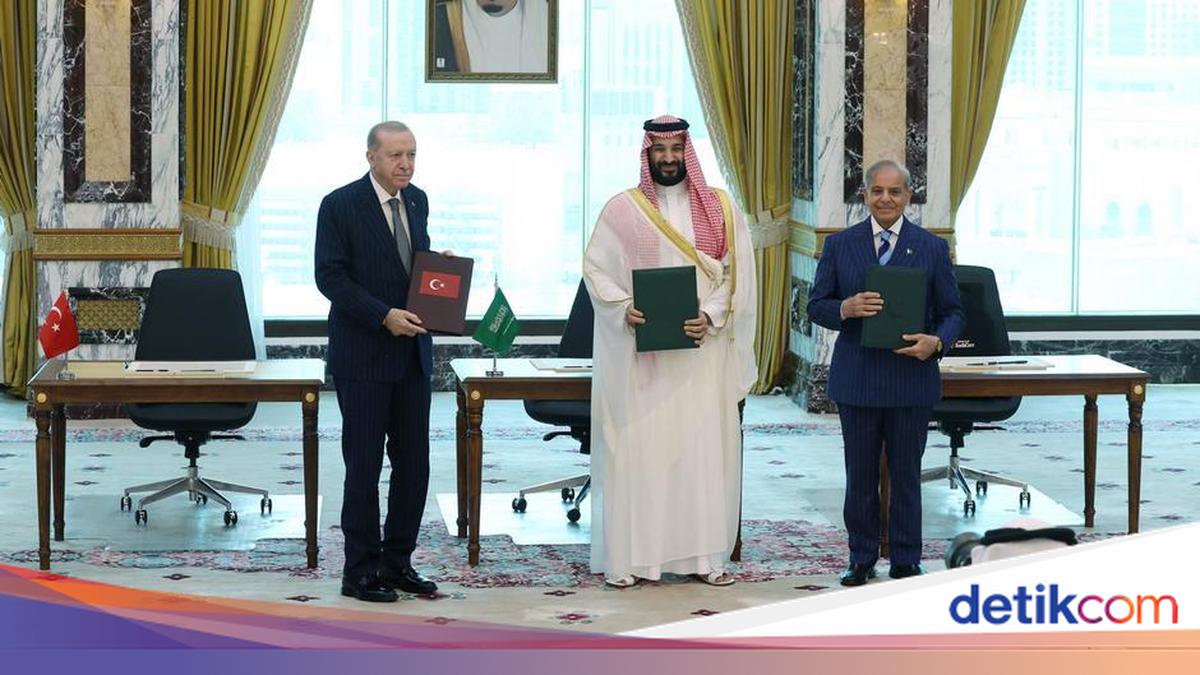
Turkey, Pakistan, and Saudi Arabia signed a historic defence pact on Friday (7/8) that ‘aims to strengthen collective deterrence against all forms of aggression.’ The Makkah Defence Pact was signed by Saudi Crown Prince Mohammed bin Salman, Turkish President Recep Tayyip Erdogan, and Pakistani Prime Minister Shehbaz Sharif. All three nations have majority Sunni Muslim populations. The agreement, signed in Makkah, is intended to enhance cooperation amidst regional uncertainty and the threat of war with Iran.
Although it has been compared to NATO, especially after Pakistan’s Foreign Ministry stated that an attack on one member would be considered an attack on all, experts and analysts suggest the pact is unlikely to function in that manner. For instance, when Houthi rebels in Yemen, who are allied with Iran and view Saudi Arabia as an enemy, launched attacks on Saudi oil facilities last weekend, neither Turkey nor Pakistan automatically came to Saudi Arabia’s defence or launched a counterattack. Analysts also note that both Turkey and Pakistan are unlikely to attack Iran, the Houthis’ ally, especially as Pakistan currently acts as a mediator between Iran and the United States.
Dania Thafer, executive director of the Washington-based think tank Gulf International Forum, described the pact as more of a flexible deterrent. ‘If you look at the parties involved in this agreement, you have Saudi Arabia, which is in the middle of this conflict. But you also have Turkey and Pakistan, both of which have good relations with Iran and also with the US. So, I think this is an additional layer of deterrence for Saudi Arabia,’ Thafer explained. She added that Saudi Arabia is considering layered deterrence against emerging regional threats. Kamran Bokhari, a senior researcher at the Middle East Policy Council in Washington, suggested the alliance would likely proceed in stages with short-term goals like regional stability.
Other experts believe the long-term focus will be more on defence cooperation than combat. Andreas Krieg, a security lecturer at King’s College London, noted that the three countries complement each other well. Saudi Arabia possesses oil wealth but has limited defence technology and remains dependent on the US. Meanwhile, Turkey and Pakistan need investment and have strong armed forces, with Turkey boasting an advanced defence industry sector. Pakistan is the only one of the three to possess nuclear weapons. ‘Turkey has the technology and production capacity but needs markets and investment. Pakistan has the manpower, military institutions, and nuclear deterrent, but needs financing and industrial capability,’ Krieg said.
A Turkish official quoted by Reuters stated that the pact is purely defensive and open to neighbouring countries in the region that might wish to join. Egypt is considered a potential partner, though it must also consider its other allies, including the United Arab Emirates, which remains at odds with Saudi Arabia and has not joined. The official also said the pact does not replace or nullify previous bilateral or multilateral agreements and is not directed at or intended to threaten any specific party. However, it is undoubtedly understood as a deterrence effort, particularly against Iran and Israel.
Khalid al-Jaber, director of the Doha-based Middle East Council on Global Affairs, wrote that the pact’s goal is not to achieve any military victory but to prevent hegemony. He argued that waning American influence could leave the region subject to an order dictated by two parties: Israel and Iran. ‘The Makkah Pact is best understood as an initial effort to build a third axis, a bloc that does not necessarily oppose either of these two powers but has enough influence to prevent either from monopolising the region,’ he wrote.
Regarding Israel, two signatories, Pakistan and Saudi Arabia, do not recognise it and have no official bilateral relations, although Saudi Arabia may have covert contacts. Turkey recognises Israel but tensions are high due to what Turkey calls genocidal actions in Gaza. Turkish President Erdogan recently stated that Israeli activities in Syria and Lebanon also pose a threat to Turkey’s security. Oshrit Birvadker, a researcher at the Jerusalem Institute for Strategy and Security, wrote that this development poses a significant challenge for Israel, further distancing the prospect of normalisation with Riyadh and shattering the vision of a ‘new Middle East.’ Birvadker also believes the new trilateral alliance will exacerbate the growing rivalry and tensions between Turkey and Israel. The Institute for National Security Studies in Tel Aviv is observing the varied reactions within Iran to the pact.
Source: jawawa.id (https://jawawa.id/newsitem/turkey-pakistan-and-saudi-arabia-sign-makkah-defence-pact-what-are-its-objectives-1786517590)
Originally published by detikcom (https://news.detik.com/dw/d-8615063/diteken-turki-pakistan-saudi-apa-tujuan-pakta-pertahanan-makkah), translated from Indonesian