
Turkey Deploys Air Power as Rivalry with Israel and Greece Heats Up
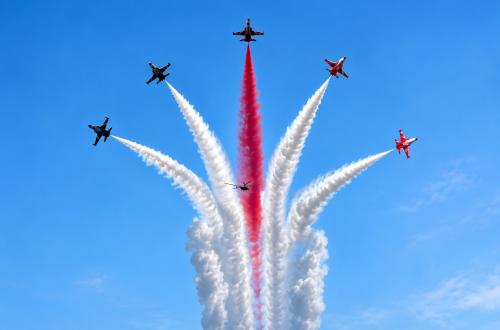
JAKARTA — Turkey demonstrated its long-range air-operation capabilities in the eastern Mediterranean when Turkish Air Force fighter and support aircraft conducted an exercise south of Cyprus. The military activity took place amid intensifying strategic competition between Ankara, Greece and Israel, increasingly evident in the strengthening of air-defence systems, arms cooperation and maritime disputes.
Turkey’s Ministry of National Defence announced the exercise on 21 September 2026. Military aircraft took off from several air bases and carried out missions in international airspace over the Mediterranean, including the area south of Cyprus. Ankara said the activity aimed to improve operational capabilities, maintain combat readiness and protect Turkey’s national rights and interests in the Mediterranean.
The exercise was not a new deployment in late October. However, its significance has resurfaced as a maritime dispute between Turkey and several countries in the region entered a new diplomatic phase. On Monday (26 October 2026), Greece, Egypt, Bahrain, the United Arab Emirates, Cyprus and the European Union issued a joint statement at the United Nations opposing Turkey’s maritime boundary agreement with Libya.
The statement was delivered by Greek Foreign Minister George Gerapetritis after Libya’s eastern-based parliament approved the maritime agreement signed by Ankara and the Tripoli-based Libyan government in 2019. The six parties said the agreement disregarded the maritime rights of coastal states and could undermine regional stability.
Turkish President Recep Tayyip Erdogan rejected the objections. Ankara maintains that the agreement with Libya is a legitimate arrangement between two states and that other parties have no authority to set aside Turkey’s maritime rights.
These developments show that competition in the eastern Mediterranean extends beyond maritime boundaries. The region, which links Europe, North Africa and the Middle East, is increasingly a meeting point for military, energy, trade and diplomatic interests.
Against this backdrop, closer defence ties between Greece and Cyprus and Israel have added a new dimension to Ankara’s strategic calculations. However, there is no evidence that Turkey’s September air exercise was specifically directed at Israel or constituted preparations for an attack on Greece.
Fighter aircraft and long-range operational capabilities
Footage released by Turkey’s Ministry of National Defence showed fighter aircraft and several support planes taking part in the exercise south of Cyprus. According to the Cypriot media outlet Politis, the formation included F-16 fighter jets, an E-7T airborne early warning and control aircraft, a KC-135R refuelling tanker and T-70 helicopters.
This mix matters because modern air operations do not rely solely on fighter jets. Airborne early-warning aircraft can monitor a wide area of airspace and coordinate different aircraft. Tankers, meanwhile, extend fighter aircraft’s range and time in operation by allowing them to refuel without returning to base.
Using different types of aircraft in a single exercise demonstrates an effort to maintain integrated air-operation capabilities. These are needed for long-range patrols, surveillance and other military missions across extensive maritime areas.
In its official statement, Turkey’s Ministry of National Defence stressed that the activity took place in international airspace. Ankara also linked it to efforts to protect its national interests in the Mediterranean.
The emphasis on international airspace carries diplomatic significance. In a region marked by competing jurisdictional claims and political disputes, the location and legal status of military activity can themselves become a source of contention.
The air exercise followed Turkey’s expansion of its military presence in northern Cyprus. On 9 March 2026, Turkey’s Ministry of National Defence formally announced the deployment of six F-16 fighter jets and air-defence systems to territory controlled by the Turkish Cypriot administration.
Ankara described the move as part of a phased approach to strengthening security in northern Cyprus, adding that further measures could be taken depending on developments.
The deployment of six F-16s in March and the air exercise in September were separate events. Both demonstrate Turkey’s focus on security around Cyprus, but without further information they should not be treated as a single, continuing military operation.
Israel strengthens defence ties with Cyprus
One development that has drawn Ankara’s attention is the Republic of Cyprus’s acquisition of an Israeli-made air-defence system. The internationally recognised government controls the southern part of the island.
Cyprus has acquired the Barak MX air-defence system, developed by Israel Aerospace Industries. In September 2026, Cypriot Defence Minister Vasilis Palmas confirmed that the system would be displayed to the public at a military parade on 1 October, Independence Day.
The acquisition is part of Cyprus’s defence modernisation. The system is designed to counter a range of aerial threats using radar, command systems and interceptor missiles.
For Cyprus, strengthening air defences is directly linked to the security situation on an island that has been divided for decades. For Turkey, the presence of new weapons systems in southern Cyprus raises concerns about a shift in the military balance.
Reuters previously reported that Turkish Defence Ministry officials said Ankara was monitoring Cyprus’s arms acquisitions, which they considered could disrupt the island’s security balance.
The Cypriot government, by contrast, maintains that modernising its military is a right of self-defence. Nicosia argues that stronger defence capabilities are necessary while the division of Cyprus remains unresolved politically.
The difference in perspective reflects a more fundamental issue: a step seen by one side as improving defensive capacity may be regarded by another as altering the strategic balance.
Israel’s defence relationship with Cyprus is also developing within the context of regional security cooperation. However, Cyprus’s purchase of Israeli weapons does not in itself make it part of a formal military alliance directed at attacking Turkey.
Israel has an interest in maintaining ties with Cyprus and Greece, including in regional security and energy cooperation. Turkey, meanwhile, seeks to preserve its influence in the eastern Mediterranean and opposes regional arrangements that Ankara believes disregard its interests.
These competing interests are creating an increasingly complex strategic rivalry, although that does not mean the three countries have entered into direct military confrontation.
Source: jawawa.id (https://jawawa.id/newsitem/turkey-deploys-air-power-as-rivalry-with-israel-and-greece-heats-up-1793245896)
Originally published by Republika (https://news.republika.co.id/berita/tnnbsj451/turki-kerahkan-kekuatan-udara-persaingan-dengan-israel-dan-yunani-memanas), translated from Indonesian