
Trunojoyo University Assists Tette Chips MSME in Implementing GMP
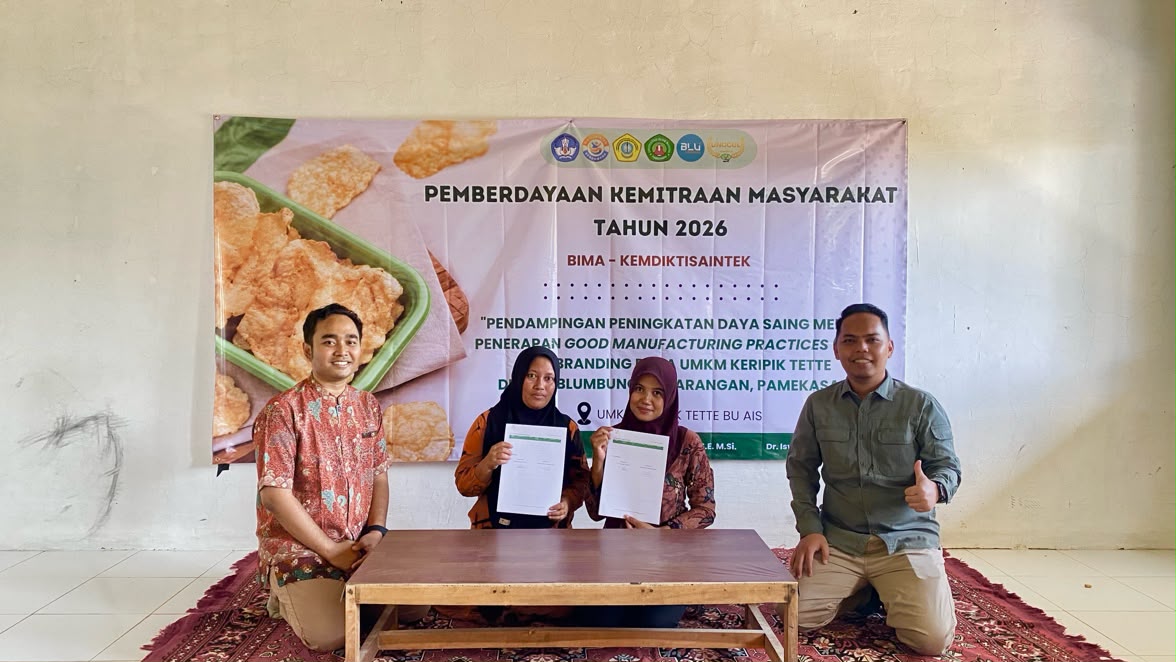
A community service team from Trunojoyo Madura University (UTM) is assisting the implementation of Good Manufacturing Practices (GMP) at the Keripim Tette MSME in Blumbungan Village, Larangan District, Pamekasan Regency. This six-month mentorship programme is designed to raise food safety standards while strengthening product competitiveness in the market.
The programme serves as an effort to encourage food MSMEs to meet the standards of hygiene, sanitation, documentation, and quality control required to enter modern retail markets. The UTM community service team leader, Dita Megasari, stated that improving product quality cannot rely solely on flavour; it must also be supported by a production system that meets food safety standards. “Consumers now judge products not only by taste but also by the safety and consistency of the production process. Therefore, implementing GMP is a vital first step for MSMEs to increase competitiveness,” said Dita.
The Keripik Tette MSME, the programme’s partner, already possesses a Business Identification Number (NIB), employs approximately 20 workers, and produces ‘tette’ chips in both raw, ready-to-fry and ready-to-eat formats.
ASPECTS FOR IMPROVEMENT
Based on initial identification, the team found several aspects requiring improvement, including production flow arrangement, worker hygiene, equipment sanitation, environmental cleanliness, raw material handling, product storage, and the documentation of production and sanitation processes. Over the six-month period, all employees will receive guidance through training and direct practical application on-site. The programme also includes the development of Standard Operating Procedures (SOPs), the implementation of production area cleaning schedules, the recording of sanitation activities, and the habituation of using hygiene equipment for workers.
Team member Dr Iswahyudi noted that implementing GMP is not merely about meeting administrative requirements but about building a work culture capable of maintaining product quality sustainably. “Once the production process aligns with standards, MSMEs will be better prepared to develop products, strengthen brand identity, meet certification requirements, and expand market access,” he said.
NEW UNDERSTANDING
The owner of Keripik Tette MSME, Bu Ais, admitted that the assistance has provided new insights into the importance of food safety standards in the production process. “Previously, we focused more on maintaining flavour. Through this assistance, we are beginning to understand that the cleanliness of the work area, equipment sanitation, and an organised production process also determine product quality and consumer trust,” she said.
The team will conduct regular monitoring and evaluation to ensure all recommendations are implemented according to the business conditions. Following the GMP implementation, the programme will proceed to focus on brand strengthening, packaging refinement, certification assistance, and marketing expansion.
According to data from the Ministry of MSMEs, the MSME sector accounts for over 99% of business units in Indonesia and absorbs approximately 97% of the national workforce. However, increasing production capacity and implementing quality standards, particularly in the food sector, remains a significant challenge. This community service programme is conducted by a team of lecturers from Trunojoyo Madura University alongside Islamic University of Madura, involving students. The activity is part of the Community Service Programme funded by the Directorate of Research and Community Service, Ministry of Higher Education, Science, and Technology, under the 2026 BIMA scheme.