
Trump's Uncertainty Disorients the World, This Asian Giant Prepares to Be the Saviour
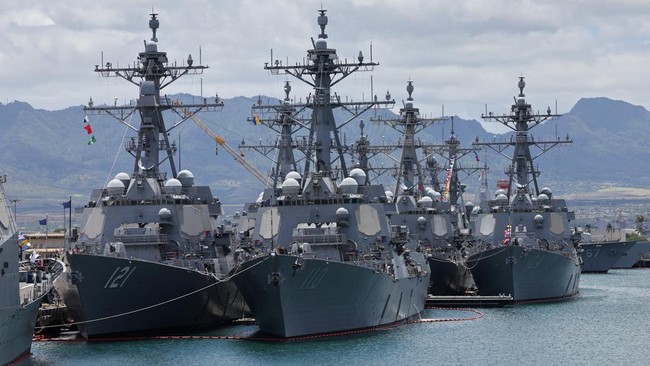
Jakarta, CNBC Indonesia - Japan has decided to ease its export rules on major defence equipment for the first time since the Second World War. This step is being taken as the US ally grows concerned about the uncertainty of President Donald Trump’s commitments and the thinning US weapons stockpiles due to wars in Iran and Ukraine.
The administration of Prime Minister Sanae Takaichi has approved the rule changes this week to strengthen its domestic military industry. Three Japanese government officials confirmed that the new rules will be officially adopted by the end of this month to support the military strength of allied countries.
Although long known for its pacifism, Japan boasts a giant defence industry with a budget of US$60 billion (Rp1,020 trillion) this year. Countries such as Poland and the Philippines are now queuing up to purchase advanced Japanese technology, from warships to radar systems.
The first agreement to be approved is the export of second-hand frigates to the Philippines to address tensions with China in the South China Sea. Additionally, Poland has expressed interest in collaborating on anti-drone technology and electronic warfare.
“There are some obstacles that we can overcome by involving Japan,” said Mariusz Boguszewski, Deputy Head of the Polish Embassy Mission in Japan, quoted by Reuters on Wednesday (15/4/2026).
Concerns about Donald Trump have become the main factor for allies seeking alternatives to US weapons. European diplomats say Trump’s unpredictable stance, such as threats to withdraw from NATO, is forcing them to no longer rely solely on one supplier.
“Offers are coming from everywhere,” said Masahiko Arai, Senior Vice President of Mitsubishi Electric’s defence unit.
Prime Minister Sanae Takaichi, in her speech, emphasised that this rule overhaul is Japan’s way of strengthening collective defence capabilities. Meanwhile, the White House claims that US-Japan relations are growing even closer under the Trump-Takaichi duo.
China has voiced its objections and urged Japan to act cautiously. However, Japanese giants like Toshiba are accelerating, planning to recruit 500 new employees and build weapons testing facilities to meet export demand.
“Reputational risks are no longer what they used to be. Rather than worrying about that, we focus on fulfilling our role and growing our business,” asserted Kenji Kobayashi, Vice President of Toshiba’s defence division.
Mitsubishi Electric even targets sales of its defence unit to soar to US$3.8 billion (Rp64.6 trillion) by 2031. Amid these changes, Ukraine also sees great opportunities by planning to form a drone company alliance with Japan.
“The Kyiv Chamber of Commerce in Tokyo will soon launch a new industry group for Ukrainian and Japanese drone companies to accelerate new technology development, coinciding with the rule changes,” said Kateryna Yavorska, head of the chamber.
Japan’s move is predicted to alter the global power map. Previously, the US dominated 95% of Japan’s defence imports, but the US’s slow and expensive bureaucracy is causing many countries to look to Tokyo as a new primary supplier alternative.
“Japan has honestly been in the penalty box because of the Second World War. But they will surely swing closer to the centre of global politics,” concluded Andrew Koch, founder of the Nexus Pacific defence industry advisory firm.