
Trump's Stance Shifts Dramatically in Iran War, What's Behind It?
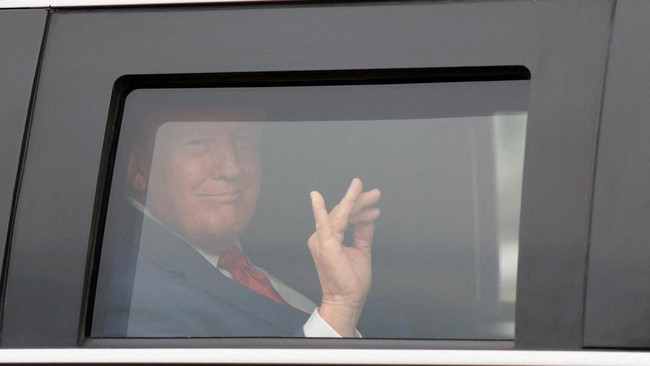
US President Donald Trump has stressed that he is in no hurry waiting for Iran to return to the negotiating table to end the conflict between the two countries. The statement was made as the US-Iran war entered its sixth month.
“I have no timetable, none. I’m not in a hurry. I have no timetable at all,” Trump told Al Jazeera on Wednesday (26/8/2026), when asked how long he would give Iran to return to negotiations.
Trump claimed that the pressure exerted by the US has had a major impact on Iran. When asked whether economic pressure was more effective than military strikes, Trump replied that both had an impact.
“We are winning very big,” he said, referring to inflation, Iran’s economic condition, and the government’s handling of domestic demonstrations.
“I think both are effective,” he added.
Trump’s statement this time differs from several of his previous statements which had hinted that the conflict would be short-lived. After the war began on 28 February, he once predicted the conflict could end within “four to six” weeks.
In June, the US and Iran agreed to a 60-day memorandum of understanding covering a number of issues, including transit through the Strait of Hormuz, the lifting of sanctions on Iran, and talks on Tehran’s nuclear programme. However, the agreement ended in early August without producing a breakthrough that brought both parties back to the negotiating table.
Washington then stepped up economic pressure on Tehran. On Monday, the US announced sanctions against Iran and 60 entities in various countries doing business with the country, in a policy US officials called “Economic D-Day” or “Operation Economic Outcast”.
Iran condemned the move as a threat to international law and the UN Charter. Iran’s Foreign Ministry said no country that respects its sovereignty and national interests would accept the “grave lawlessness and systematic intimidation” carried out by the US.
The pressure is increasingly felt by the Iranian people. The rial currency has plunged past 2 million rials per US dollar on the free market, while prices of basic necessities have soared. Tomato prices were reported to have risen by 71%, chicken by 74%, and cooking oil by 177% compared to before the war.
However, analysts say the new sanctions may not be enough to force Tehran back to negotiations. Trita Parsi of the Quincy Institute said the sanctions are likely to be very painful for the Iranian people, but “translating that pain into a change in their policy is a completely different matter”.
On the other hand, the US has also not yet targeted a number of major Chinese entities involved in Iran’s oil trade, while around 90% of Iran’s crude oil exports are said to end up in China.