
Trump's Rages Come Thick and Fast: What Will BI Choose Tomorrow?
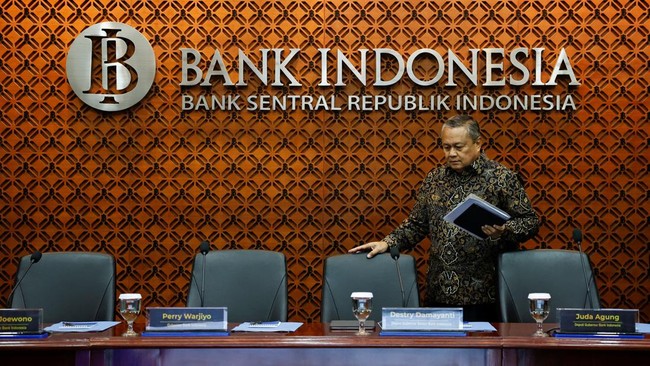
Heading into the Bank Indonesia (BI) Board of Governors Meeting (RDG BI), market participants anticipate that the central bank will continue to hold its benchmark interest rate at this meeting. Bank Indonesia is scheduled to hold the April RDG today, Tuesday (21/4/2026), with the decision outcome to be announced tomorrow, Wednesday (22/4/2026). A consensus gathered by CNBC Indonesia from 14 institutions shows a unified result. All respondents project that BI will once again maintain the BI Rate at 4.75% for this RDG meeting. At the last BI RDG in March 2026, BI decided to keep the BI Rate at 4.75%. This decision marked the sixth time BI has held its benchmark interest rate consecutively. If maintained again at this April RDG, it will be the seventh time in a row. In its official statement last March, BI affirmed that the decision was aimed at strengthening the stability of the rupiah’s exchange value amid deteriorating global conditions due to the war in the Middle East, while also safeguarding the inflation target achievement. Meanwhile, at this RDG, BI is also expected to choose to hold interest rates in line with its focus on maintaining rupiah stability amid still high external pressures. The current rupiah exchange rate is still facing pressure from the US dollar, in line with the strengthening of the US dollar index which measures the greenback’s strength against six major world currencies. Amid ongoing uncertainty due to geopolitical tensions in the Middle East between the US and Iran, investors tend to flock back to safe-haven assets like the US dollar. This situation ultimately narrows the room for manoeuvre for other currencies, including the rupiah, which tends to weaken. The rupiah exchange rate has now breached its psychological level at Rp17,000/US.EvenatthecloseoftradingonFriday(17/4/2026), therupiahalsotoucheditsall − timeweakestlevelatRp17, 180/US, getting closer to the new psychological level of Rp17,200/US.Therupiah′scollapseisavictimofuncertaintyintheMiddleEastignitedbyDonaldTrump′srepeatedwarpoliciesthatkeepchangingstatementsaboutthewar.Onamonth − to − datebasisuptoTuesday(21/4/2026)at14 : 10, therupiahhasweakened0.85. Meanwhile, if pulled back since the beginning of the year or year-to-date, the rupiah has depreciated 2.79% against the US dollar. This aligns with the view of Bank Maybank Indonesia’s Chief Economist, Juniman, who anticipates that BI will still hold its benchmark interest rate in April 2026. According to him, the ongoing pressure on the rupiah amid global financial market uncertainty and escalating geopolitical tensions is the main reason BI does not yet have sufficient safe room to ease policy. “We anticipate that Bank Indonesia will maintain the BI Rate at 4.75% in April 2026. This is due to the ongoing pressure on the rupiah from global financial market uncertainty and the impact of rising geopolitical tensions, namely the Iran, Israel, and US war,” Juniman told CNBC Indonesia. Juniman added that BI currently also still needs to monitor persistent domestic inflation pressures, amid still high global oil prices. “In addition, domestic inflation pressure that remains relatively high in March, namely 3.48% year-on-year, as well as rising global oil prices, also make BI consider maintaining its benchmark interest rate. Currently, BI is more focused on domestic financial sector stability rather than supporting economic growth,” Juniman continued. A similar view was expressed by Bank Permata’s Chief Economist, Josua Pardede. According to him, the strongest base scenario for this April RDG is for BI to maintain the BI Rate at 4.75%, neither raising nor lowering it yet. “In my view, for this April RDG, the strongest base scenario is for Bank Indonesia to hold the BI Rate at 4.75%, not raising it and also not lowering it yet,” Josua told CNBC Indonesia. According to him, this direction aligns with two things. First, at the March 2026 RDG, Bank Indonesia has already affirmed that the decision to maintain the BI Rate at 4.75% is aimed at strengthening rupiah exchange rate stability from the impact of global conditions due to the Middle East war while also safeguarding the 2026-2027 inflation target. Second, Bank Indonesia is expected to maintain the BI Rate to support rupiah stability. Nevertheless, Josua assesses that the chance of lowering the BI Rate this year still exists, although very limited and likely only opening up at the end of the year. “So, the main trigger for lowering the BI Rate is not primarily due to weak domestic growth, but because external pressures ease,” Josua said.