
Trump's Blunder Again
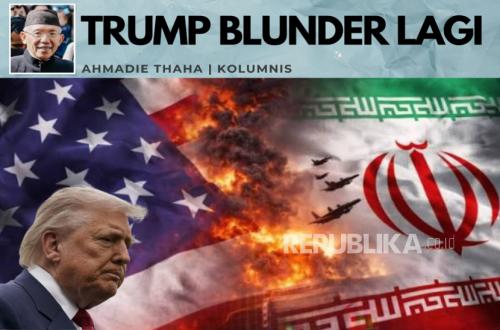
There is an old saying in the world of diplomacy: the greatest mistake is not starting a war, but thinking that war will solve the problem. In the Middle East, that adage is proving itself true once again. The United States appears to be repeating the same blunder: believing bombs can replace diplomacy.
A memorandum of understanding (MoU) between the United States and Iran, initially promoted as a gateway to peace and stability, failed to generate even trust. Barely three weeks after it was agreed in mid-June, Donald Trump declared the deal ‘over’.
This decision marks another Trump tantrum and makes Washington seem to be repeating a blunder: thinking bombs can solve what diplomacy failed to. It is not Iran that has lost its bargaining chip, but rather the US that has pushed Tehran to use its ultimate weapon: the Strait of Hormuz.
After the word ‘over’ left Trump’s mouth in Turkey, at the NATO meeting on 8 July, the skies over Iran were once again filled with the sound of fighter jets. American airstrikes hit dozens, even more than a hundred, military targets. The destruction was inevitable, simultaneously igniting the spirit of jihad among the Iranian people, already inflamed by the martyrdom of Ali Khamenei.
Iran retaliated by launching missiles and drones at several American military facilities in the Gulf region. Primary targets included the Arifjan and Ali Al Salem bases in Kuwait, the US Navy complex in Juffair, and the Sheikh Isa Air Base in Bahrain. The Middle East was once again ablaze.
Iran also claimed to have struck Patriot missile defence systems in Kuwait, satellite antennas in Qatar, and American military fuel depots in Bahrain. Kuwait stated it successfully intercepted most of the missiles, while Qatar raised its security threat level. Jordan was also hit by missiles.
Iran’s attacks appeared to be more of a political message than an attempt to win a war. Iran sought to demonstrate that American bases in the Gulf are no longer out of reach, while reminding everyone that every bomb dropped on Tehran could ricochet across the entire Gulf region.
Herein lies the blunder. Washington still seems to view this conflict as a war that can be won through air superiority. Yet the battlefield has changed. Iran may lose in a contest of fighter jets, but it still holds a card far more valuable to the world: the ability to disrupt the Strait of Hormuz.
The world is once again witnessing an old paradox: every party claims to be defending peace, but the path they take always involves adding more missiles.
This is where many people misread the conflict. They think the issue is solely Iran’s nuclear programme. However, recent developments show that the heart of the dispute has shifted to a narrow strait about 40 kilometres wide: the Strait of Hormuz.
That is where Iran’s final card lies. The Strait of Hormuz is not just a sea lane. It is the world’s energy tap. Nearly a fifth of global oil trade and about a fifth of the world’s liquefied natural gas (LNG) passes through it. Every day, dozens of tankers worth billions of dollars take turns navigating the narrow corridor flanked by Iran to the north and Oman to the south. If the Suez Canal is the artery of global trade, then Hormuz is the heart of the world’s energy.
This is why Iran has repeatedly called Hormuz its final red line. Iran’s Parliament Speaker, Mohammad Baqer Qalibaf, even stressed that the strait would only be reopened under Iran’s arrangements, not because of American threats. The statement is not merely nationalist rhetoric. It is a strategic message. When American air power is vastly superior, Iran knows it cannot win a conventional war. But it can still control the narrow chokepoint that almost the entire global economy depends on.
Ironically, this ultimate weapon also wounds the wielder. When shipping traffic is disrupted, Iran’s own oil exports plummet. Iranian oil must be sold at a massive discount. National revenue shrinks drastically. Iran’s economy, long squeezed by sanctions, is now being strangled further. This is the geopolitical paradox: a trump card played too often slowly turns into a suicide card.
Ironically, after cancelling the MoU, America’s position did not automatically become stronger. This is why many observers call Washington’s move a strategic blunder. Modern warfare is not just about winning on the battlefield. It is also about winning the confidence of economic actors. Once insurance companies raise premiums tenfold, and once shipping companies charge millions of dollars per vessel in conflict fees, the cost of war will be paid by the entire world’s population through market prices.