
Trump's Backfire: US Citizens Strangled by High Fuel Prices
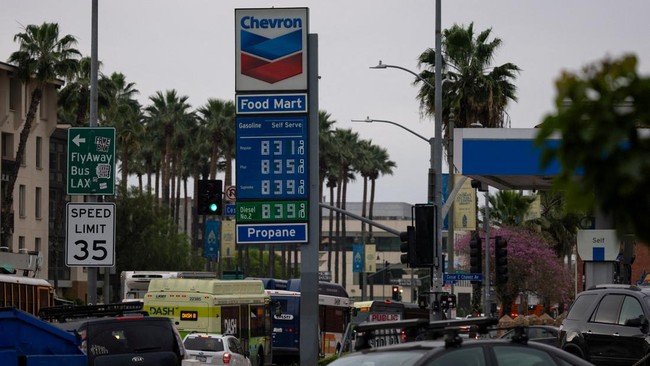
Diesel prices in the United States have skyrocketed, surpassing the US$6 (Rp106,200) per gallon mark for the first time in history on Friday. This extreme surge was triggered by fuel supply disruptions caused by the ongoing wars in Ukraine and Iran, which have subsequently driven up transportation costs across all economic sectors.
Citing CNBC International on Friday (11/09/2026), AAA data noted that truck drivers and farmers must now pay approximately 63% more to fuel their tractors and vehicles compared to the same period last year. The national average price now sits at US$6.05 (Rp107,184) per gallon; even in California, the largest agricultural state in the US, prices have exploded to US$7.98 (Rp141,293) per gallon.
This diesel price crisis coincides with surging crude oil prices due to the sharp escalation of fighting between the US and Iran this month. US crude oil futures even breached the US$100 (Rp1,770,000) per barrel mark on Thursday for the first time since May, recording an increase of approximately 20% in September.
The President of Rapidan Energy, Bob McNally, emphasised that diesel is essentially the lifeblood of the economy, even though consumers typically pay more attention to retail petrol prices. High diesel prices are directly transmitted to consumers through surges in food prices, consumer goods, and energy.
This is because diesel serves as the primary fuel for trucks, trains, ships, agricultural machinery, and power plants. “This is a more dangerous, more expensive, and more impactful fuel. As prices creep up, it becomes a very real concern,” he explained.
Patrick De Haan, Head of Oil Analysis at GasBuddy, also warned that diesel prices at current levels will act as a silent killer for the economy. Meanwhile, petrol prices also broke Labor Day records at US$4.15 (Rp7gsub7,455) per gallon earlier this week. US citizens are now estimated to be spending approximately US$700 million (Rp12.39 trillion) more per day on petrol and diesel compared to last year.
“There is a price shock there for consumers,” he said.
The surge in costs is a direct consequence of the wars in Ukraine and Iran, which have paralysed global supplies. Ukraine continues to strike Russian refineries, forcing Moscow to ban diesel exports. Simultaneously, Iran and its Houthi militant allies in Yemen have attacked refineries belonging to US Gulf allies, while exports through the Strait of Hormuz have been obstructed due to Iranian attacks on tanker ships.
The Chief Operating Officer of Valero, Gary Simmons, stated that conflicts in Eastern Europe and the Middle East have wiped out refinery capacity by approximately 5 million barrels per day. This is exacerbated by statements from the President of Lipow Oil Associates, Andy Lipow, who noted that the world has now lost nearly 8% of its diesel supply, with minimal spare refining capacity to cover the deficit.
Helima Croft, Head of Global Commodity Strategy at RBC Capital Markets, assessed that this storm of rising prices presents an extraordinary challenge for the Donald Trump administration.
“US refineries are operating at a 98% utilisation rate—there is absolutely no spare capacity,” she asserted.