
Trumpism: The New Style of Militarism and a Steel Fortress on Sinking Ground
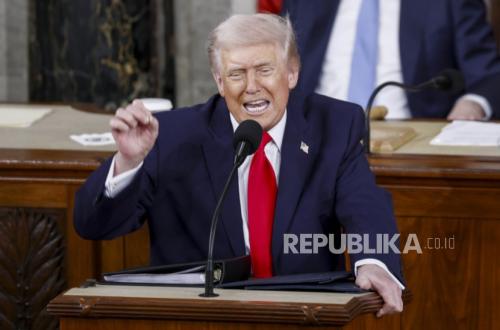
REPUBLIKA.CO.ID, JAKARTA – In early 2026, the world witnesses an unprecedented leadership paradox. Donald Trump, a property entrepreneur now back in the presidential seat, announces a staggering defence budget proposal: $1.5 trillion USD.
With the narrative of building a “Dream Military,” Trump is forging a new face of militarism—a phenomenon we term “Trumpistic Militarism.” Yet, behind the bravado of stealth fighter jets and ocean-filling naval fleets, there lies a fatal crack in its supporting foundation: national debt that has surpassed $38 trillion USD. This is the phenomenon of “A Steel Fortress on Sinking Ground”—an effort to build extraordinary physical strength on an economy experiencing acute structural deficits.
Historically, militarism has typically been driven by military juntas or power-hungry generals. Trump, however, is a pure civilian. For him, the military is not merely a defence tool, but an instrument of power branding and trade negotiation. Trumpism views weapons strength as the primary support for its tariff policies. Yet, Trump’s fondness for military parades and flaunting military hardware obscures a fundamental economic fact: the military is a consumptive sector, not productive. Every dollar spent on ballistic missiles is a dollar withdrawn from investments in infrastructure or education, which have multiplier effects for the long-term economy.
Shadows of History: From Rome to the Soviet Union
If Trump insists on ignoring economists’ warnings, he is essentially challenging the gravity of history. History is a graveyard for empires that suffered from Imperial Overstretch—a condition where military commitments exceed the economic capacity to fund them.
The Roman Empire fell not because its legions were weak, but because the costs of maintaining vast borders forced the government to devalue the currency and raise taxes to the point of strangling its own people. A similar fate befell Spain in the 17th century under the Habsburg Dynasty. Despite holding a monopoly on gold from the New World, King Philip II’s militaristic ambitions to dominate Europe bankrupted Spain four times. The gold they possessed merely “passed through” to pay debts to German and Italian bankers.
The most terrifying similarity is, of course, the Soviet Union. At the peak of the Cold War, the Soviets had weaponry on par with, and in some lines surpassing, the United States. However, their steel fortress stood on a crumbling economy. Disproportionate resource allocation to the military (reaching 15-20 percent of GDP) starved their civilian sector, until the state collapsed without needing a single bullet from its enemies.
Sinking Ground: The $38 Trillion Debt Trap
In 2026, the United States faces a fiscal situation far more dangerous than during the Cold War. With $38 trillion USD in debt, interest payments alone now compete with budgets for vital departments. Trump argues that revenue from import tariffs—including aggressive tariffs against trading partners from various countries—will fund it.
However, this is flawed logic. Import tariffs instead trigger domestic inflation and global trade wars that slow economic growth. Funding the military by burdening global trade is a contradictory strategy; it destroys the free trade system that has long been the source of America’s prosperity. If economic growth slows due to trade wars, the “ground” beneath that steel fortress will sink even further.
This phenomenon brings us back to the classic warning from Yale University historian Paul Kennedy in his seminal book, The Rise and Fall of the Great Powers. Kennedy introduced the concept of Imperial Overstretch—a condition where a superpower’s foreign commitments systematically exceed its economic capacity.
Kennedy argued that “If a country allocates too many of its resources to military purposes rather than wealth creation, it will cause long-term economic decline.”
Trump appears to be doing the opposite; he believes military strength can “force” wealth creation through tariffs and trade concessions. However, history from Rome to Habsburg Spain proves that an overly bloated military without an efficient domestic production base is a recipe for national bankruptcy.
Flawed Logic of Civilian Militarism
Unlike traditional militarism driven by generals, Trumpism is militarism born from an autocratic business mindset. Geopolitical analyst Robert Kaplan often reminds that an empire’s stability depends on the balance between “muscle” (military) and “nerves” (economy).
Trump is trying to build massive muscle while his economic nerves are squeezed by debt interest burdens. In 2026, US debt interest payments are projected to exceed the entire education and health budgets if interest rates remain high. In this context, Trump’s ambition to build a “Steel Fortress” is no longer a security strategy, but an existential gamble.
The Soviet Union’s mistake in the 1980s is the most relevant mirror. As noted by economist Marshall Goldman, the Soviets collapsed because they had a “military-industrial complex” that sucked up the best brains and resources, yet left grocery stores empty.
Currently, Trump is trying to fund his military with 19 percent import tariffs (including on Indonesian products). This strategy, according to Nobel laureate economist Joseph Stiglitz, will instead create a “hidden tax” on the American people themselves. Rather than generating
Source: jawawa.id (https://jawawa.id/newsitem/trumpism-the-new-style-of-militarism-and-a-steel-fortress-on-sinking-ground-1774936318)
Originally published by Republika (https://analisis.republika.co.id/berita/tcqvvi393/trumpisme-militerisme-gaya-baru-dan-benteng-baja-di-atas-tanah-amblas), translated from Indonesian