
Trump-Xi Jinping Meeting: Who Holds the Upper Hand in Geopolitical Power Struggle
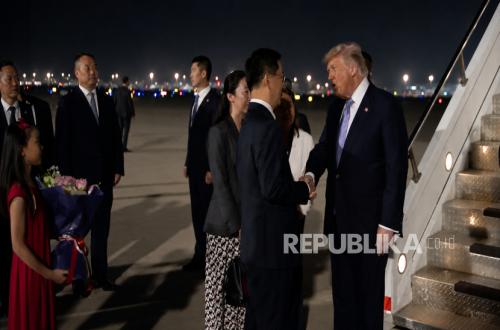
US President Donald Trump’s visit to Beijing to meet Chinese President Xi Jinping is more than just a routine bilateral agenda. Amid escalating global geopolitical tensions, the meeting is seen as a symbol of the battle over the direction of the new world order between the world’s two greatest powers. Three writers from international media offer differing interpretations of the meeting. However, beneath these differing perspectives lies a common thread: the rivalry between the United States and China has now surpassed trade issues and evolved into a contest for global influence touching on energy, military, technology, and the future of the international system. Russian writer David Narmania, in his article for RIA Novosti, sees Trump arriving in Beijing from a weakened position. According to him, various domestic pressures and failures in Washington’s foreign strategy have made the US’s bargaining position less strong than before. “Trump is heading to China not as a winner, but as a leader who has started a war without a good exit,” Narmania writes. He highlights how the US-China tariff war has not produced the impact Washington expected. The US trade deficit is said to have barely changed, while the tariff burden is also borne by American domestic consumers. He also assesses that the US operation against Iran has complicated Washington’s geopolitical position because Tehran now has greater influence over the Strait of Hormuz, a vital global energy trade route. In Narmania’s view, this situation creates strategic momentum for Beijing. China is seen to have a greater opportunity to push for international compromises more favourable to its interests, especially when the US is facing economic pressures, domestic politics, and geopolitical challenges simultaneously. A different view comes from Turkish analyst Nedret Ersanel in his article for Yeni Şafak. Ersanel sees US-China relations as no longer merely interdependent trade ties, but an unavoidable global strategic competition. “The US-China rivalry shows its spread to every region of the world in terms of global influence, military power, and global governance,” Ersanel writes. “There is a war on every front.” According to him, the Ukraine war, Iran conflict, Taiwan issue, and rivalry in the Indo-Pacific are actually interconnected in the global influence contest between Washington and Beijing. Ersanel assesses that the world is now entering a new phase where the competition between the two great powers is no longer limited to traditional battlefields, but also spreads to energy, technology, supply chains, and even outer space.