
Trump vs Fed Chair Conflict Intensifies: Choosing Between Fighting Inflation or the White House
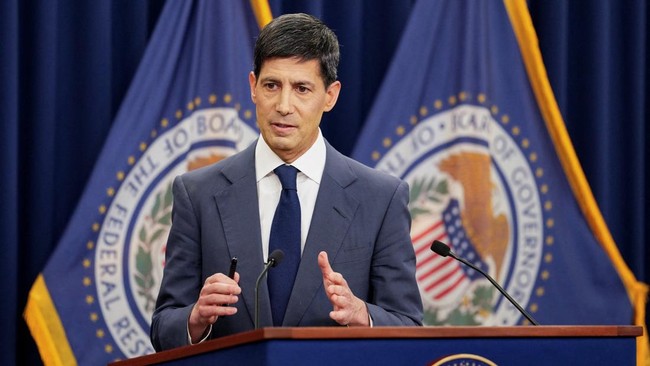
The Chair of the United States central bank, Kevin Warsh, is set to face one of the most significant decisions since assuming his position at the Federal Reserve (The Fed). During the Federal Open Market Committee (FOMC) meeting on 15-16 September 2026, Warsh must choose between maintaining current interest rates or initiating a tightening cycle by raising them.
This decision is not merely about whether rates will rise and by how much; it will test Warsh’s resolve in tackling inflation, which has yet to return to the Fed’s target. Markets are also awaiting his firmness in the face of pressure from US President Donald Trump, who continues to demand interest rate cuts.
As reported by The Economist, current US economic conditions provide a strong rationale for the Fed to raise interest rates. Inflation remains above the Fed’s 2% target, while the economy continues to grow, unemployment remains low, and job creation is increasing. Simultaneously, credit remains accessible and the stock market is trading at high levels. Under these conditions, the risk of the US economy overheating is deemed greater than the threat of an economic slowdown.
This September FOMC meeting will mark the third time Kevin Warsh has led a meeting since becoming Fed Chair, following meetings in June and July 2026. Throughout 2026, the Fed has not once changed its benchmark interest rate. In the most recent meeting on 28-29 July 2026, rates were maintained in the 3.50%-3.75% range, though the decision was not unanimous, with three of the 12 FOMC members voting for a 25 basis point hike.
Inflation has not yet truly subsided. US Bureau of Statistics data shows the Consumer Price Index (CPI) rose by 0.4% month-on-month in August 2026, a higher increase than the 0.1% recorded in July. Annually, US inflation stood at 3.4%, unchanged from July but still significantly above the Fed’s 2% target. Rising energy prices were the primary driver; petrol prices surged 3.9% monthly, contributing to more than a third of the CPI increase in August. Annually, petrol prices have risen by 27.4%, while the overall energy group jumped 16.3%.
The surge in energy prices extends beyond the petrol pump, as higher fuel costs drive up shipping costs, airfares, and travel expenses. Price pressures are also evident when food and energy components are excluded; core inflation rose 0.3% month-on-month, its largest increase since April 2026. While annual core inflation has eased from 2.5% to 2.4%, it remains above the Fed’s target, and the monthly increase suggests underlying price pressures have not vanished.
These data points have increased market certainty regarding a Fed rate hike. The probability of a 25 basis point increase surged to 91% before settling around 87%, compared to 72% the day before the CPI data release. While inflation could potentially ease on its own if price hikes due to the war with Iran and import tariffs are merely temporary, The Economist suggests the Fed cannot rely solely on this possibility. Having endured inflation above target for approximately five years, assuming price pressures have ended too early could prove a mistake.
Inflation is not the only reason for a potential hike. The US economy does not yet show signs of needing the assistance of lower borrowing costs. The unemployment rate stands at 4.1%, with job vacancies beginning to rise, and August’s labour additions were much stronger than expected. Furthermore, the explosion in Artificial Intelligence (AI) investment has not yet triggered the feared wave of layoffs; instead, the construction of data centres and spending on hardware and software are creating jobs and driving investment.
Financial market conditions also indicate that liquidity remains ample, with credit flowing and the stock market remaining buoyant. While the bond market has faced pressure, this is partly because investors anticipate that interest rates must remain high or be raised again to curb inflation. When rate hike expectations rise, bond prices typically fall and yields increase. Given high inflation and a strong labour market, conventional monetary policy benchmarks would place US interest rates higher than their current position.
Trump’s pressure makes the decision increasingly complex. Trump has repeatedly called for the Fed to lower interest rates and has even threatened to halt trade with countries causing US trade deficits. “Lower interest rates or I will stop trading with the countries that cause us to have a deficit,” Trump wrote via Truth Social on Friday (4/9/2026), as cited by Reuters. Trump reaffirmed his stance ahead of the Fed meeting; speaking to journalists in Ireland on Sunday (13/9/2026), he stated that US interest rates should be the lowest in the world, regardless of inflation data or economic conditions. “The United States should pay the lowest interest rates in the world,” Trump stated.
This pressure places Warsh in a difficult position. If the Fed maintains interest rates while inflation remains high, the decision could create the impression that the central bank is following the wishes of the White House.