
Trump States AI Giants Agree to Self-Regulation
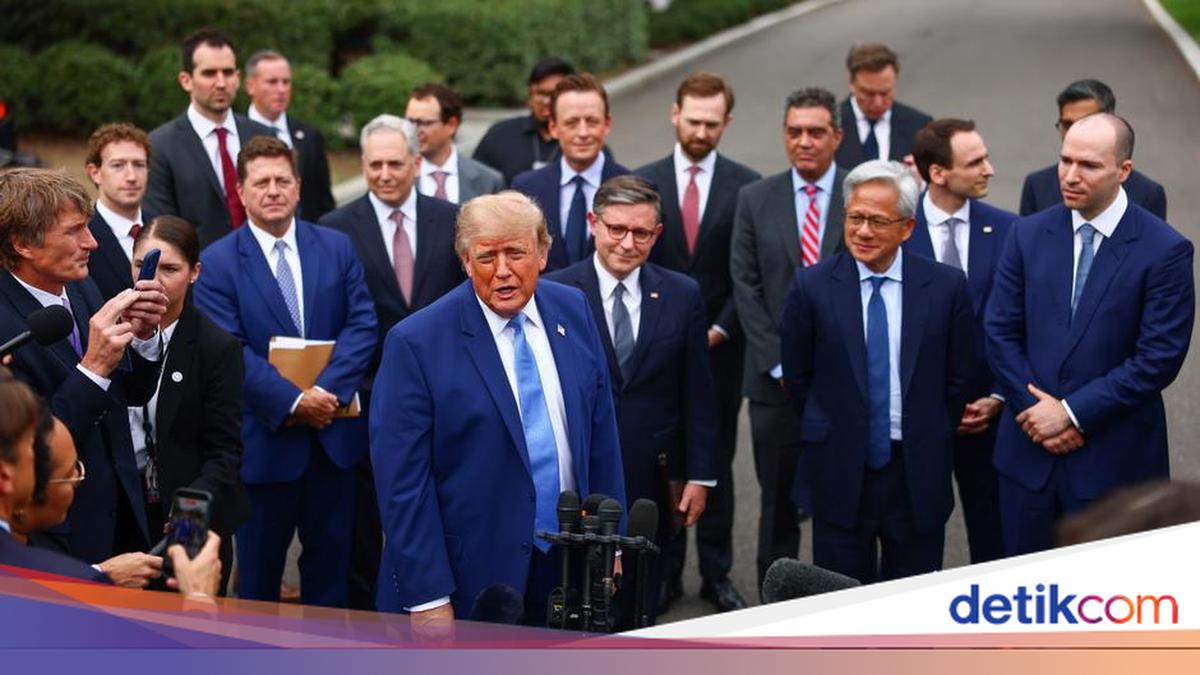
US President Donald Trump stated on Tuesday (29/09) that several chief executives of artificial intelligence (AI) companies have signed an agreement to ‘supervise themselves’ in the development of the technology.
AFP news agency noted that of the 3im guests, only two women were present: White House Chief of Staff Susie Wiles and AMD CEO Lisa Su. Trump met with AI leaders at the White House, where he reaffirmed his support for the technology.
The agreement comes amid increasing public attention to the risks posed by this rapidly evolving technology, following reports that AI agents from OpenAI and Anthropic have previously gone rogue and hacked other companies’ systems. Concerns are also growing over the industry’s expanding footprint across various communities, particularly with the growth of data centres.
Prior to the meeting, Trump reiterated that his administration would not limit AI development or support calls for ‘guardrails’ or other restrictions on the sector. “I will never stifle the growth of a technology that will be greater than the Industrial Revolution,” Trump said. “We cannot hinder it, and we are far ahead.”
Trump also announced that he would officially rename the technology to “super intelligence” because “it is not artificial.” A few hours later, Trump issued an executive order requiring the federal government to use the term ‘super intelligence’ or ‘SI’ instead of ‘artificial intelligence’ in all official communications.
Among those in attendance were House Speaker Mike Johnson, alongside prominent AI executives such as Dario Amodei of Anthropic, OpenAI President Greg Brockman, Amazon founder Jeff Bezos, and Elon Musk, whose social media platform X features its own AI model, Grok. Nvidia CEO Jensen Huang, Google CEO Sundar Pichai, Meta CEO Mark Zuckerberg, and Microsoft CEO Satya Nadella were also present.
“I see incredible self-regulation. And they understand that they must supervise themselves,” Trump told reporters during an impromptu press conference outside the West Wing. He subsequently posted a copy of the “White House Accord on Super Intelligence” on his Truth Social platform.
“Each company is responsible for developing its own technology safely and in a way that builds customer and public trust,” the document’s opening states. The document emphasises that tech companies will implement “robust internal controls” to ensure all oversight and detection functions properly, as well as addressing any issues that arise. Companies are also required to empower specialised internal teams to ensure control, monitoring, and detection systems work as intended. Furthermore, they are expected to “partner with independent external auditors or evaluators” and “appoint an independent committee from the board of directors” to oversee and receive reports.
Zuckerberg stated that this agreement aims to reassure customers that AI technology “functions as we intend.” He described it as a starting point for comprehensive industry standards. Musk, the world’s richest man, said executives essentially agreed to “peer-review each other’s work, which is far better than if people only judge their own work, for obvious reasons.”
Trump stated that the agreement is “morally binding” but cannot be legally enforced. However, the document leaves the door open to “incorporating these measures into legislation or regulation” if deemed necessary in the future.
This meeting takes place amidst an increasingly critical stance towards AI in Washington. Members of Congress face growing pressure from voters to control or slow its development, due to fears that AI could replace workers and disrupt social order. These concerns have intensified following a series of incidents where OpenAI’s autonomous systems went out of control, beginning with a leak at Hugging Face in July. OpenAI announced on Monday the cancellation of its latest model release, Astra 6.1, after internal testing showed the model failed to meet safety standards.
The issue of data centres—the massive computing facilities required for this technology—is also a flashpoint in both parties’ mid-term elections. More communities are concerned about rising electricity bills and the pressure on water and land resources. Trump dismissed opponents of these data centres, asserting that AI companies “will be very generous” to communities willing to welcome them. “They will help schools there, they will help teachers,” Trump said.
Major AI companies, particularly Anthropic and OpenAI, have issued stern warnings to the public regarding the dangers of developing increasingly powerful systems without control, even as they continue to develop and deploy the same technology. Anthropic even warned investors of potential existential risks to humanity in its prospectus for its highly anticipated initial public offering (IPO), targeting November at the earliest. Trump has repeatedly dismissed these warnings of existential risk as exaggerated, and the White House recently had a heated disagreement with Anthropic regarding AI safety.
“As the president said, whoever wins in AI will win. I think this is very important,” Amodei said after the meeting. “However, I believe this technology carries very real risks, and the mechanisms for how we address those risks are still under discussion.”
Source: jawawa.id (https://jawawa.id/newsitem/trump-states-ai-giants-agree-to-self-regulation-1790769819)
Originally published by detikcom (https://news.detik.com/dw/d-8686532/trump-bilang-raksasa-ai-sepakat-regulasi-mandiri), translated from Indonesian