
Trump Proposes 20% Fee for Hormuz Strait Passage: How Would the Mechanism Work?
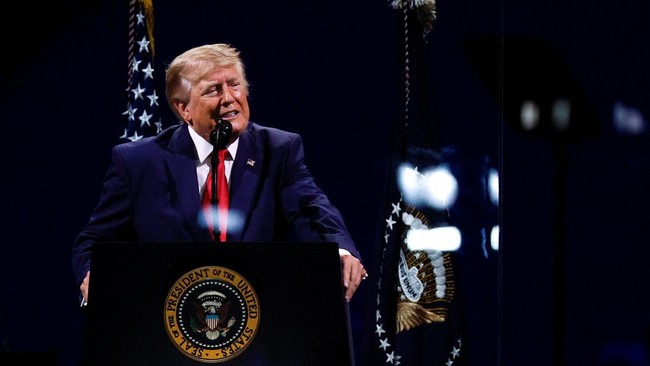
US President Donald Trump has surprisingly declared that his country is ready to provide full security protection for merchant vessels transiting the Strait of Hormuz. However, military protection in the crucial trade route currently controlled by Iran is not free, but must be exchanged for compensation in the form of a fee amounting to 20% of all cargo transported.
Citing a CNN International report on Tuesday (14/07/2026), this controversial proposal emerged after global shipping companies repeatedly urged stronger military protection following the outbreak of war between the US-Israel alliance and Iran. Nevertheless, the idea floated by the number one person in Washington immediately sparked fierce debate and raised significant doubts regarding its legality under international law and its operational feasibility on the ground.
“The U.S.A. will henceforth and forever be known as ‘THE GUARDIAN OF THE HORMUZ STRAIT,’ but as a consequence, and for the sake of Justice, it will be compensated, with a tariff of 20% on all cargo shipped, for any and all costs necessary to perform the task of providing safety and security in this very volatile part of the World,” Trump wrote in a post on his Truth Social media platform on Monday.
How Would the Mechanism Work?
To date, the White House has not provided an official response when asked for details on the calculation scheme for this massive tariff. The lack of clarity on the tariff formula has led maritime logistics industry players to question whether the 20% fee would be calculated from the total operational cost of the US military blockade divided per ship, the operational costs of US Navy escort duties, or calculated based on the total value of the commodities being transported.
The protection fee demanded by Trump is considered so excessively high that it is predicted no commercial shipping party would be willing or able to pay it. As an industry comparison, cargo owners typically pay only about 2% to 3% of the total value of their goods to the ship operator for shipping services, meaning Trump’s protection tariff, which is ten times the normal logistics cost, would certainly paralyse the cost structure of global trade.
“First and foremost, people need to know what the cost is to evaluate whether they want to use this service. Is it 20% of our cost for the blockade, somehow divided by the number of ships?” asked John McCown, a senior researcher at the Center for Maritime Strategy and former CEO of maritime logistics firm Trailer Bridge.
Beyond financial constraints, the final decision on whether to continue sailing through the Strait of Hormuz actually lies with international marine insurance companies. Insurers have the right to refuse to provide coverage or protection guarantees for ships that insist on transiting the Strait of Hormuz if the security risks in the conflict zone are deemed too extreme, regardless of whether the ship owner can afford to pay the protection fee to the US military.
Is the Fee Legal?
Under international maritime law, the Strait of Hormuz is an international waterway where all merchant ships have the absolute right to free passage. The move to impose a mandatory fee by a security guarantor nation is considered a violation of global rules, similar to past instances when Iran attempted to impose unilateral service charges that were subsequently classified as illegal tolls by maritime law experts.
“The last time the world faced a situation like this was when Denmark charged fees on foreign ships passing through the Øresund, from the early 1400s until the mid-1800s. The levies were also assessed based on the declared value of the cargo. Ironically, that practice was stopped by American intervention,” said Bjorn Vang Jensen, an executive industry advisor at the logistics analysis platform Xeneta.
Nevertheless, some legal experts argue that Trump’s proposal could still be legal under the strict condition that the military escort is optional or voluntary for companies that specifically request convoy protection. Although the commercialisation scheme for military protection is technically possible if it is voluntary, international law experts still caution the US government that legality does not automatically make the policy feasible or safe to implement amid a raging war.