
Trump Furious Again at Iran: Claims Hormuz as US Territory, Shuts Door on Peace
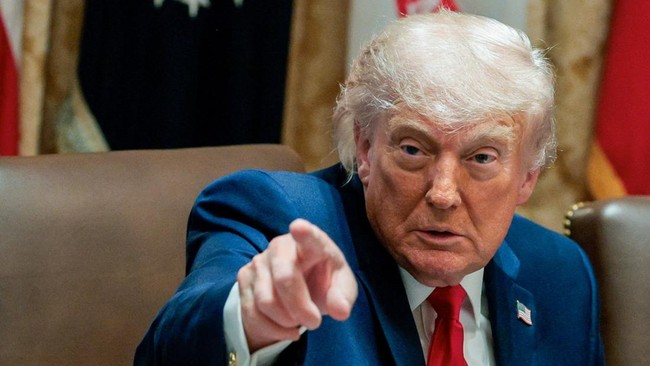
US President Donald Trump has once again triggered extraordinary controversy by claiming the strategic waters of the Strait of Hormuz as new territory belonging to his country. The unilateral claim immediately drew anger from Tehran, which said the president was fantasising amid a deadlock in peace negotiations.
Citing Russia Today and Reuters on Wednesday (19/08/2026), Trump made the territorial claim through a post on the Truth Social platform on Tuesday. The president shared a map of the strait and its surroundings with an area circled and labelled.
‘New United States territory,’ the label read.
The provocative post immediately prompted a sharp reaction from Tehran. Iran’s Deputy Foreign Minister, Kazem Gharibabadi, strongly condemned Trump’s delusion and warned that his country was ready to act to correct the fantasy.
At the same time, Gharibabadi also delivered a sharp jibe at the US president’s earlier intention to rename the waters the Arabian Gulf. According to him, this intention would not succeed and would instead further cement the name Persian Gulf on the world map.
‘He managed to write the eternal name Persian Gulf correctly,’ he said.
The exchange of threats erupted just after the two-month window to reach a formal peace agreement ended on Monday. The failure of the deal has again pushed up world oil prices, with Brent crude futures surging to a peak of US$126 (Rp 2,242,800) per barrel before closing at US$91 (Rp 1,619,800) per barrel on Tuesday.
Shortly after claiming Hormuz, Trump again insisted that there were absolutely no talks or conversations ongoing or scheduled with the Islamic Republic of Iran. This contrasted with the optimistic tone from his son-in-law, Jared Kushner, on Monday, who said discussions were still going strong.
‘The Naval blockade remains fully in place and effective. The Strait of Hormuz is open and operational. All sea mines have been removed or detonated,’ Trump said.
However, Trump’s claim that the Strait of Hormuz was open was strongly denied by Iranian officials. Iran’s chief negotiator, Mohammad Baqer Qalibaf, insisted that the strait would remain tightly closed to shipping traffic until the US met all the conditions of the interim agreement signed in June.
‘These conditions include the US ending the blockade of Iranian ports, lifting oil sanctions, releasing Tehran’s frozen assets, and ending threats and military operations on all fronts,’ he stressed.
Amid the diplomatic deadlock, a senior Iranian official disclosed that the country was beginning to move towards a ‘fully offensive’ military posture. Adviser to Iran’s supreme leader, Mohammad Mokhber, said Iran remained fundamentally open to dialogue with the aim of defending its security and allies without seeking war, but would never equate negotiation with surrender.
Reality on the ground also belied Trump’s claim that the waters were safe. The United Arab Emirates’ Ministry of Defence reported detecting two ballistic missiles from Iran that fell into the sea and targeted maritime traffic on Tuesday. As a result of the escalation, the UAE immediately suspended all trade, shipping and financial transactions with Iran.
At the same time, the United Kingdom Maritime Trade Operations (UKMTO) received a report that a vessel was struck by an unknown projectile while sailing out through the Strait of Hormuz. The attack caused damage to the engine room and left one crew member injured, who was assisted by the Omani Coast Guard. Maritime data also showed ship crossings in the waters remained at single-digit levels.
For context, the deadly conflict, which has killed thousands of people in Iran and Lebanon, was triggered by a joint US-Israel attack. Iran has responded by striking US military bases in Oman, Jordan, Kuwait, Israel, the UAE and Saudi Arabia. The US itself insists its primary goal is to prevent Iran from acquiring nuclear weapons, a mission experts consider difficult without clearing buried uranium sites.
Although they always project resilience in public, Iranian leaders are reportedly beginning to worry internally that further US economic punishment could trigger unrest and erode the Islamic Republic’s legitimacy. Recognising this weakness, a US official warned that Washington was now preparing to pull the economic sanctions lever again.
‘These sanctions are likely to be far harsher and will be imposed in the coming months,’ the official concluded.