
Trump Faces 60-Day Deadline on Iran, Oil Breaks Through US$114 per Barrel
Oil prices rose on Friday, a day after fluctuating movements that saw the June Brent crude contract reach its highest level in four years. According to CNBC, the June contract, which expired on Thursday, climbed to US$126.41 per barrel before settling at US$114.01.
On Friday, the July Brent futures contract rose 0.9% to US$111.34 at 7:17 a.m. ET, while the US West Texas Intermediate futures for June pared earlier gains and traded flat at US$105.07.
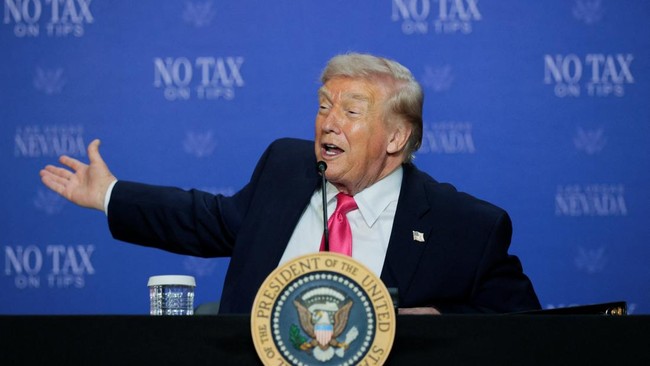
This movement occurred as US President Donald Trump faces a 60-day deadline based on the War Powers Resolution regarding military action in the Iran war.
Under the 1973 law, a president must withdraw troops within 60 days of notifying Congress of their deployment, unless lawmakers authorise the military action. The US Congress has not done so.
According to MSNow, the Trump administration argued on Friday that the ceasefire reached three weeks ago has “ended” hostilities between the two parties. This allows the White House to avoid seeking congressional approval for the war.
A government official said that the absence of direct fire between US and Iranian forces since the first ceasefire was agreed on 7 April means the 60-day countdown no longer applies.
“For the purposes of the War Powers Resolution, the hostilities that began on Saturday, 28 February, have ended,” a government official told MSNow, quoted by CNBC on Friday (1/5/2026).
This argument was first raised by Defence Secretary Pete Hegseth during his confirmation hearing before the House Armed Services Committee on Thursday morning, where he said the ceasefire effectively pauses the war.
The US and Israel launched attacks on Iran on 28 February, and Trump officially notified Congress on 2 March, starting the 60-day countdown and setting a deadline of 1 May.
According to lawmakers, Trump could request a 30-day extension under the law but has not done so.
Tensions remain high despite the ceasefire. Trump on Wednesday escalated threats against Tehran, vowing to maintain the US blockade on Iran until Tehran agrees to a nuclear deal.
Tehran refuses to reopen the Strait of Hormuz unless the US lifts the blockade on Iranian ports.
Axios also reported that US Central Command has prepared plans for a “short and devastating” wave of attacks on Iran in hopes of breaking the stalled negotiations between Washington and Tehran.
Although both sides are currently in a ceasefire, a senior Iranian Revolutionary Guard official reportedly threatened a “long and painful” attack on US positions if Washington renews attacks on Iran. This was reported by Reuters, citing Iranian media.