
Trump Claims War is Over, Invites Iran to Negotiate
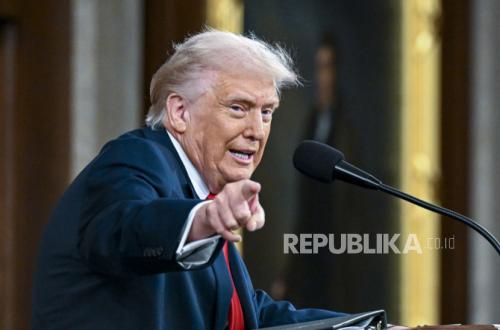
The United States (US) has finally opted for the path of negotiations with the Islamic Republic of Iran. In a press conference on Tuesday (24 March 2026) US time, President Donald Trump stated that the war with Iran would end.
Trump claimed victory in the war after being convinced that the mission and objectives of invading Iran had been accomplished. He said that negotiations and talks to cease the war with the leaders of the Mullahs’ country were being pursued.
“The US has ‘won’ in Iran,” Trump said, as quoted from Al Jazeera on Wednesday (25 March 2026) early morning. “I think we will end it,” he added.
However, Trump said he could not guarantee whether this round of negotiations and talks to end the war with Iran would truly result in a certainty that could stop the fighting. “I cannot tell you for sure,” he said.
Trump stated that the cessation of war he desired with Iran this time was because the US had already achieved its initial goals. Trump said the objective of fighting Iran to effect a change in leadership in Tehran had succeeded.
Trump also said that the US objective of invading Iran to prevent it from having the opportunity to enrich uranium for producing nuclear weapons had also been achieved. Therefore, Trump said it was time for negotiations and talks.
“We are currently in the negotiation stage,” Trump said. In the press conference, Trump announced four members of the US negotiating team who would discuss the war cessation with Iran.
They include US Vice President JD Vance, US Secretary of State Marco Rubio, and two trusted individuals, including his son-in-law, Steve Witkoff and Jared Kushner. In the press conference, Trump did not discuss Israel’s participation in the planned negotiations with Iran.
This US war against Iran actually involved Zionist Israel as an aggressor. The US-Zionists opened the war on Saturday (28 February 2026) by bombing the capital Tehran. In that first attack, Iran’s Supreme Leader Wali Faqih Ayatollah Ali Khamenei was martyred along with his wife, children, and son-in-law, as well as his granddaughter.
Several Iranian figures and military leaders also fell. The first US-Zionist attack also bombed a girls’ school, killing at least 175 people.
Iran responded by retaliating against Israeli-occupied territories in Palestinian land with assault drones and high-explosive missiles. Iran’s military also bombed US military bases, including Uncle Sam’s economic assets scattered in Saudi Arabia, Qatar, Kuwait, Bahrain, the United Arab Emirates, Jordan, and Iraq. Iran’s counter-resistance escalated the war with the US-Zionists to the Arab Gulf countries and threatened the Middle East (Timteng).
The war widened further after the Hezbollah fighters’ faction in Lebanon joined Iran by firing combat rockets at Zionist-occupied areas in northern Palestine. As of Wednesday (25 March 2026), the war has entered its fourth week or 26th day.
However, since the war entered its third day, Iran has imposed a blockade and limited closure of the Strait of Hormuz. Iran’s move has shaken global economic stability. Because the Strait of Hormuz is a global waterway for fossil oil and liquefied gas traffic.
The waters in the Persian Gulf gap control 22 percent of the world’s total fossil oil and liquefied gas supply. Iran only allows tanker ships flying the flags of friendly countries to pass.
The Islamic Revolutionary Guard Corps (IRGC) has laid sea mines and will destroy or prohibit passage of tanker ships flying the flags of countries assisting the US and Israel. The Strait of Hormuz blockade has driven up global oil and gas commodity prices to high levels.
President Trump once invited European countries and North Atlantic Treaty Organization (NATO) member states to help the US and Israel clear the Strait of Hormuz. Trump also asked for help from China, Japan, South Korea, and Australia to send warships to assist the US-Zionists in freeing the Strait of Hormuz.
However, none of those countries were willing to join the war against Iran. Trump was angry and threatened to attack all of Iran’s power plants and energy facilities if they continued to close the Strait of Hormuz.
But Iran remained unmoved. To this day, Iran’s military still keeps the Strait of Hormuz closed. On Monday (23 March 2026), Trump announced a delay in his massive attack on Iran because negotiations were underway to discuss ending the war.
However, Iran responded coldly to Trump’s statement. Authorities in Tehran confirmed there were no talks with Washington regarding ending the war. Iran emphasised that it would continue proportionate resistance against US-Zionist aggression.