
Trump Claims US Will Control Strait of Hormuz, Demands 20% Fee from All Ships
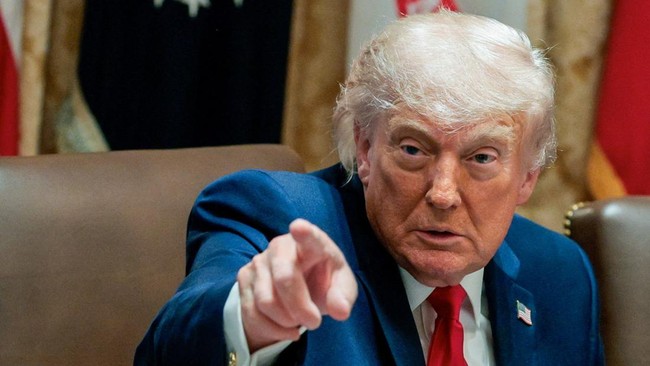
President Donald Trump has claimed Washington will take over the role of guardian of the Strait of Hormuz and impose a 20 per cent levy on all cargo transiting the strategic shipping lane. The statement came after Iran announced the closure of the strait amid renewed conflict between the two countries.
“The Strait of Hormuz is open, and will remain open, with or without Iran. We are reimposing a blockade on Iran,” Trump wrote on Truth Social. He added that the United States would be known as the “Guardian of the Strait of Hormuz” and, “in the interest of fairness”, would receive a 20 per cent fee for all cargo shipped through the passage.
Trump also asserted that the US military would continue to pound Iran. In an interview, he claimed Tehran’s military capabilities had been “almost wiped out” and warned that new strikes would continue. “We are going to control this strait. They have nothing,” Trump said. He also threatened to destroy Mount Pickaxe, an underground complex near the Natanz nuclear facility believed to be one of Iran’s most protected sites.
Shortly after Trump’s statement, US Central Command (CENTCOM) announced the start of a third consecutive night of strikes against targets in Iran. Iranian media reported explosions heard in Bandar Abbas, Kish Island, Qeshm, and Abu Musa, while Tehran claimed it had retaliated with cruise missile and drone attacks on several US military facilities in Kuwait, Bahrain, Jordan, Oman, and US warships in the Gulf region.
Tensions also spilled over into international shipping lanes. The UAE Ministry of Defence reported that two of its oil tankers were attacked while transiting the southern route of the Strait of Hormuz in Omani waters. The attack killed one crew member and injured eight others, while the United Kingdom Maritime Trade Operations (UKMTO) also reported a tanker hit by an unknown projectile in the same area.
Iran firmly rejected Trump’s claims. Foreign Minister Abbas Araqchi insisted Tehran remains the guardian of the Strait of Hormuz. “Iran is the guardian of the strait and will remain so forever,” Araqchi wrote on social media platform X. Responding to the proposed 20 per cent levy, he quipped, “20 per cent is certainly too much. We will be fair.”
Iran’s top military command also stressed that the US has no authority to determine the future of the Strait of Hormuz or regulate shipping traffic in the region. Tehran maintains it has the right to manage vessel flow, designate shipping routes, and collect fees according to its own rules.
Trump’s plan drew criticism from the United Nations shipping agency, which affirmed there is no international legal basis for a country to impose mandatory levies on ships transiting an international strait. Nevertheless, the US Navy-led Joint Maritime Information Centre stated that a blockade on Iranian shipping would take effect on Tuesday at 20:00 GMT, covering all Iranian ports and oil terminals, with exceptions for inspected neutral shipping and humanitarian aid.
The Strait of Hormuz is a vital artery through which roughly one-fifth of the world’s daily oil and gas trade passes, amounting to more than 15 million barrels. The value of energy trade transiting the strait is estimated at a minimum of US$1.2 billion per day. If the 20 per cent levy were actually implemented, the potential revenue for the US is estimated at around US$250 million per day.
The escalating conflict sent global oil prices surging more than 9 per cent in a single day, while shipping activity in the Strait of Hormuz fell by approximately 52 per cent compared to the previous week. The situation has heightened market concerns over global energy supply disruptions and increased the risk of a wider conflict involving more countries in the Middle East region.