
Trump Claims Moon Belongs to America, Tells the World to Step Aside
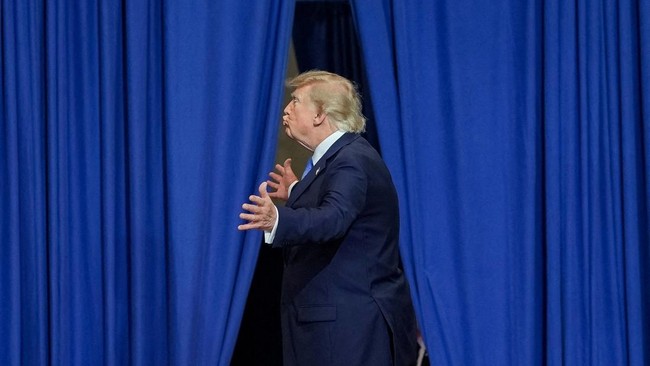
US President Donald Trump has once again made a controversial statement on social media. This time, Trump claimed the Moon belongs to the United States, while also proposing to rename the state of New Mexico to ‘New America’.
Trump made these claims through several posts on Truth Social, his personal social media platform. The posts appeared amidst his habit of sharing various images and videos generated by artificial intelligence (AI).
Although these were merely AI-generated images, the claim regarding the Moon has drawn significant attention because it involves matters of international law.
Legally, the United States cannot simply claim the Moon as its territory. A total of 111 countries signed the Outer Space Treaty in 1967. This treaty serves as one of the fundamental international legal frameworks governing human activity in outer space, including issues of territorial ownership in space.
The treaty explicitly states that no nation may claim territory in outer space as its own through a declaration of sovereignty, use, or occupation. This rule applies not only to the Moon but also to other celestial bodies such as Mars. Consequently, a nation cannot simply plant a flag on the lunar surface and declare that territory as part of its country.
“The most important principle of the Outer Space Treaty is that space is for everyone, and every party has the freedom to conduct exploration and access all regions,” said Michelle Hanlon, an instructor in air and space law at Research Counsel, as quoted by IFLScience on Thursday (10/09/2026).
“Another vital principle is that no nation may claim territory in space. No party possesses such authority over the Moon,” she continued.
The issue becomes more complex when discussing the construction of facilities on the Moon. Hanlon explained that the Outer Space Treaty allows for the construction of research stations on the Moon for scientific purposes, provided that information regarding such activities is shared with other parties.
However, regulations regarding the construction of commercial facilities, such as hotels on the Moon, are not as straightforward. “If you build a research station on the Moon, the Outer ’Space Treaty has provisions that such activities are permitted as long as the purpose is science and you share all information with all parties,” said Hanlon.
“But what if you build a hotel on the Moon? No party has the authority to declare, ‘Yes, you may build that hotel’,” she added.
In other words, the treaty clearly prohibits nations from claiming lunar territory. The United States itself is one of the nations bound by this agreement.
Nevertheless, the existence of international treaties does not automatically guarantee that violations will not occur. Space industry analyst Peter Hague stated that international law ultimately depends on the willingness of powerful nations to enforce it. He even suggested that the Outer Space Treaty currently serves essentially as a “fig leaf” that masks the real issue.
“In reality, the only international law that exists is the law enforced by the hegemon (or hegemons), who can violate it at will,” Hague wrote in his Substack post.
He added that the treaty is not a magic document that can automatically stop nations from committing violations in space. The enforcement of rules remains dependent on the pressure and responses of other nations on Earth.
Source: jawawa.id (https://jawawa.id/newsitem/trump-claims-moon-belongs-to-america-tells-the-world-to-step-aside-1789052816)
Originally published by CNBC Indonesia (https://www.cnbcindonesia.com/tech/20260910163615-37-766997/trump-bilang-bulan-milik-amerika-warga-dunia-silakan-minggir-dulu), translated from Indonesian