
Trump Backs Down: Finally Delays 50% Import Tariff
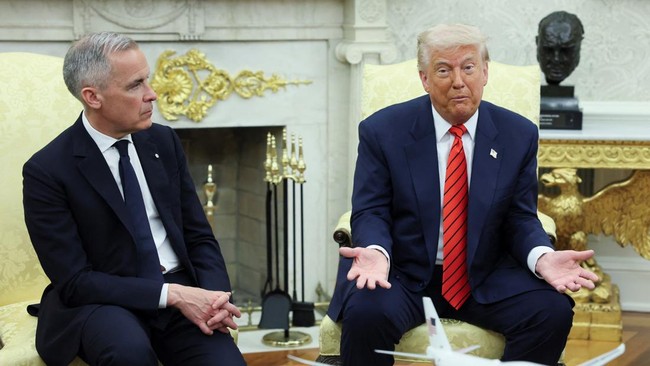
US President Donald Trump abruptly postponed the imposition of a 50% tariff on a range of Canadian imports just moments before the policy was set to take effect at midnight. Trump claimed the decision was made because Washington and Ottawa had reached a trade agreement, although the official documents were still being finalised.
In a post on Truth Social on Tuesday evening US time, Trump said the tariff delay was based on an agreement between the two countries. “Based on the fact that Canada and the United States, pending finalisation of documents, have A DEAL!” Trump wrote.
The announcement came after Trump and Canadian Prime Minister Mark Carney held trade talks on Tuesday. The deal claimed by Trump emerged just hours before the new tariff was scheduled to take effect.
Trump also raised the possibility of reviving the long-stalled Keystone XL oil pipeline project. In the same post, he said the project could perhaps be “brought back from the grave”, referring to the pipeline linking oil pipeline systems in Canada and the United States.
Keystone XL had previously received approval from Trump during his first term. However, the project’s permit was later revoked by former President Joe Biden in 2021. Trump is now signalling that the project could potentially be revived as part of the evolving trade relationship between the two countries.
The delayed 50% tariff would have affected various Canadian imports, ranging from hockey sticks and wine to a number of other consumer goods. The policy was first announced last month in response to what the Trump administration described as discriminatory Canadian trade practices against the US motor vehicle, alcoholic beverage, and dairy industries.
The tariff was imposed using Section 338 of the Tariff Act of 1930, a Great Depression-era law that is very rarely used and has practically not been a primary instrument of American trade policy for decades.
According to the US Trade Representative, the new tariff policy would have covered approximately US$20 billion worth of Canadian imports. While that amount is only a small fraction of total US imports from Canada, which reached around US$382 billion last year, the high tariff on certain products was still considered capable of dealing a major blow to Canadian exporters.
Dan Kelly, President of the Canadian Federation of Independent Business, said a 50% tariff can effectively make a product lose its competitiveness in the American market. “A 50% tariff basically makes a product uneconomical to sell in a particular market,” Kelly told CNBC.
He said many of the organisation’s 103,000 members had expressed concern that the tariff could halt their sales to the United States. According to Kelly, a number of companies had already seen US buyers begin to delay new orders in anticipation of the tariff taking effect.
Trump had previously imposed various tariffs on Canada, including on exports of metals, lumber, and automotive parts. The Trump administration had also briefly imposed a large tariff on Canada citing concerns over drug trafficking, but the US Supreme Court struck down that tariff in February.
Kelly assessed that the Section 338 tariff was far more worrying for small businesses than several other tariffs because its primary targets were products directly consumed by the public. “The Section 338 tariff really hits at the heart of small business trade between Canada and the United States,” he said.
He added that many of the targeted products were consumer goods, meaning the impact would be felt across a very broad spectrum of businesses.