
Trump-backed Candidate Defeated as El-Sayed Says Michigan Chose Hope
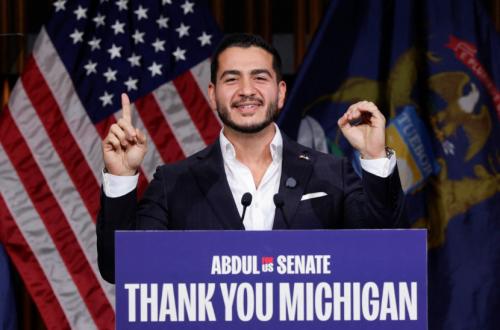
JAKARTA — Mike Rogers, the Republican candidate backed by US President Donald Trump, was defeated in Michigan’s Senate election, one of the significant results of the US midterm elections on Tuesday (3 November 2026). Abdul El-Sayed, the Democratic politician who beat Rogers, celebrated the historic victory with a pointed message about political rivalry and attacks on his religious identity.
“You chose hate; Michigan chose hope,” El-Sayed told Rogers in his victory speech in Detroit in the early hours of Wednesday (4 November 2026), local time. The remark came after months of campaigning marked by debate over the cost of living, foreign policy and allegations concerning El-Sayed’s Muslim background.
The Associated Press (AP) and Reuters projected El-Sayed as the winner of the Senate seat being vacated by Democrat Gary Peters. The result also makes the 42-year-old politician the first Muslim elected to the United States Senate.
According to AP data shown by Fox News as of 5.23pm US Eastern time on Wednesday (4 November 2026), El-Sayed had received 2,507,454 votes, or 52.50 per cent. Rogers had 2,172,586 votes, or 45.49 per cent, with about 98.19 per cent of results reported.
The pair were separated by about 334,000 votes, or seven percentage points. However, the figures were still preliminary and had not yet been certified as the final result by Michigan election authorities.
El-Sayed’s victory is a blow to Republican efforts to win Michigan’s Senate seat, which Democrats have held for decades. The result has drawn particular attention because Trump won the state in the 2024 presidential election.
Michigan Swings Away from Trump’s Victory
Michigan is one of the key battleground states in US national politics. Changes in voter preferences there are closely watched because the state brings together industrial areas, major cities, suburbs and communities with diverse social and political backgrounds.
In the November 2024 presidential election, Trump received 2,816,636 votes, or 49.73 per cent, in Michigan. Democratic candidate Kamala Harris received 2,736,533 votes, or 48.31 per cent, leaving Trump ahead by about 80,000 votes.
Two years later, the Senate candidate backed by Trump was defeated by a much wider margin. The shift shows a change in support between two different elections, although presidential and Senate results cannot be treated as votes for the same candidates.
AP’s analysis of election data found that every county in Michigan shifted towards the Democrats compared with the 2024 results. This does not mean El-Sayed won every county; rather, the Democratic vote improved compared with the previous election.
A 4 November report by Bridge Michigan identified gains in Democratic support in several urban and suburban areas. El-Sayed also performed strongly in university towns, while Rogers’ support in Detroit fell compared with his performance in the 2024 Senate election.
In Detroit, El-Sayed received about 92 per cent of the vote, according to preliminary results analysed by Bridge Michigan. That was higher than Kamala Harris’s approximately 90 per cent in the city in the presidential election two years earlier.
Rogers received only about five per cent of Detroit’s vote, down from roughly seven per cent in the 2024 Senate election. The result suggests his efforts to broaden support in Michigan’s largest city did not deliver the gains he had hoped for.
Mike Rogers Falls Short for a Second Time
Mike Rogers is no newcomer to Michigan politics or the US legislature. The 63-year-old politician previously served in the US House of Representatives, chaired its Intelligence Committee and worked as an FBI agent.
Rogers also ran for Michigan’s Senate seat in 2024, but narrowly lost to Democratic candidate Elissa Slotkin. That defeat came as Trump won Michigan in the presidential election held at the same time.
Republicans nominated Rogers again in 2026, hoping to capitalise on the open seat being vacated by Gary Peters. Trump’s backing and the Republican Party’s national network were important parts of his campaign strategy.
In this election, Rogers focused on tax cuts, strengthening domestic manufacturing and greater transparency in healthcare pricing. He also highlighted border security, immigration enforcement and his national security experience.
However, Rogers faced political challenges that were not entirely within his campaign’s control. Voter concerns about prices, trade tariffs and the effects of the US war with Iran also shaped economic debate ahead of the election.
Reuters reported that, in the run-up to voting, Rogers distanced himself from Trump over the Iran war and trade disputes with Canada. He called for both issues to be resolved, citing their impact on costs for businesses and consumers.
The strategy illustrated Rogers’ difficulty in maintaining his political relationship with Trump while addressing voter concerns about federal government policy. The president’s support was a political asset, but did not guarantee victory in Michigan’s Senate race.
After the result was projected, Rogers issued a statement acknowledging his defeat. However, according to an AP report on Wednesday afternoon, Rogers and El-Sayed had not spoken directly, despite the election having ended.
The situation differed from the 2024 election, when Rogers called Elissa Slotkin to concede on Wednesday morning, before AP had officially projected the winner. The contrast was one indication of the political tensions surrounding this year’s Michigan Senate contest.
Source: jawawa.id (https://jawawa.id/newsitem/trump-backed-candidate-defeated-as-el-sayed-says-michigan-chose-hope-1793854319)
Originally published by Republika (https://news.republika.co.id/berita/to0dyi451/jagoan-trump-keok-elsayed-michigan-memilih-harapan), translated from Indonesian