
Trump and Xi Jinping to Meet, Investors Urge Them Not to Interfere in This Matter
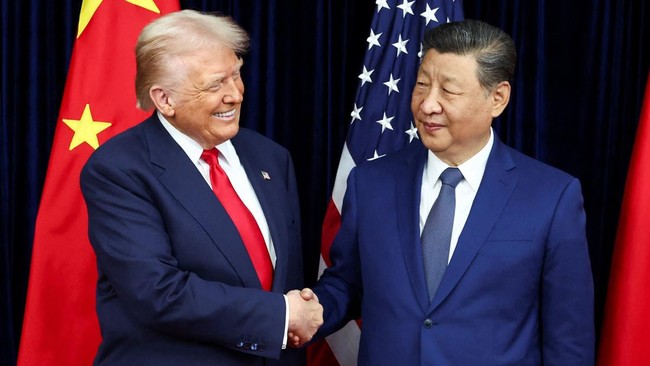
US President Donald Trump and Chinese President Xi Jinping will hold a bilateral meeting in Beijing on 13-15 May 2026. The outcome of this meeting will determine global geopolitical dynamics, considering that the US and China are the two largest economies in the world.
Investors are warning Trump and Xi Jinping to set aside trade tensions between the US and China during the meeting. Meanwhile, investors admit they are currently focused on the rapidly developing AI sector. It is hoped that Trump and Xi Jinping will not interfere too deeply in AI development business matters.
Although sensitive topics such as the US-Israel war in Iran, Taiwan, rare earth metals, and nuclear weapons may be discussed and major differences of opinion could damage market confidence, investors are currently betting on China’s technological push.
China’s benchmark Shanghai Composite Index is trading at its highest level in 11 years, and export growth continues to rise rapidly thanks to a wave of AI-driven orders.
Even the widening trade surplus does not worry fund managers about a new round of US tariffs. They have shifted their portfolios to support China’s AI self-sufficiency efforts.
“The situation has reversed. There is little that China wants to discuss with Trump,” said Yang Tingwu, deputy general manager of Tongheng Investment, quoted from Reuters on Wednesday (13/5/2026).
At the same time, the trade war and US tariff threats over the years have triggered asset price fluctuations in China. The most evident is the yuan currency, which has continued to appreciate over the past year to reach its highest peak in three years.
Although US-China tensions have persisted for years and peaked during Trump’s administration, the current situation is assessed to have softened.
Trump is making his first visit to China in nearly nine years. Previously, Trump and Xi Jinping also met in South Korea in October 2025 and agreed to a ‘truce’ in the US-China trade war.
US courts have overturned most of Trump’s initial tariff barriers. Trade data shows that Chinese goods continue to reach the US via Southeast Asia.
Along with the impact of the Iran war strengthening China’s efforts to bolster its supply chain, investors have also factored in US-China tensions and are betting that it will drive Chinese technological development.
“China has made significant progress in technology, developing a new economy, expanding its global influence, and increasing its bargaining power in global power competition,” said Wen Xunneng, founder and CEO of Zhu Liu Asset Management.
Xunneng invests in AI infrastructure and expects US-China relations to stabilise, at least until Xi Jinping makes a reciprocal visit to the US as anticipated.
“After Xi’s visit to the US, the two countries may enter the next stage of competition, but now is a relatively peaceful time,” he said.
For some investors, the fact of the meeting itself is sufficiently reassuring.
“Both sides have made efforts to meet during very difficult times. As an investor, I prefer to see that rather than total communication failure as we saw a few years ago,” said Tiffany Hsiao, portfolio manager at Matthews Asia.
However, with low expectations for major announcements, the alternative choice for most trading investors is to observe what has been moving the market, and that is the global AI boom.
Zeng Wanping, fund manager at Beijing Monolith Fund Management, said he is particularly interested in whether the US will allow more advanced Nvidia chips to be sold in China, which would pressure local producers.
“The only thing worth monitoring is developments around AI,” he said. “This is the market’s main focus, nothing else,” he added.