
Trump and Xi: A Gamble on Global Stability
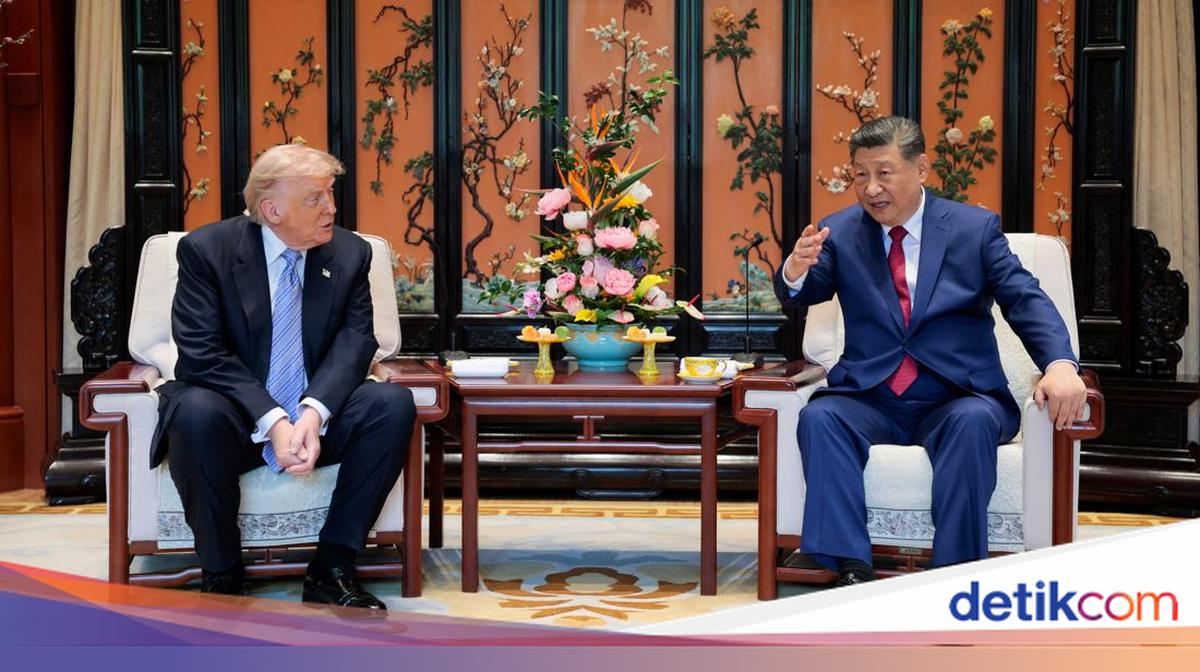
The meeting between Donald Trump and Xi Jinping has once again captured the attention of the international community amid an increasingly unstable global situation. Most of the public’s attention is still focused on the trade war, technological competition, and economic rivalry between the United States and China.
However, if examined more closely, the main substance of the meeting actually goes beyond the issue of trade tariffs or artificial intelligence competition. The world is currently facing the threat of geopolitical fragmentation, which can affect international security stability and exacerbate the global economic slowdown.
In this context, communication between Washington and Beijing is becoming increasingly important because the two countries still hold the greatest influence in the contemporary international system.
The global situation today shows that regional conflicts can quickly turn into international issues that have a broad impact on the world economy. The tensions in Iran and the Middle East are the most obvious examples of this condition.
The conflicts in the region are not only about political or regional security rivalries, but are also directly related to international energy distribution routes, global trade stability, and the sustainability of the world’s supply chain. When the security situation around the Persian Gulf escalates, the global energy market immediately reacts through rising crude oil prices, increased logistics costs, and increased uncertainty in international trade flows.
In such a situation, major countries no longer have the luxury of only thinking about narrow national interests without paying attention to the stability of the international system as a whole.
For the past few decades, the Middle East has remained one of the most sensitive points in global geopolitics. The Strait of Hormuz still plays a vital role as a route for the distribution of oil and gas in the world.
Disruptions to this route will have a direct impact on international energy distribution. Industrialized countries will face rising production costs, while developing countries will bear the burden of inflation and economic slowdown simultaneously.
Therefore, today’s Iranian conflict cannot be understood as just an ordinary regional conflict. The conflict has a global strategic dimension because it is directly related to international energy security. In this condition, the role of the United States and China is very important because both countries have the same large economic and security interests in the stability of the Middle East.
The United States certainly does not want a prolonged conflict because the increasing escalation will increase Washington’s own geopolitical and economic costs. The Trump administration understands that excessive involvement in conflict in the Middle East can drain the United States’ political and economic energy in the face of increasingly expensive strategic competition with China.
At the same time, China also has no interest in instability in the region. Beijing is still very dependent on energy imports from the Middle East to support its national industrial needs. If the conflict continues to spread, China will face threats to its energy security as well as pressure on its own economic growth.
Thus, both the United States and China actually have the same objective need to ensure that the conflict in Iran does not develop into a larger regional war.
This is where the Trump and Xi meeting becomes very strategic. The meeting cannot be understood as just a symbol of ordinary bilateral diplomacy. The world today needs intensive communication between the two largest global powers so that geopolitical rivalry does not turn into uncontrolled international chaos. The question is not whether Washington and Beijing have ended their rivalry.
The rivalry between the two countries continues and is even intensifying in various strategic areas. Competition in the development of artificial intelligence, the semiconductor industry, the control of digital data, the dominance of the technology supply chain, to the issue of Taiwan are still the main points of tension in the relationship between the two countries.
However, both the United States and China seem to be starting to understand that competition without a management mechanism will actually harm the long-term interests of each country.
In international relations studies, this condition is often understood as a form of managed rivalry. Major countries continue to compete to maintain their geopolitical influence and national interests, but at the same time still open up communication to prevent open conflict that can destroy the international system.
This situation occurred during the Cold War when the United States and the Soviet Union maintained diplomatic communication channels even though they were in a very sharp ideological and military rivalry. The difference is that the rivalry between the United States and China today takes place in a much more integrated global economic situation.
The economic interdependence of the two countries makes global stability a shared need. A major economic disruption on one side will immediately have a domino effect on the other.
Therefore, trade and economic issues remain an important agenda in the Trump and Xi meeting. The global economic slowdown that has occurred in recent years has put serious pressure on many countries. The Covid-19 pandemic has left the problem of the supply chain that has not fully recovered. The Russia-Ukraine conflict has caused disruptions in the distribution of food and energy internationally.
Now, tensions in Iran are again increasing uncertainty.