
Trump Advisers Suggest Iran War Could Persist Until 2029
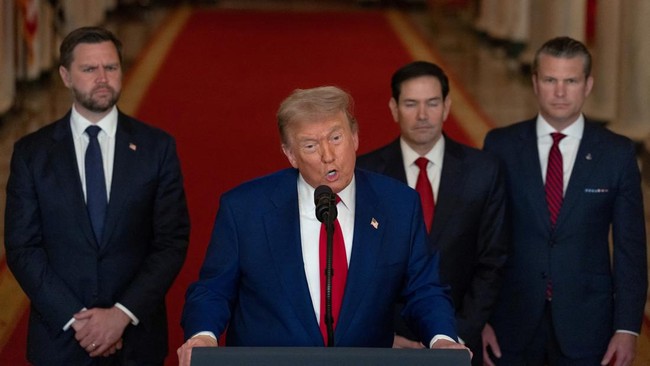
White House advisers and President Trump’s cabinet members have indicated that the war with Iran could continue until the end of his term in 2029. This stance directly contradicts Trump’s public assurances of a rapid victory.
Advisers and ministers, including Vice President JD Vance, Secretary of State Marco Rubio, and several others, have discussed with the President that Tehran may continue to resist US pressure through blockades and other military tactics, potentially extending the conflict past the inauguration of a new president in January 2029.
These officials stated that such discussions took place behind closed doors after Trump told reporters that the war would end “soon” following the midterm elections in November, claiming that “Iran cannot hold out any longer.”
A multi-year conflict would strain military resources and risks causing long-term disruptions to global oil markets ahead of the 2028 US presidential election. Both Vance and Rubio are considered potential presidential candidates, although neither has declared an intention to run.
Trump, who returned to power vowing not to engage in “forever wars” in the Middle East, stated he is not concerned about the political hurdles his party faces, even if the war impacts crude oil prices. Average petrol prices reached $4.22 per gallon on Wednesday, according to AAA, up from $4.01 a month ago and $3.19 a year ago.
Trump frequently speaks privately with his aides about his desire to quickly end the seven-month conflict, which has claimed the lives of 18 military personnel. However, Trump also supports a long-term economic siege, utilising naval blockades and sanctions in an effort to force the regime to dismantle its nuclear programme.
Treasury Secretary Scott Bessent described this new strategy—dubbed “Operation Economic Isolation”—as an alternative to large-scale combat operations.
“President Trump has crushed Iran’s military capability and crippled its failing economy with the strongest naval blockade in world history and devastating sanctions. Only President Trump knows what he will do and when,” White House spokesperson Olivia Wales was quoted as saying by WSJ.com on Sunday (13/9/2026).
Personal admissions from key aides that the military conflict could drag on for years contradict Trump’s assurances that the US has defeated Iranian forces and that the regime will surrender shortly. Last week, Vance told reporters that he would not refer to the current military conflict as a “war,” despite the ongoing blockade and periodic attacks.
Vance added that he was unsure when hostilities would end, refusing to provide an “artificial timeline” that Iran could exploit.
“It would be irresponsible to formulate our strategy and schedule for an Iranian nation that is completely unable to respect its commitments and cannot stop firing at merchant ships,” said Vance.
Iran has responded to the US-led pressure campaign with missile attacks as a form of protest, indicating that periodic military clashes in the Strait of Hormuz will be difficult to avoid. On Tuesday, the US destroyed five Iranian tankers after Tehran targeted several US military vessels. All attacks failed, though officials described some as near misses.
Defence Secretary Pete Hegseth has extended several troop deployments in the Middle East until 2027, as reported by The Wall Street Journal, providing Trump with military options as the conflict continues.
The Pentagon plans to extend the deployment of several air defence units in the Middle East without a definite end date, according to officials familiar with the matter. These units, part of approximately 50,000 troops deployed to the region, are spread across the Gulf to intercept missiles and drones.
A US official stated that the 3rd Marine Expeditionary Unit is preparing for deployment to the region this autumn, signalling a continuous rotation of amphibious units operating from a group of warships. The 31st Marine Expeditionary Unit arrived in the region in March and was replaced by the 11th Marine Expeditionary Unit in June.
The Pentagon is also rotating Air Force fighter squadrons in the region, with Air National Guard F-16 aircraft replacing fighters that have returned to their bases in Aviano, Italy.
Analysts suggest it is logical that the Trump administration is preparing for a protracted struggle. One consequence of a multi-year blockade and military presence in the Middle East is the diversion of resources from Europe and Asia. US officials are also increasingly concerned about the regime’s ability to adapt its attacks and rebuild its supplies of missiles, drones, radar, and other military equipment.