
Trisakti University's PKM Introduces SI-KASEP App to Control Tuberculosis in Badui Community
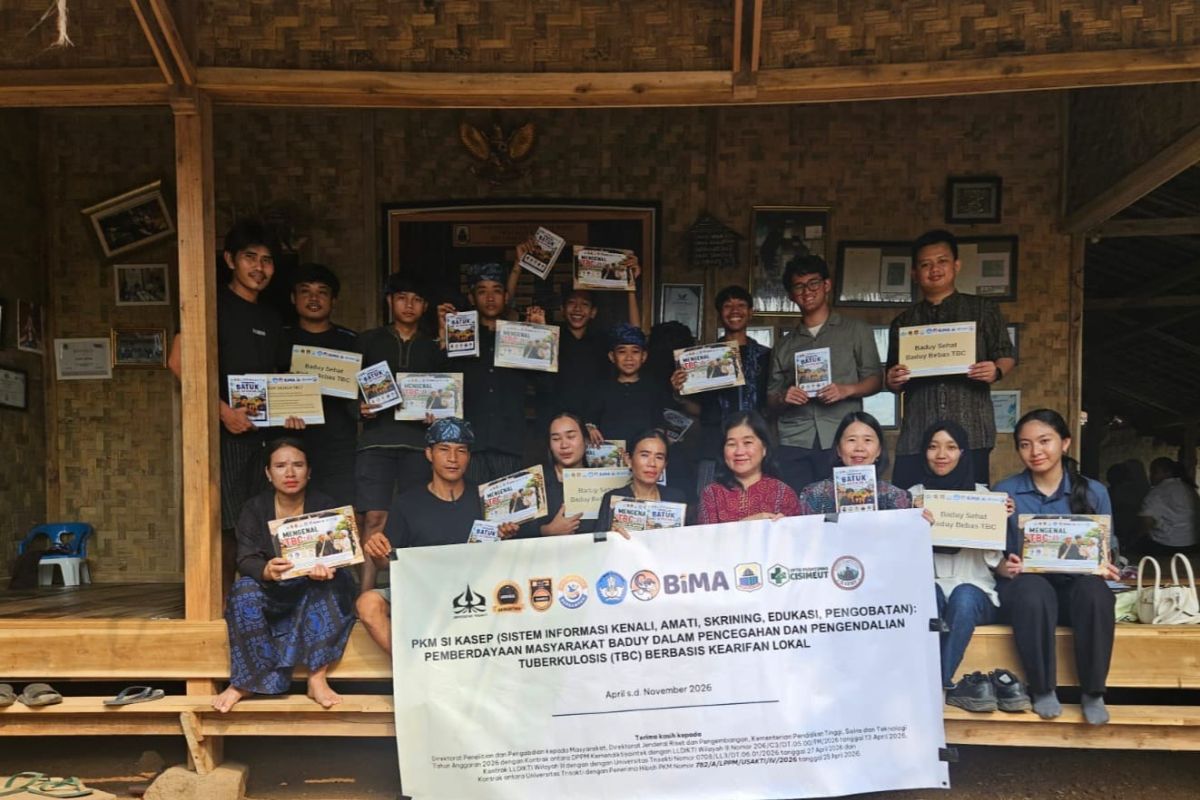
Lebak (ANTARA) - The Community Service Team (PKM) of the Faculty of Medicine, Trisakti University (Usakti) Jakarta has introduced a digital innovation called SI-KASEP (Information System – Recognise, Observe, Screen, Educate, and Treat) to improve early detection and control of Tuberculosis (TBC) among the Badui community in Lebak Regency, Banten.
The Head of the Trisakti University PKM, Dr Purnamawati Tjhin, M.Pd.Ked, explained in a statement in Lebak on Friday that the development of SI-KASEP does not merely present digital technology, but also integrates community empowerment approaches and local wisdom.
She said the team recognises that health interventions in indigenous communities require a different approach.
“Technology must be present as a simple tool that is easy to understand and still respects the values and habits of the local community. Therefore, SI-KASEP is designed not only as an application, but as part of the process of empowering the community and health cadres,” said Purnamawati.
The SI-KASEP application is an innovation developed to address the challenges of TB control in indigenous areas, particularly regarding limited access to health information, regular health examinations, early detection, and treatment monitoring.
Through SI-KASEP, she said, the community and health cadres are encouraged to be more active in recognising TB symptoms, monitoring health conditions, obtaining initial screening, receiving easily understood education, and getting assistance in completing treatment.
The five pillars of SI-KASEP were developed with an integrated staged approach, namely Recognise, Observe, Screen, Educate, and Treat.
Recognise is the initial stage to improve the community’s ability to identify the signs and symptoms of TB.
Furthermore, the Education stage is delivered in simple language so that the community can understand when someone should be suspected of having TB and requires further examination.
In the Observe stage, the community is encouraged to routinely monitor their own health condition and that of family members.
This is because the information from monitoring results can serve as a basis for determining screening needs, which is an important part of efforts to find TB cases as early as possible.
The screening process can be carried out with the support of the application and assistance from cadres and health workers, so that people with symptoms or risk factors can be directed to obtain further examination at health service facilities.
In the Education stage, SI-KASEP provides health information about TB using more engaging and easily understood media, including image- and video-based materials.
Education also emphasises the importance of preventing transmission and adherence to treatment.
Meanwhile, the Treatment stage is directed at supporting patients who have been diagnosed with TB to undergo therapy as recommended by health workers until completion. This assistance is expected to help improve treatment success rates while preventing transmission and the emergence of drug resistance.
Purnamawati said the Usakti PKM team not only introduced the application to the community, but also provided education and assistance to health cadres.
Cadres play an important role as a link between the community, health programmes, and health service facilities.
This approach is expected to improve the sustainability of the programme because health cadres are part of the community who understand local social and cultural conditions.
“We want cadres not only to be application users, but also to become community mobilisers. Thus, the technology developed can truly be used in daily life and become part of the community health monitoring system,” added Dr Purnamawati.
She noted that the presence of the SI-KASEP innovation has received a positive response from the community, health cadres, and officials of the Kanekes Traditional Village.
The digital approach combined with direct education is considered helpful in simplifying information about TB and increasing community awareness of the importance of early detection.
A representative of the indigenous community expressed appreciation for the programme implemented by the Usakti PKM team.
“This programme is good because it helps the community understand TB disease in a simple way that suits the conditions of the residents. If the symptoms can be recognised more quickly, the community can also immediately obtain examination and treatment,” he said.
The SI-KASEP programme is part of the Community Service activities of the Faculty of Medicine, Trisakti University, implemented with the support of the Directorate of Research and Community Service (DPPM) of Trisakti University and through the Community Service Grant scheme of the Directorate General of Higher Education, Research, and Technology (DIKTI/Kemdiktisaintek).
Through this programme, Usakti not only carries out its educational and research functions, but also seeks to present innovations that provide direct benefits to the community.
Going forward, SI-KASEP is expected to continue to be developed and integrated with local health services, including coordination with community health centres and health cadres.
Sustainable development is also expected to make SI-KASEP a model for digitalising TB control based on indigenous communities that can be replicated in other areas with similar characteristics.
“We hope SI-KASEP does not stop as an application or a community service activity in one period. We want this innovation to continue to be used, developed, and provide real benefits to the community. Ultimately, technology must be able to bring health services closer to the community, including communities living in areas with special geographical and socio-cultural characteristics,” concluded Dr Purnamawati.
Through synergy between universities, indigenous communities, health cadres, and health service facilities, this programme is expected to strengthen early case finding, prevention of transmission, treatment adherence, and improvement of community health literacy, so that the goal of realising a healthier and TB-free Badui community can be achieved.
Source: jawawa.id (https://jawawa.id/newsitem/trisakti-universitys-pkm-introduces-si-kasep-app-to-control-tuberculosis-in-badui-community-1786683303)
Originally published by Antara (Indonesian) (https://www.antaranews.com/berita/5693808/pkm-usakti-hadirkan-aplikasi-si-kasep-kendalikan-tbc-di-badui), translated from Indonesian