
Trisakti Institute of Tourism Prepares Hospitality Students for Industry Needs
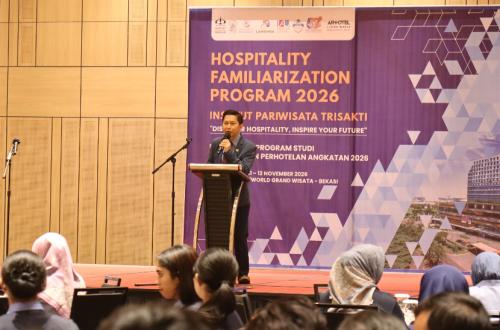
BEKASI – The hotel industry needs workers who not only have service skills, but also understand technology, communicate effectively, work well with others and adapt to change. Trisakti Institute of Tourism (IP Trisakti) is preparing students on its Hospitality Management programme to meet these needs through learning linked directly to industry practice from the start of their studies.
One such learning initiative is the Hospitality Familiarization 2026 programme, held on 11–12 November 2026 at Artotel Living World Grand Wisata in Bekasi. New students had the opportunity to learn about service standards, hotel operating systems and the division of responsibilities across departments through direct interaction with industry practitioners.
Agus Riyadi, IP Trisakti’s Vice-Rector for Academic and Student Affairs, said early exposure to the industry was important for developing three core student competencies: knowledge, skills and professional attitudes.
“Make the most of this opportunity to ask practitioners directly, from front office, kitchen, pastry and housekeeping to finance. Ask about operational matters, because this is your laboratory,” Agus said in a press release on Thursday (12 November 2026).
Agus said direct interaction with practitioners helped students understand the application of operating standards, service processes and the role of each department in making guests comfortable. Technical abilities also needed to be matched by friendliness, discipline and professionalism to build customer satisfaction and loyalty.
Amrullah, Dean of IP Trisakti’s Faculty of Vocational Studies, said connecting campus learning with industry was an important part of vocational education. First-hand experience enabled students to understand workplace needs and challenges before beginning work placements.
“New students interact with the real industry straight away, giving them a clear picture of the hotel sector. They do not just hear about it from lecturers; they also see and interact directly with practitioners in the workplace,” he said.
Amrullah explained that hotel operations involved many departments with different functions and responsibilities. All of them had to work in coordination to ensure good service for guests.
For example, a hotel room could not be sold until housekeeping staff had confirmed it was clean. Front-office services also required coordination with other departments, including administration and finance.
“Through this experience, students are expected to understand that working in the hotel industry is not simply about handling check-ins and check-outs. It also requires communication skills, teamwork and accuracy in resolving problems,” he said.
Alongside technical skills, students also needed to master service quality. This included welcoming guests, handling complaints and providing solutions while taking customer satisfaction into account.
“Students need to learn problem-solving: how to handle complaints, offer solutions and ensure guests still have a good experience. All of this needs to be understood from the outset,” Amrullah said.
As part of the Hospitality Familiarization programme, students received briefings from managers and staff across a range of departments, including food and beverage, human resources, front office, kitchen, pastry, housekeeping, finance, sales and marketing, and security.
Students were also assigned to produce a video report on the programme for publication on YouTube. The hotel can use the students’ work as material for its social media channels.
Amrullah said the industry introduction was the first stage in a series of learning activities. As their studies progressed, students would take part in industry visits, guest lectures with practitioners and hotel general managers, and preparation for and participation in work-placement or training programmes.
“Thanks to the network developed by IP Trisakti, students have opportunities to undertake training at hotels both in Indonesia and overseas. Training is arranged according to students’ interests and readiness,” he said.
According to Amrullah, the growth of Indonesia’s hotel business was creating career opportunities for professional workers. He said Indonesia had 4,790 star-rated hotels in 2025.
“The growth of the hotel business in Indonesia is accompanied by increasingly high demands for professionalism. The industry needs workers who are not only skilled in service, but also understand technology, communicate well, are creative and adapt to change,” he said.
Robiatul Adawiyah, head of IP Trisakti’s Applied Bachelor’s Degree programme in Hospitality Management, said Hospitality Familiarization 2026 was designed to introduce students directly to the industry. The programme aims to improve their competencies and professionalism so they can become outstanding, adaptable graduates who can compete globally.
Through this series of learning activities, IP Trisakti is preparing students not only to enter the workforce, but also to develop into hotel managers, entrepreneurs and professionals in the hospitality industry.
Source: jawawa.id (https://jawawa.id/newsitem/trisakti-institute-of-tourism-prepares-hospitality-students-for-industry-needs-1794502275)
Originally published by Republika (https://news.republika.co.id/berita/toeb22416/ip-trisakti-siapkan-mahasiswa-perhotelan-hadapi-kebutuhan-industri), translated from Indonesian