
Trenggono's Three Major Breakthroughs: From Salt to Vessels and Fishing Villages
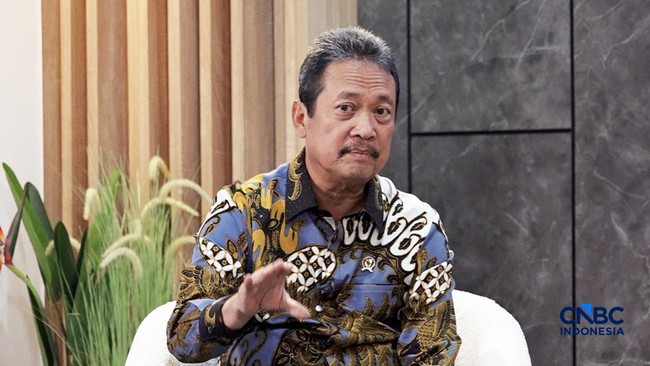
The Indonesian government, through the Ministry of Marine Affairs and Fisheries (KKP) under Sakti Wahyu Trenggono, is implementing several breakthroughs in the marine and fisheries sector. This is intended to ensure that the marine and fisheries sector can become a primary pillar of Indonesia’s future economic growth.
There are three major breakthroughs currently being undertaken by Trenggono: the construction of massive salt ponds in Rote Ndao, East Nusa and Nusa Tenggara (NTT) to achieve salt self-sufficiency, the modernisation of fishing vessels, and the development of the ‘Kampung Nelayan Merah Putih’ (Red and White Fishing Village).
Massive K-SIGN Salt Ponds in Rote Ndao, NTT
The government has set a target to completely halt both industrial and consumer salt imports by 2029. This bold step is being taken as the government has established massive salt ponds in East Nusa Tenggara (NTT).
The first phase of the National Salt Industry Centre Area (KSIGN) development in Rote Ndao Regency, NTT, covering 616 hectares, has been completed. According to the plan, KSIGN Rote Ndao is scheduled for its first harvest in November 2026.
“The KKP is currently conducting production trials on the 616-hectare area that has been completed, with a target for the first harvest in November 2026,” said the Head of the Government Communication Agency (BAKOM), Muhammad Qodari, at the BAKOM office on Wednesday (2/9/2026).
Qodari explained that the total area for the salt industry centre to be developed covers 10,764 hectares in NTT. Approximately 2,000 hectares are being developed through a community-government partnership scheme, while the remaining 8,000 hectares are being developed through direct investment schemes.
Through this programme, the government also targets a gradual increase in national salt production to 2.5 million tonnes in 2026, from a baseline of 1 million tonnes. This is expected to rise to 3.5 million tonnes in 2027 and 5 million tonnes by 2029. The government aims for salt self-sufficiency by 2029, meaning imports will no longer be necessary.
“In line with this, salt import volumes are targeted to decrease from a baseline of approximately 2.6 million tonnes to 2 million tonnes in 2026, 1 million tonnes in 2027, and reaching zero by 2029,” said Qodari.
KKP has a new salt production centre, K-SIGN, in Rote Ndao, NTT. This massive pond has an NaCl purity level of up to 97%. With this standard, Rote Ndao salt is considered suitable for industrial needs, even though the refining plant facilities have not yet been fully constructed.
K-SIGN is designed as a modern salt industry facility, not just building ponds and physical infrastructure, but ensuring the production process can yield industrial-standard salt from the start. For the initial stage, industrial salt production at K-SIGN will be carried out directly from the ponds with quality control. Meanwhile, advanced facilities such as washing plants and refineries are being prepared as part of the area’s development.
Modernisation of Fishing Vessels
The government is preparing a fishing vessel modernisation programme. The plan is to build 4,582 modern fishing vessels gradually until 2029.
Qodari stated that in 2026, the government targets the construction of 50 vessels with a capacity of 30 Gross Tonnage (GT). The categories of vessels to be built include 11 general categories with a total of 43 variations of GT criteria ranging from 10 to 2,500 GT. These include Ring Nets, Gillnets, Handlines, Longlines, Trawls, Shrimp Trawls, Lift Nets, Traps, Transport Vessels, Processing Vessels, and operational support vessels.
The investment required for the construction of 4,582 vessels from 2026 to 2029 reaches IDR 125.5 trillion.
“The construction of these modern fishing vessels requires an investment of approximately IDR 125.5 trillion. The Ministry of Marine Affairs and Fisheries (KKP) is involving the domestic shipbuilding industry in this construction,” said Qodari.
According to Qodari, this vessel construction is expected to stimulate the domestic economy, create jobs, and encourage technology transfer from abroad to Indonesia.
He hopes this programme can result in the absorption of up to 89,000 workers, including vessel operators, administrators, and vessel document managers. Of that number, 55,000 will fulfil the needs of vessel crews, such as captains, officers, chief engineers, and crew members.
Through this programme, the government also targets an increase in capture fisheries production to 2.3 million tonnes per year, an increase in fishermen’s income by IDR 20.7 trillion, and an increase in Non-Tax State Revenue (PNBP) from the fisheries natural resources sector by IDR 1.8 trillion.
Red and White Fishing Village (KNMP)
KKP has a major programme to improve the welfare of coastal communities through the development of the ‘Kampung Nelayan Merah Putih’ (KNMP). This programme is part of the blue economy implementation strategy, which combines production, social, and environmental aspects.
KNMP is supported by cold chain facilities (cold storage), logistics, and vessel workshops. It will also feature ice factories, vessel berths, culinary centres, vessel fuel stations, and tourist parks.
This programme does not only target increased production but also the formation of new economic hubs in coastal areas. KKP targets the development of 1,389 locations, with 100 sites set to be inaugurated in the near future, promising significant production impacts.
Through this new approach, the government aims to transform the face of the coastal economy to be more productive and self-sufficient.
The concept for developing fishing villages will not be uniform. Each region will be adjusted to local characteristics and environmental carrying capacity. A thematic approach is key to ensuring that development does not damage existing ecosystems.
Through this strategy, the government hopes to create a new economic ecosystem that is more inclusive and sustainable in Indonesia’s coastal regions.
Source: jawawa.id (https://jawawa.id/newsitem/trenggonos-three-major-breakthroughs-from-salt-to-vessels-and-fishing-villages-1788425887)
Originally published by CNBC Indonesia (https://www.cnbcindonesia.com/news/20260903145213-4-764687/3-gebrakan-besar-trenggono-dari-garam-kapal-sampai-kampung-nelayan), translated from Indonesian