
Trenggono at AT ONE Impact Week: Indonesia Urges Global Ocean Commitments to Turn into Action
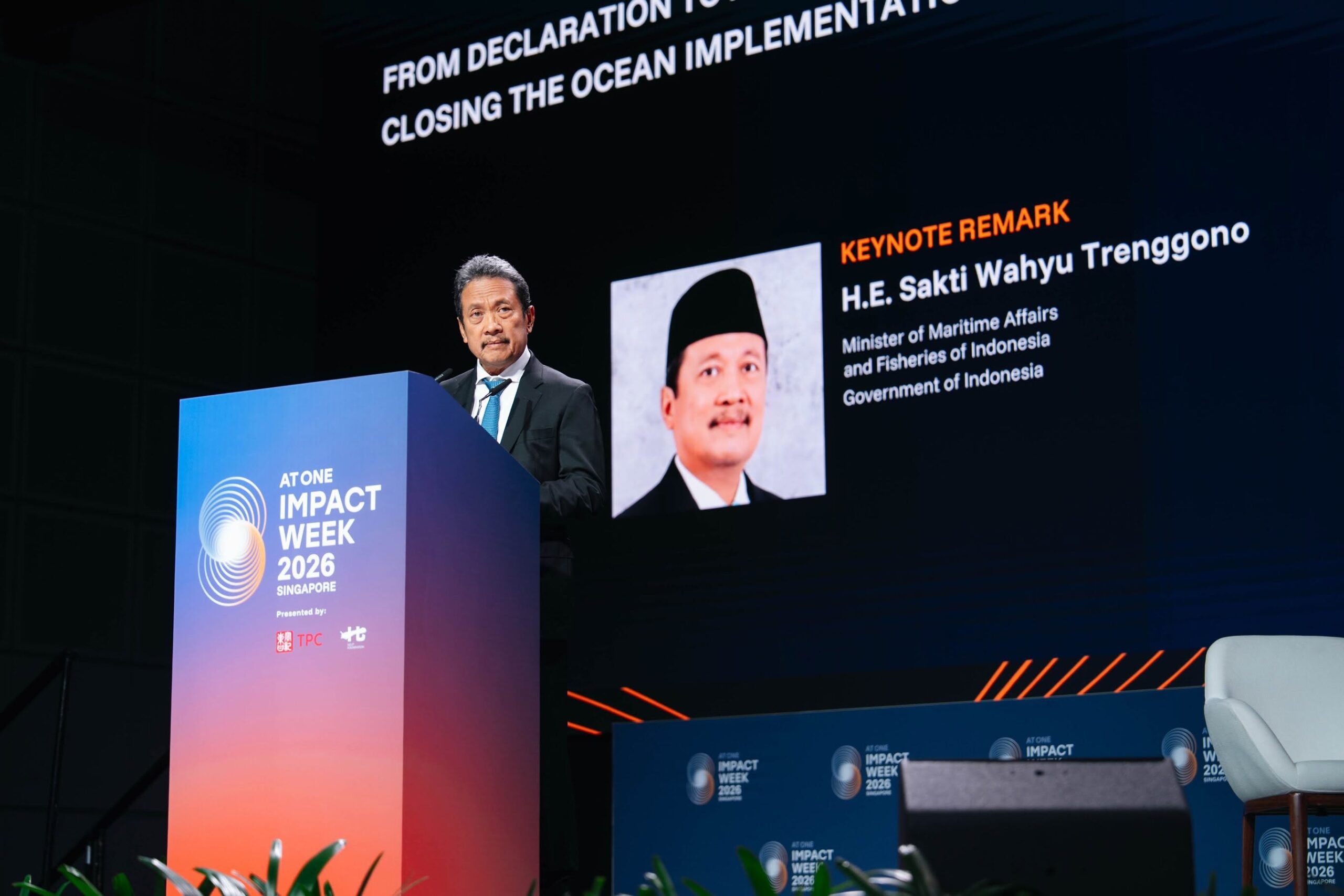
SINGAPORE, 12 September 2026 — The Minister of Marine Affairs and Fisheries of the Republic of Indonesia, Sakti Wahyu Trenggono, has emphasised the importance of transforming global commitments to ocean sustainability into real action that impacts ecosystems while simultaneously improving the welfare of coastal communities.
Trenggono shared these views during his participation in the AT ONE Impact Week 2026 in Singapore, held from 8–12 September 2026. The forum brings together leaders from government, business, investment, policy, science, and various change-making groups to build an economy oriented towards prosperity and sustainability.
The Ocean Ecosystem is one of the four transformative ecosystems that form the primary framework of the agenda.
During the forum, Trenggono was honoured as one of the “Impact Architects” for the Ocean Ecosystem, alongside global leaders and stakeholders driving new ideas and actions for marine sustainability and blue economy development.
For Indonesia, Trenggono asserted that the sea cannot be viewed merely as an economic resource. The ocean is a vital part of the national identity and a living space for communities that have, for generations, relied on coastal and marine resources for their livelihoods, food, and future.
“For the Indonesian nation, the sea is not just a resource, but an identity,” Trenggono remarked in his reflection on Indonesia’s involvement in the global forum.
This position aligns strongly with the policy direction of the Ministry of Marine Affairs and Fisheries (KKP). In the 2026 development policy, the blue economy is placed as the main pillar for the development of the marine and fisheries sector, balancing the utilisation of marine resources with ecosystem preservation.
The five main agendas include the expansion of marine protected areas, quota-based measurable fishing, the development of sustainable aquaculture, the supervision of coastal areas and small islands, and the reduction of marine debris through fisherman participation.
Therefore, according to Treudgono, protecting the ocean does not end with a conservation agenda. Ecosystem protection must go hand-in-hand with human development agendas, the strengthening of coastal economies, increased productivity, and the creation of prosperity for communities whose lives depend on the sea.
This view is consistent with the KKP approach, which positions coastal communities not merely as beneficiaries, but as essential participants in the implementation of the blue economy. The KKP emphasises that marine conservation must be conducted in an inclusive, participatory, and equitable manner, so that ecosystem protection simultaneously opens opportunities for economic improvement for coastal populations.
In this context, Indonesia’s blue economy is directed towards bridging two interests that have often been pitted against each other: the need to maintain ecosystem health and the need to increase community welfare. For Trenggono, these are not opposing choices, but two goals that must be achieved simultaneously.
“Protecting the sea means protecting the source of life and increasing the welfare of the communities that depend on the sea,” was the core message brought by the Minister during discussions regarding the future of the marine economy.
The Ocean Ecosystem agenda at AT ONE Impact Week demonstrates that global discussions regarding the ocean are moving far beyond conventional conservation approaches.
The programme includes discussions on marine innovation, blue finance, regenerative business, coastal communities, and ways to accelerate the transformation of ideas into implementation. One agenda specifically addresses Regenerative Blue Enterprises, a business model that seeks to restore marine ecosystems while strengthening coastal communities and local economies.
For Indonesia, such dialogue spaces are vital because marine economic strength is determined not only by the extent of maritime territory but also by the ability to integratedly manage ecosystems, resources, technology, investment, institutions, and communities.
On several previous occasions, Trenggono has voiced similar ideas in international forums. At the World Economic Forum 2026 in Davos, for instance, he called for the collective restoration of marine ecosystems in the face of threats such as climate change, pollution, ocean warming, acidification, declining fish stocks, and illegal fishing practices. He emphasised that Indonesia, with its blue economy agenda, is ready to contribute to global efforts to protect marine ecosystems.
This commitment has been translated into various national policy instruments. In June 2026, the KKP, together with the World Resources Institute Indonesia, introduced the Ocean Calculator, a geospatial platform designed to calculate the economic value of marine and coastal ecosystems, including mangroves, seagrass, and coral reefs. This instrument is expected to strengthen data-driven decision-making and demonstrate the link between ecosystem health, blue carbon, coastal protection, and community livelihoods.
At the community development level, the government is also developing various programmes aimed at increasing productivity and coastal welfare. The ‘Kampung Nelayan Merim Putih’ (Red and White Fishing Village) programme, for example, is directed towards strengthening production facilities, economic activities, and the quality of life for fishing communities, ensuring that coastal areas are not just places to live, but centres of new economic growth.
Source: jawawa.id (https://jawawa.id/newsitem/trenggono-at-at-one-impact-week-indonesia-urges-global-ocean-commitments-to-turn-into-action-1789318257)
Originally published by pelakita.id (https://pelakita.id/2026/09/13/trenggono-di-at-one-impact-week-indonesia-dorong-komitmen-laut-menjadi-aksi-dan-dampak-nyata/), translated from Indonesian