
Trekking Cibaliung: From Dry Inclines to the Murmur of Water
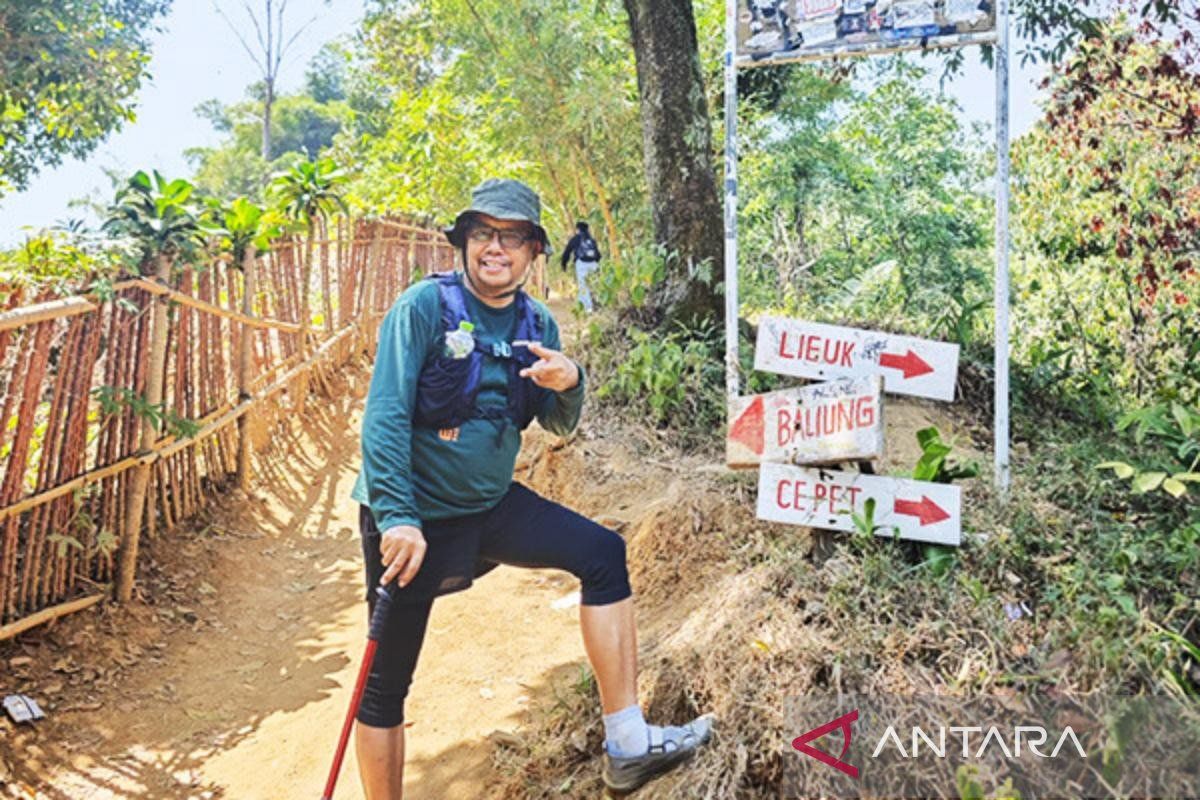
In the mountains and forests, we take it for granted that paths must twist, climb, descend, turn rocky or dusty, sometimes become busy and then grow quiet again.
Jakarta (ANTARA) — “In every walk with nature, one receives far more than he seeks.” — John Muir (1838–1914), American naturalist and writer.
This time, my journey was a trip: a trek in Cibaliung on the morning of Saturday, 5 September. It was not a high-mountain climb, but neither was it a leisurely walk in a park.
Cibaliung is in Karang Tengah Village, Babakan Madang sub-district, Bogor Regency, a hilly area whose village sits at about 529 metres above sea level. That figure describes the area, not the precise elevation of Curug Cibaliung.
The character of the trek is shaped by inclines, dirt and rocky paths, gardens, forest, rivers, pools and waterfalls. The medium-grade route in the Leuwi Hejo–Cibaliung area is typically around six to seven kilometres return, linking places such as Leuwi Hejo, Benjol, Barong, Ceupet, Lieuk, Lengsa and Cibaliung. On paper, it sounds moderate. On foot, it is another story.
At 7.10 am, we arrived at JungleLand, our first meeting point with our guide, Egi. Before our trekking shoes had really come into their own, the journey had already provided an opening act. After only about five minutes in the car on the way to the base camp, traffic came to a standstill. The small asphalt road was narrow but two-way. Private cars, motorbikes and even lorries had to share the space.
The first traffic jam lasted about seven minutes. Once it cleared, the road began to rise and fall with the contours of the hills. Houses and buildings gradually gave way to forest and gardens. A thin mist hung over the ridges. Not long afterwards, we queued again for about five minutes on an uphill stretch of damaged, potholed asphalt.
Ahead of us were around five pick-up trucks carrying trekkers. We had not yet reached the forest, but the weekend tourism atmosphere was already in evidence.
Tourism signs appeared along the way: campsites, Curug Mutiara, Gunung Keramat, glamping, trekking and family gatherings.
The hills of Karang Tengah are evidently no longer a quiet place known only to local residents. They are developing into a nature-tourism corridor, with small businesses growing around them. But the roads have not entirely kept pace with that growth. Tourist cars, open-back transport vehicles, residents’ motorbikes and lorries all have to negotiate the same village road.
After the ticket office, we arrived at the base camp. At 8.29 am, before setting off, Egi led us in prayer.
Then came the section that quickly challenged our assumptions about what a ‘medium’ trek meant: for almost the first hour, the climbs seemed never-ending.
Inclines, dust and the rhythm of breathing
It was the dry season. September was sunny. The ground was dry and hard, and dusty in some places. Our shoes trod on a mixture of compacted earth, gravel, protruding rocks and roots. At times the path was quite narrow along the slope.
I could not place my feet carelessly. Every so often, I had to stop for a fraction of a second to choose a foothold, shift my weight and then continue. My breathing began to find its own rhythm: breathe in, breathe out, step. Breathe in, breathe out, step again. Rhythmic.
At one point, a sign warned of landslides and falling trees. Not far beyond it, a distance marker read: Leuwi Ceupet about 1.5 kilometres, Leuwi Lieuk two kilometres and Cibaliung about 3.3 kilometres.
There was still a long way to go. Strangely, that was precisely when the trek began to feel enjoyable.
The route on either side was not uniform forest. It was like a botanical corridor whose appearance changed every few dozen metres. We passed durian, avocado, jackfruit, bamboo, banana plants, shrubs and climbing vines.
There was a type of durian that locals call ‘Duren Salak’. I was curious. Why salak? They said it was not because it tasted like salak, but because its seeds were small, like salak seeds.
Egi also occasionally switched from trekking guide to impromptu botany teacher. He pointed out bilimbi, or belimbing wuluh; sintrong leaves, commonly eaten as fresh vegetables; and a fruit he called a berry.
We also passed through coffee-growing country. This was not merely tourist decoration. The Ministry of Agriculture has documented Karang Tengah as an area where robusta coffee is cultivated, and Babakan Madang has community-managed robusta plantations. The signboard there confirmed it.
When the forest lowers its volume
Source: jawawa.id (https://jawawa.id/newsitem/trekking-cibaliung-from-dry-inclines-to-the-murmur-of-water-1794034345)
Originally published by Antara (Indonesian) (https://www.antaranews.com/berita/5838183/treking-cibaliung-dari-tanjakan-kering-ke-gemericik-air), translated from Indonesian