
'Treasure' Discovered Beneath Mount Tangkuban Parahu
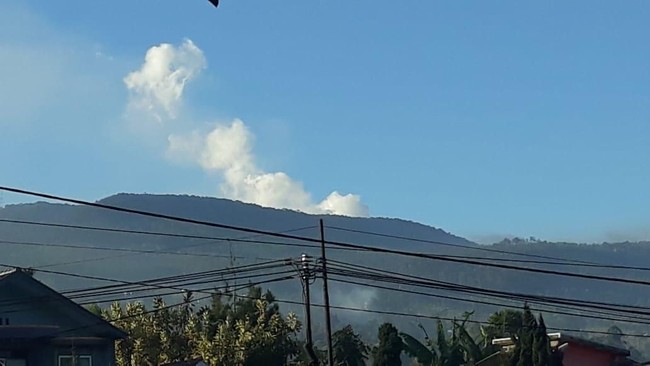
The National Research and Innovation Agency (BRIN) has revealed the dynamics of the hydrothermal and magmatic-gas systems beneath Mount Tangkuban Parahu, which are linked to phreatic eruption activities. This was presented by Syahreza Saidina Angkasa, a Junior Expert Researcher at BRIN’s Geological Resource Research Centre, during the DIGDAYA #25 Studium Generale at Padjadjaran University (UNPAD) held on Wednesday (26/8).
Syahreza provided an in-depth analysis of the characteristics of the underground hydrothermal and magmatic-gas systems at Mount Tangkuban Parahu. The joint research between BRIN, UNPAD, and Akita University observed the composition of tephra layers and changes in mineral types resulting from volcanic eruptions.
“Phreatic eruptions (hot steam) at Tangkuban Parahu disperse material up to a 1.5-kilometre radius from the crater. This rock material undergoes colour changes to grey, rust red, or even transforms into fine clay, with deposit temperatures reaching up to 400 degrees Celsius,” said Syahreza, as quoted on Saturday (5/9/2026).
Furthermore, Syahreza explained that the research successfully identified various important minerals, including quartz, cristobalite, opal, and alunite, as well as the first discovery of the mineral jarosite in the rocks of Mount Tangkuban Parahu. Based on sulphur content examinations, it was found that the temperature of the hot water underground ranges between 200 and 240 degrees Celsius, driven by the interaction between the hydrothermal system and gases originating from within the magma.
“There are three main possible causes for eruptions at Tangkuban Parahu: pure steam eruptions, eruptions caused by magmatic gas pressure mixing with groundwater, and eruptions due to gas accumulation trapped beneath the lava dome. Understanding these patterns is vital for predicting and reducing the risks of volcanic eruptions in the future,” he explained.
The Head of BRIN’s Geological Resource Research Centre, Iwan Setiawan, stated that BRIN offers various facilities and programmes open to anyone wishing to study and develop earth sciences. “We have many schemes available for all students here. I invite all students and academics to join BRIN’s internship programmes. This research partnership is expected to drive progress in earth sciences that impacts sustainable development,” he clarified.
The Dean of the Faculty of Geological Engineering at Padjadjaran University, Boy Yoseph Cahya Sunan Sakti Syah Alam, also expressed his satisfaction with this collaboration. He noted that Indonesia’s natural character is incredibly rich and dynamic, and studying it can provide new perspectives on understanding Earth’s transformative processes.
“Geological understanding never truly stops at a single point. New challenges, technologies, and analytical methods can provide new interpretations of the processes we previously observed. The cooperation between UNPAD and BRIN is an important step in advancing earth science research while mentoring young researchers,” said Boy.