
Transport Ministry begins deliberating National Transport System Bill to strengthen transport integration
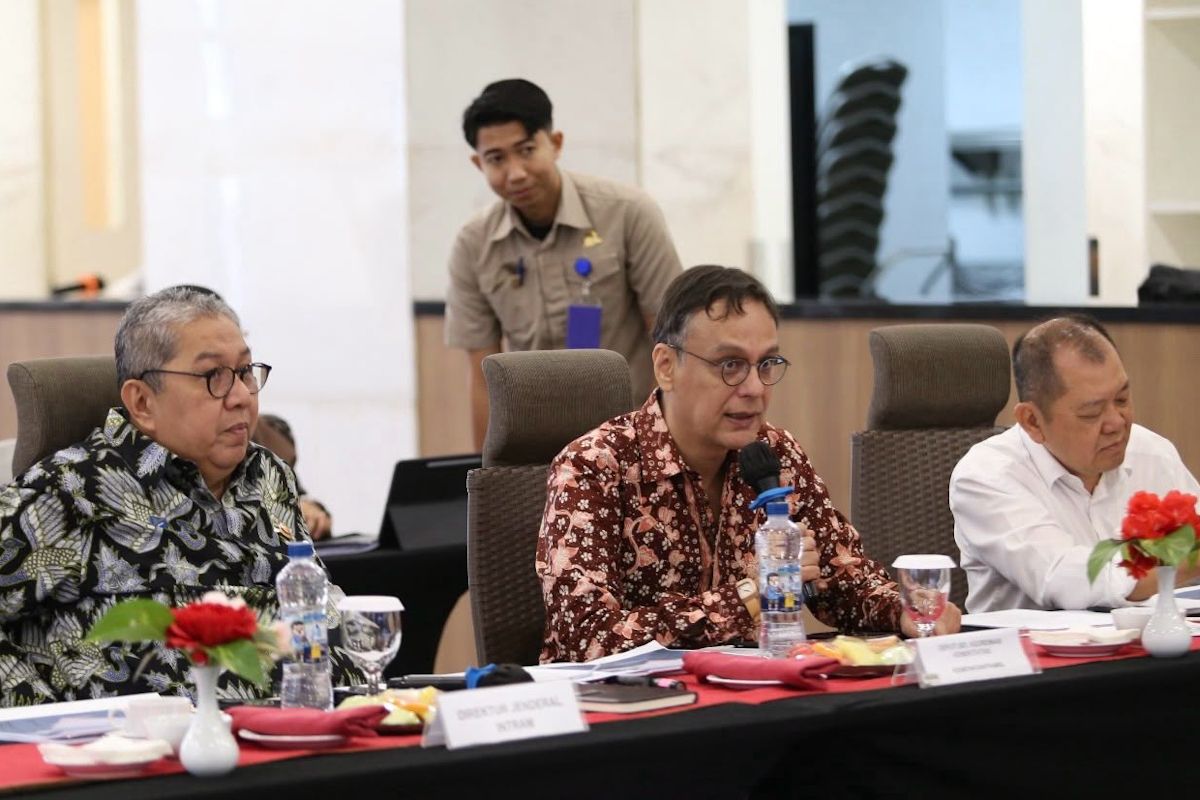
Jakarta (ANTARA) - The Ministry of Transport has begun deliberating the National Transport System (Sistranas) Bill through an Inter-Ministerial Committee (PAK) in order to strengthen national transport integration as the legal foundation for the organisation of integrated transport.
“The government has begun deliberating the Bill on the National Transport System through the Inter-Ministerial Committee (PAK),” said Risal Wasal, Director General of Transport and Multimodal Integration at the Ministry of Transport, in Jakarta on Monday.
This stage forms an important part of the drafting process for the Sistranas Bill, initiated by the government to build a legal foundation for an organised, unified and integrated national transport system.
The deliberations involve relevant ministries and agencies to discuss the substance of the bill comprehensively, covering the national transport system and planning, network integration, safety and services, the logistics system, as well as technology, the environment, human resources, funding and governance.
Risal said the drafting of the Sistranas Bill was undertaken to address the challenges facing transport provision, which still suffers from fragmented regulation and a lack of comprehensive integration across the various aspects of national transport.
“The Sistranas Bill is an Umbrella Act in the form of legislation that accommodates strategic national and global demand,” said Risal.
According to him, the challenges to be addressed include planning that is not yet unified, suboptimal coordination across modes, still-limited intermodal integration, division of authority that is not fully synchronised, digitalisation that is proceeding only partially, and a logistics system that remains inefficient.
The Sistranas Bill is positioned as an Umbrella Act that integrates all transport modes into a single National Transport System.
“This bill does not replace the entire body of sectoral laws. It is a legal umbrella that integrates all transport modes into a single National Transport System,” Risal explained.
Under its concept, the National Transport System is an organised, unified and systematically integrated transport arrangement that synergises policy, institutions, networks, infrastructure and facilities, hubs, services, technology, data and information, human resources, and funding.
Risal said the concept of the Sistranas Bill is also directed at unifying passenger and freight transport services, or the supply chain, taking into account needs, availability, optimisation of strategic assets, and the use of data.
“The drafting of the Sistranas Bill takes into account stakeholder input as part of efforts to realise a transport system that is effectively and efficiently integrated,” said Risal.
The inter-ministerial deliberations also form part of the process of preparing the Sistranas Bill for proposal for inclusion in the 2027 Priority National Legislation Programme (Prolegnas). Refining the substance through the PAK is an important step in maturing the bill’s conception before it enters the next legislative stage.
Through this process, the government seeks to strengthen the regulatory foundation for realising a national transport system that is integrated, sustainable, resilient, and adaptive to technological developments.
Odo R.M. Manuhutu, Deputy for Connectivity Coordination at the Coordinating Ministry for Infrastructure and Regional Development, said the Sistranas Bill must ensure the integration of four transport modes while anticipating developments in transport technology.
According to him, the Sistranas Bill is important for ensuring that the integration of the four transport modes — land, sea, air and rail transport — can be built within a single unified system.
He also assessed that the regulation needs to anticipate future developments in transport technology, including the arrival of autonomous vehicles, so that the national transport system remains adaptive to technological change and advancement.
According to him, deliberations across ministries and agencies are necessary because transport provision is connected to many sectors, including regional development, the economy and logistics, infrastructure, energy, financing, and transport digitalisation.
The series of PAK deliberations covers various areas of substance, including the national transport system, planning and network integration, safety, security and services, the national logistics system, transport in disadvantaged regions, transport resilience, technology and information systems, the environment, human resources, funding, and governance.
Source: jawawa.id (https://jawawa.id/newsitem/transport-ministry-begins-deliberating-national-transport-system-bill-to-strengthen-transport-integration-1788807063)
Originally published by Antara (Indonesian) (https://www.antaranews.com/berita/5730604/kemenhub-mulai-bahas-ruu-sistranas-perkuat-integrasi-transportasi), translated from Indonesian