
Transport Ministry Accelerates Transformation to Efficient, Low-Emission Freight Logistics
Jakarta (ANTARA) - The Ministry of Transport is accelerating the transformation of the goods transport sector towards a more efficient, competitive and low-emission national logistics system in order to support sustainable national economic growth.
“These efforts are being carried out through the development of a Green Logistics Corridor as part of the national transport decarbonisation strategy,” said Robby Kurniawan, Expert Staff to the Minister of Transport for Regional and Environmental Affairs, in a statement in Jakarta on Thursday.
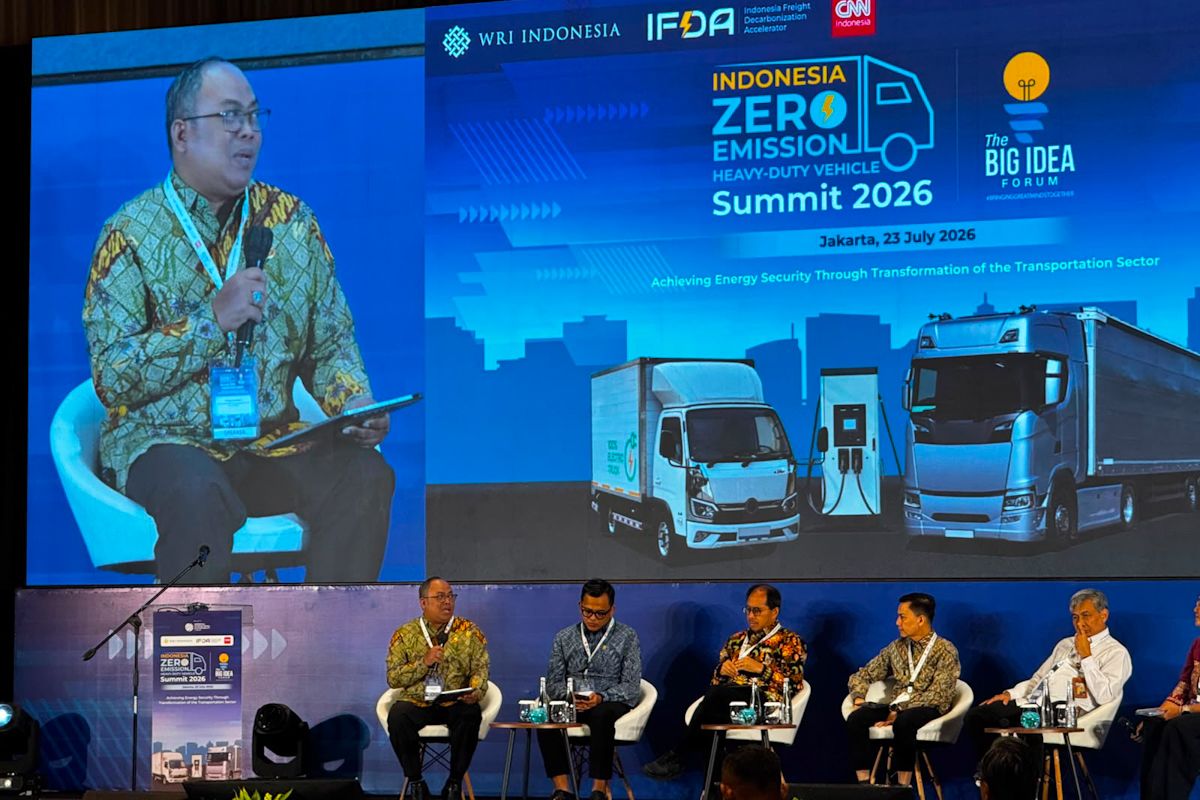
He made the remarks while serving as a panellist at the Indonesia Zero Emission Heavy-Duty Vehicle (IZEHDV) Summit 2026, organised by World Resources Institute (WRI) Indonesia together with the Indonesia Freight Decarbonization Accelerator (IFDA) in Jakarta.
The national-level forum, titled “Achieving Energy Security Through Transformation of the Transportation Sector”, brought together ministers, heads of ministries and agencies, regional governments, industry players, academics, financial institutions and international development partners to accelerate the transition to zero-emission heavy-duty vehicles in Indonesia.
Robby stressed that the goods transport sector is the backbone of national distribution while also being one of the largest contributors to emissions in the transport sector.
Therefore, the transformation towards ZEHDV cannot be carried out piecemeal, but must be built through an ecosystem approach that integrates policy, infrastructure, technology, financing and cross-sector collaboration.
He emphasised that the transformation to zero-emission heavy vehicles is not merely about replacing diesel engines with electric ones, but about building a national logistics system that is efficient, competitive, strengthens energy resilience and sustainable.
The Ministry of Transport is currently continuing to strengthen various policies supporting the acceleration of transport decarbonisation through the development of sustainable transport, improving logistics system efficiency, digitalising transport services, and developing infrastructure that supports the use of low-emission vehicles.
Robby also highlighted the importance of the Green Logistics Corridor as a model for developing future logistics corridors, connecting industrial areas, ports, toll roads, logistics centres, warehouse zones and clean energy networks within a single integrated ecosystem.
According to him, the corridor will become a strategic platform to accelerate the adoption of electric trucks while improving the efficiency of the national supply chain.
He explained that the successful implementation of the green logistics corridor requires close synergy between the central government, regional governments, toll road operators, ports, state utility PLN, the automotive industry, logistics companies, financing institutions and the business community.
“This transformation requires policy orchestration. It is not enough simply to provide electric vehicles; this must be accompanied by readiness of charging networks, adaptive regulation, innovative financing models and incentives capable of creating an investment ecosystem that is attractive to the business world,” he said.
At the forum, Robby also affirmed that the decarbonisation of goods transport offers strategic benefits that extend far beyond environmental considerations.
The transition to low-emission heavy vehicles is believed to strengthen national energy resilience by reducing dependence on imported diesel fuel, improve the efficiency of national logistics costs, improve air quality and support the achievement of Indonesia’s Net Zero Emission target by 2060.
The Indonesia Zero Emission Heavy-Duty Vehicle Summit 2026 represents an important moment in strengthening national collaboration to accelerate the transformation of the goods transport sector towards a logistics system that is greener, more efficient, more resilient and globally competitive.
WRI Indonesia stated that the forum brought together government, industry and business leaders to discuss accelerating the transition to zero-emission freight transport as well as the development of the National Green Logistics Corridor as one of its main agendas.