
Transport Minister Responds to Airlangga's Announcement of 0% Import Duty on Aircraft Spare Parts
The government has issued a latest policy package following geopolitical tensions in the Middle East region stemming from the US-Israel war against Iran. Among these, mitigation measures for the aviation/aircraft industry in Indonesia.
The government has allocated a budget of approximately Rp2.6 trillion for subsidies in the form of government-borne VAT (PPN DTP) at 11% to keep the maximum increase in aircraft ticket prices within the 9-13% range. This budget applies for 2 months.
Previously, the fuel surcharge itself has been raised to an average of 38% for jet and propeller aircraft, from previous levels of 10% and 25% respectively, based on the 2019 upper tariff limit figures.
Meanwhile, according to Pertamina’s official website, the official avtur price has increased at every domestic operating airport, applicable to both domestic and international flights, effective from 1 April 2026.
At Soekarno-Hatta Airport (CGK), the avtur price for domestic flights effective 1-30 April 2026 is set at Rp23,551.08 per litre. For 1-31 March 2026, it was still Rp13,656.51 per litre.
In addition, Pertamina has been granted relaxation in the payment mechanism with airlines under business-to-business (B2B) terms and conditions.
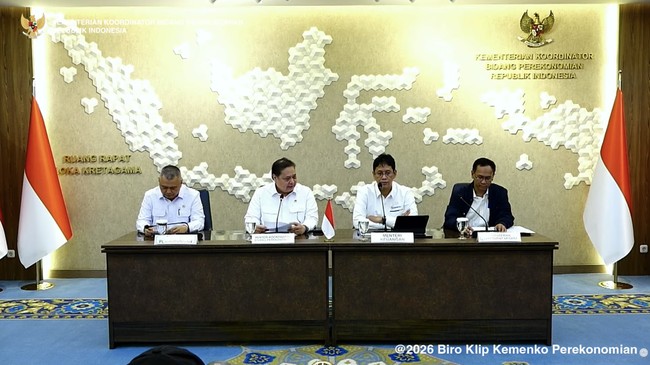
“Then, to maintain and enhance the competitiveness of the aviation industry ecosystem, the government is also providing an incentive by reducing import duties on aircraft spare parts to zero percent,” said Coordinating Minister for the Economy Airlangga Hartarto during a press conference on Transportation and Fuel Policies at the Coordinating Ministry for the Economy office on Monday (6/4/2026).
This policy is expected to suppress airline operational costs.
According to Airlangga, last year, import duties on aircraft spare parts amounted to around Rp500 billion.
“This policy is estimated to strengthen the competitiveness of the MRO (maintenance, repair, and operations or overhaul) industry with potential economic activity increasing by around 700 million per year. Of course, it can support GDP output up to 1.49 billion and create direct employment of around 1,000 people and indirect employment approaching three times that,” explained Airlangga.
This policy, he continued, will be followed up with the issuance of technical regulations in the form of the Minister of Finance Regulation and the Minister of Industry Regulation.
“All these policies are part of the government’s support for the continuity of the national aviation industry. As well as maintaining efficient, effective, and resilient economic activities,” said Airlangga.
Response from the Transport Minister
On the same occasion, Transport Minister Dudy Purwagandhi hopes that the newly released government policies will be well received by the public.
“Following up on what was conveyed by the Coordinating Minister for the Economy, with the current unfavourable conditions, especially related to the global economy and geopolitics, one of which is the increase in avtur. In setting the fuel surcharge, we have coordinated with all airlines operating in Indonesia, particularly domestic ones, so that we can set the fuel surcharge increase at 38%,” said Dudy.
“We did not act unilaterally in setting the fuel surcharge increase. This is a form of coordination and input from the airlines,” he added.
Dudy also thanked the Coordinating Minister for the Economy and the Minister of Finance for eliminating import duties on aircraft spare parts.
“So that in the future, it is hoped that the reduction or elimination of import duties will reduce the operational burden on our airlines,” said Dudy.
“We hope that the aforementioned policies are to maintain the balance of aviation industry sustainability and to protect public purchasing power. Hopefully, these policies can be well received by the public,” he stated.