
Transport Minister Discusses Dilemma Over Importing Second-hand Commuter Trains
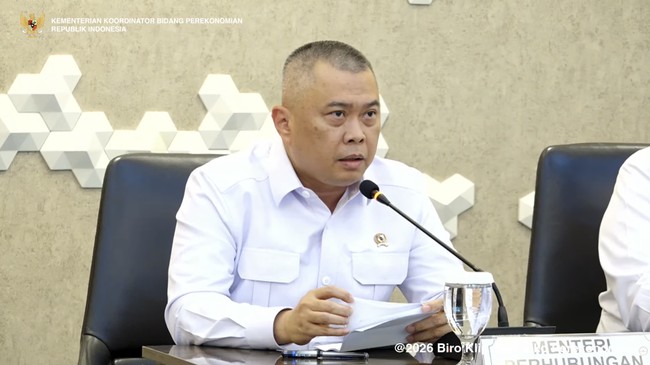
The plan to import 23 second-hand electric commuter train (KRL) sets from Japan has entered the inter-ministerial discussion stage. Minister of Transportation Dudy Purwagandli emphasised that the decision cannot be viewed solely through the lens of fleet requirements, but must also account for the capacity of the domestic industry.
The need for additional KRL fleets for the Greater Jakarta (Jabodetabek) area is becoming increasingly urgent. Passenger numbers in the first half of 2026 grew by 11.3% year-on-year, averaging approximately 1.1 million passengers per day, occasionally peaking at 1.3 million.
At the same time, several fleets operated by KAI (Kereta Api Indonesia) are over 40 years old.
“Therefore, I want us to sit together so that we have a roadmap for fulfilling these KRL procurement needs, whether domestically or through imports,” said Dudy during the Forwahub Workshop on Friday (2/10/2026).
Approval to bring in second-hand KRL sets was previously granted by Commission VI of the House of Representatives (DPR RI) during a hearing with KAI on 23 September 2026. KAI proposed 23 train sets, consisting of seven sets with a 12-car formation and 16 sets with an eight-car formation.
These fleets are intended to serve as a transitional solution before domestic production capacity can meet demand.
Discussions have now moved into technical aspects, import regulations, operator requirements, and national manufacturing capabilities. The Ministry of Transportation must also consider import regulations for second-hand goods under the jurisdiction of the Ministry of Trade, as well as the interests of industrial strengthening overseen by the Ministry of Industry.
“However, we must also consider whether there are age limits permitted for importation. But we must also recognise the necessity. There is a need from the public and a need from the operators; we must see how INKA [the state-owned manufacturer] can meet this,” said Dudly.
On the other hand, KAI requires new fleets relatively quickly. The procurement of second-hand KRL sets was chosen as a bridge because they can be deployed faster than the production of new sets. KAI estimates these fleets can be used for approximately 10 years, while the domestic industry is being encouraged to improve its production capacity.
Domestic production capacity issues have also become a concern following recalls of several INKA KRL products. This situation requires the government to recalculate domestic production capabilities while ensuring that Jabodetabek KRL service levels do not lag behind passenger growth.
“We are assessing the capabilities of the INKA industry; we must speak with the supervising ministry for the railway industry. Our role at the Ministry of Transportation is to ensure that the trains used are fit for purpose. That is the most important thing,” said Dudy.
Discussions involve not only the Ministry of Transportation but also various ministries, agencies, and State-Owned Enterprises (SOEs). The government intends for the decision to be more than just a short-term fix, but rather part of a long-term policy for fleet fulfilment.
“It is not just SOEs, but everyone. There is Danantara [the new sovereign wealth fund agency], the Ministry of Trade, the Ministry of Industry, and the Ministry of Transportation. We are sitting down to discuss not just the present, but what happens in the long run. We do not want the policy to be merely a ‘patchwork’ solution. We must be clear. There is a need, and we must determine how to meet it,” concluded Dudy.
Source: jawawa.id (https://jawawa.id/newsitem/transport-minister-discusses-dilemma-over-importing-second-hand-commuter-trains-1790995868)
Originally published by CNBC Indonesia (https://www.cnbcindonesia.com/news/20261003081318-4-773015/menhub-dudy-buka-bukaan-dilema-impor-krl-bekas), translated from Indonesian