
Transmigration Minister: Transmigration Law Reform Must Be Based on Regional Aspirations
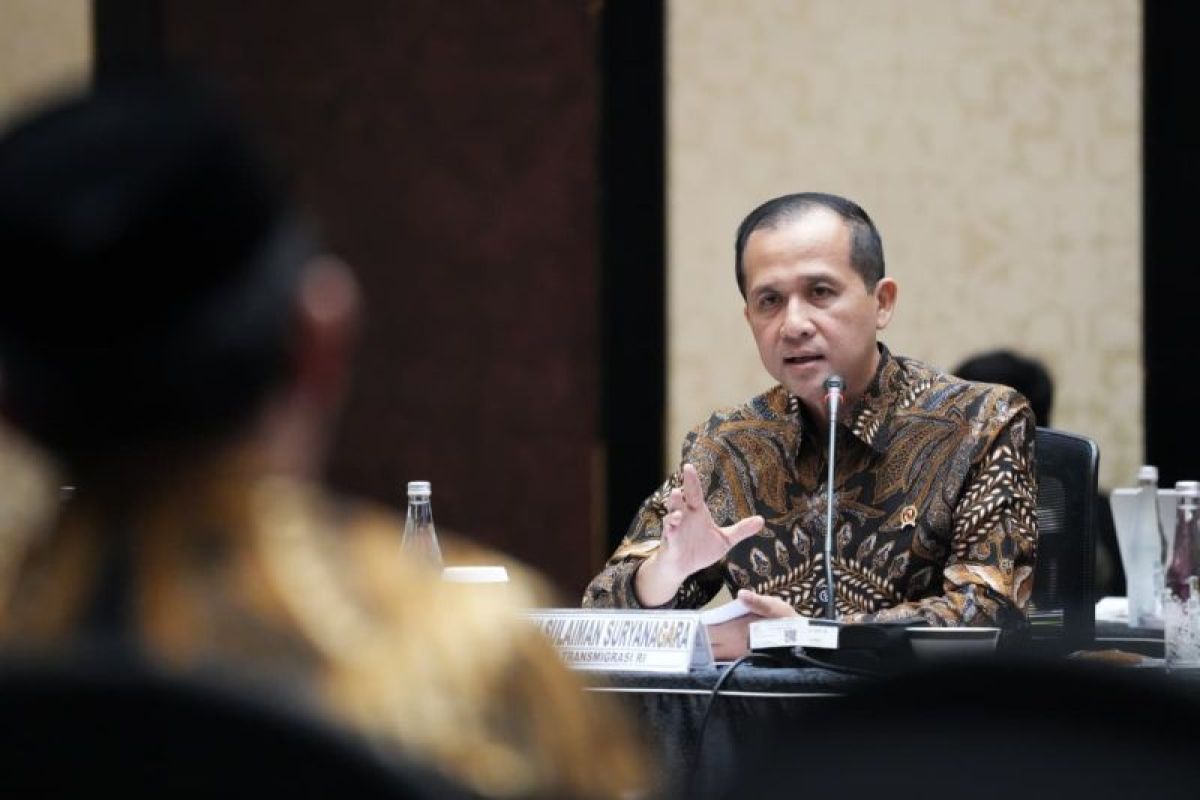
Jakarta (ANTARA) - The Minister of Transmigration, Muhammad Iftitah Sulaiman Suryanagara, has asserted that the amendment of the Transmigration Law must stem from the aspirations and actual problems faced by the community and local governments.
This statement was made during the pre-discussion phase regarding the amendment of Law Number 15 of 1997, as amended by Law Number 29 of 2009 concerning Transmigration, held alongside Committee I of the Regional Representative Council (DPD RI).
“The DPD represents the regions. Many transmigration issues are felt directly in the regions, ranging from land matters, spatial planning, and central-regional relations, to how local communities benefit from regional development,” Iftuitah stated in his remarks in Jakarta on Wednesday.
In a working meeting with Committee I of the DPD RI in Jakarta on Monday (5/10), Iftitah explained that the current Transmigration Law is not a failure, as it has successfully shifted the approach from population relocation to regional development and growth centres.
However, changes in economic structures, the need for job creation, industrialisation and downstreaming, investment, land and asset management issues, and the equitable distribution of economic benefits necessitate a legal framework that can adapt to new challenges.
“Indonesia is changing, the challenges are changing, and transmigration must also be able to respond to those changes. Transmigration can no longer be interpreted solely as moving people. What we must build is jobs, productivity, income, and new economic growth centres,” he said.
Iftitah ensured that the law revision will continue to protect the rights of transmigrants who have previously participated in government programmes, including through the resolution of land issues and the legalisation of assets.
These issues are still faced by tens of thousands of transmigrants. The Ministry of Transmigration noted in July 2026 that more than 80,000 transmigrants have not yet obtained certificates, covering approximately 129,000 plots of land.
On the other hand, the Minister believes the future model of transmigration needs to be more flexible. For industrial-based areas, for example, patterns can be developed through job certainty, decent housing, competency enhancement, and labour protection, without making transmigration merely a supplier of industrial labour.
The regulatory update is also aimed at strengthening Community Cooperatives as a shared economic vehicle. Individual rights will remain protected, while production activities, value chains, access to finance, and market power can be strengthened collectively.
The Ministry of Transmigration is also preparing the ‘Economic Engine First’ principle, which ensures that economic potential, markets or off-takers, investment, business activities, human resource needs, housing, and infrastructure are established before the placement of people.
“We do not want to move people to an area and then hope the economy grows. We want to ensure the economic engine grows first, so that those who arrive have jobs, businesses, and a future,” said Iftitah.
Furthermore, it is proposed that regional assistance should not be determined solely by a five-year time limit, but should also consider the level of regional maturity.
Land and asset management for transmigration is also expected to become stronger so that it can be utilised according to its function and legal provisions.
To handle cross-sectoral issues, the Ministry of Transmigration has also proposed the revival of the Transmigration Advisory Council with a stronger institutional framework.
The Council is proposed to be led by the President of the Republic of Indonesia, with the Minister of Transmigration serving as the secretary.
In 2027, the Ministry of Transmigration has been allocated a budget of Rp947.27 billion, with Rp612.47 billion, or 64.66 per cent, allocated to transmigration programmes.
Through the ‘Trans Tuntas’ programme, the ministry targets the issuance of 3,254 ownership certificates and the resolution of 29 cases of overlapping transmigration lands.
Iftitah stated that the measure of success for transmigration in the future cannot be judged solely by the number of families placed, houses built, land area, or the number of certificates issued.
According to him, success must also be measured by job creation, increased income, the growth of MSMEs and cooperatives, the influx of investment, and the ability of regions to become sustainable new growth centres.
During the meeting, the Chairman of Committee I of the DPD RI, Andi Sofyan Hasdam, appreciated the change in approach, which is no longer solely oriented towards population movement but also towards regional development and the improvement of community welfare.
“We greatly appreciate this because, until now, the concept we knew regarding transmigration was one of population relocation. It turns out the concept is very different now,” said Andi.
The discussions with Committee I of the DPD RI are still in the early stages and have not yet reached a clause-by-clause discussion.
The Ministry of Transmigration hopes that the Transmigration Bill (RUU) can be pushed through the DPD RI legislative mechanism to secure a place in the 2027 National Legislative Programme (Prolegnas) Priority.
“This Bill is not solely about the Ministry of Transmigration. It is about how the state strengthens the regions. Therefore, we want the reform to be born from regional aspirations and be monitored together with the DPD RI,” said Iftitah.