
Transmigration 5.0: A Vehicle for Creating New Centres of Economic Growth
Transmigration 5.0: A Vehicle for Creating New Centres of Economic Growth
Transmigration Paradigm today has changed markedly. Whereas in the past transmigration was understood as moving people from densely populated areas in Java and Bali to outside Java such as Sumatra, Kalimantan, Sulawesi, Maluku up to NTB, NTT and Papua, such a view now needs to be corrected.
Current transmigration continues to move people, but also for more substantive purposes, such as building new centres of economic growth. In other words, to distribute prosperity as widely as possible across Indonesia.
Minister of Transmigration M. Iftitah Sulaiman Suryanegara revealed that current transmigration is transmigration 5.0. The essence is revitalisation and transformation. The approach is to make land that is unproductive productive through the role of universities, including appropriate technology.
Moreover, at a certain point, government funds are no longer seen as a cost, but as an investment. Transmigration today is no longer oriented toward relocation of residents, but toward creating a new economy that is sustainable, inclusive, just and based on local potential while also addressing Indonesia’s demographic bonus challenges in the future (www.cnbcindonesia.com, 22/12/2025).
Iftitah further stated that economic growth in transmigration areas must be pro-poor and have a direct impact on the welfare of local communities. Investments must be accompanied by increasing the capacity of human resources so that the local community becomes the main actors in development. The approach to developing transmigration areas should start from strengthening human resources so that the country truly participates in every new economic ecosystem.
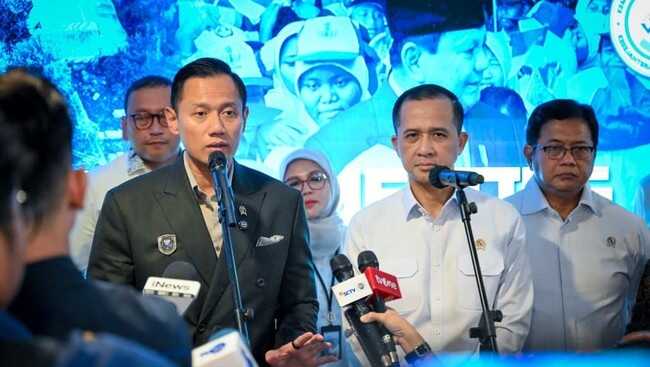
Coordinating Minister for Infrastructure and Regional Development Agus Harimurti Yudhoyono (AHY) said that the transformation of transmigration is to become a strategic instrument of national development to drive high, inclusive and just economic growth while also addressing increasingly complex global challenges.
Transmigration development is inseparable from strengthening basic infrastructure as the main foundation of regional development. The state bears the responsibility to ensure every transmigration area has infrastructure readiness to grow as new centres of economic growth.
AHY explained that the Ministry of Transmigration is currently guiding two major agendas: revitalisation of transmigration areas and transformation of transmigration areas. Revitalisation focuses on optimising existing areas through improving basic infrastructure, while transformation aims to increase the value-added of the area through collaboration with industry, investors, technology, and off-takers.
Transmigration development must be part of a national strategy to meet global challenges, including geopolitical tensions and the risk of a global economic slowdown. Therefore, development must not be centralized and must reach lagging, frontier and outer regions, including Papua.
Transformation of the Transmigration Program
The generation of the nation that is already senior may only know the transmigration programme from the Soeharto era (1967-1998), but in reality the transmigration programme has run in every era of government, even since the era of colonial Hindia Belanda. The first transmigration occurred in November 1905 with the relocation of residents from (now Central Java Province) to (now) the Gedong Tataan area of Pesawaran Regency, Lampung Province.
Post-independence transmigration first occurred in 1950 with the relocation of residents from Java Island to Lampung and the remainder to Lubuk Linggau (now part of South Sumatra Province). In the era of President Prabowo (2024-2029), transmigration has become a dedicated Ministry not merged with other government sectors, under Minister Iftitah.
The Ministry of Transmigration ensures that the transmigration programme that has been running since the era of President Sukarno will transform under the administration of President Prabowo Subianto. Transmigration is not merely moving people and housing, but also livelihoods, such as livelihoods, as well as education and health services.
Its main objective is economic equality and development. Minister Iftitah stated that since Law Number 29 of 2009 on Transmigration was enacted, a location cannot be designated as a transmigration destination without the request of the regional government. Transmigration is now not merely moving residents, but also directing superior human resources to support local economic growth.
The concept of transmigration is implemented with a pattern that blends 70 percent local residents and 30 percent migrants in a location. The aim is to ensure local residents are not marginalised by migrants. In this way, inequality and social jealousy can be avoided. One example is the South Papua region where Indigenous Papuans (OAP) will be a priority (kompas.com, 28/07/2025).
Transmigration 5.0.
To optimise the achievement of the goal of economic equality and development, the Ministry of Transmigration is introducing a new concept for the Transmigration 5.0 programme. This programme is built on five main pillars that form the strategic framework for driving the implementation of the transmigration transformation.
The first pillar is Green Development, or environmentally friendly transmigration. This concept adopts an integrated forestry system (agroforestry) and utilises renewable energy sources. The second pillar is the smart village ecosystem, i.e., smart villages based on digital technology and the Internet of Things.
Meanwhile, the third pillar is value-based citizenship, which regards transmigrants as pioneers of active citizenship. The fourth pillar, intergenerational design, namely