
Transjakarta Users Hope Two Rasuna Said Pedestrian Bridges Will Be Connected to Shorten Walking Time
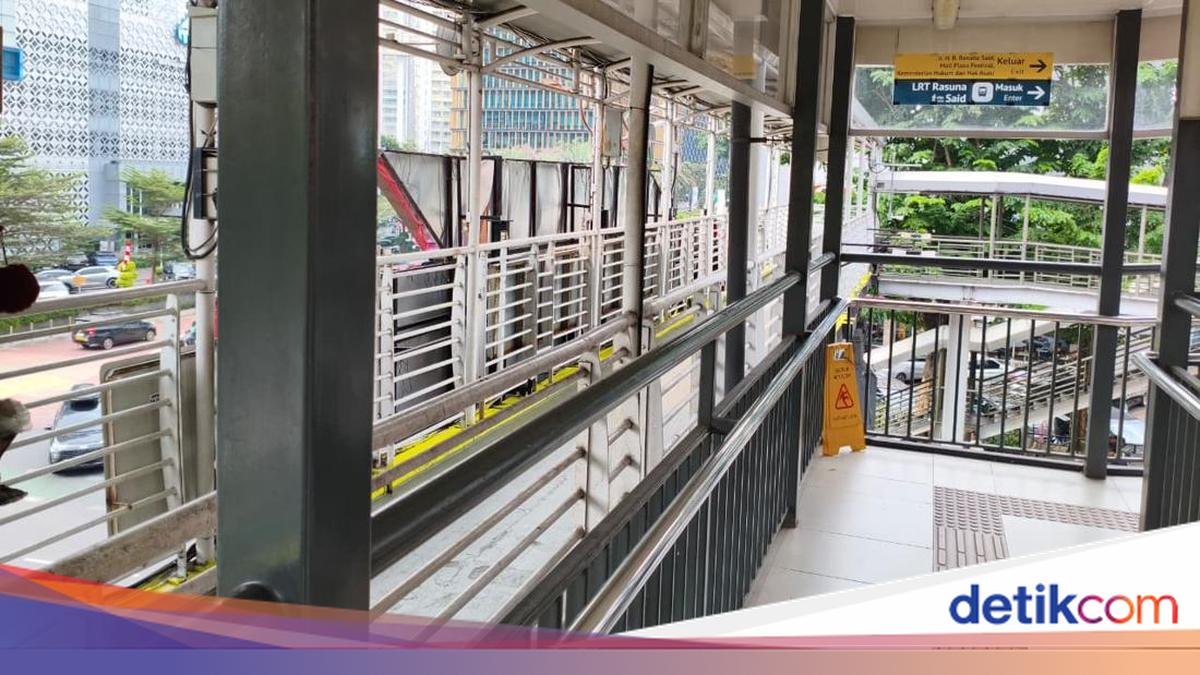
Transjakarta bus users are hoping that two pedestrian bridges (JPO) located close to each other on Jalan Rasuna Said can be connected. Users believe that linking the bridges would shorten the walking time required to exit the Transjakarta Rasuna Said bus stop.
One user, 22-year-old Anna, said the current access route forces her to walk further and for a longer duration. She explained that the two separate bridges mean passengers must first ascend the JPO integrated with the LRT Station before they can descend to the pavement. “It takes more time,” Anna said at the Rasuna Said LRT Station pedestrian bridge in South Jakarta on Tuesday.
Anna assessed that connecting the JPOs would effectively aid public mobility. She noted that some people often mistakenly use the wrong bridge, assuming the two are linked. “Just connect them again, that’s all. Because if people don’t know this area, they will be confused. They might think they’ve already entered the Transjakarta access, but then they have to turn around and go back up here to connect to Transjakarta. It’s just confusing,” she said. She added that a connection would also help ease congestion during peak hours, as the current access forces Transjakarta and LRT users to share the same bridge during rush hour.
Another Transjakarta user, Fajar, also admitted to being confused when using the JPO in the Rasuna Said area. He initially thought access to and from the Transjakarta bus stop was possible via both bridges. “It was very confusing, especially since it was my first time. So, going towards Kuningan or Menteng was quite confusing. Yes, connecting them would be good to make things easier, so you don’t get tired going back and forth if you go the wrong way,” he said.
The DKI Jakarta Public Works Agency’s Head of Data and Information Centre, Siti Dinarwenny, explained that the old JPO is a crossing facility owned by the DKI Jakarta Provincial Government. Meanwhile, the JPO right next to it is an integration bridge built by the Jabodebek LRT operator. This new JPO is now the sole access point to and from the Transjakarta bus stop. “Before the Transjakarta bus stop was relocated under the Integrated Jabodebek LRT Station, the existing JPO also served as direct access to the bus stop. However, after the relocation, access to the bus stop is now via the integration JPO built by the LRT Jabodebek,” Wenny said.
Wenny stated that the JPO integrated with the LRT station can also be used by the general public to cross the road. She noted that the integration JPO has an unpaid area, allowing citizens who do not use LRT or Transjakarta services to still utilise the facility. “The integration JPO has an unpaid area so it can be used by the general public for crossing. This facility is equipped with lifts to ease access for the public, especially persons with disabilities, the elderly, pregnant women, and other users who need easier access,” she said.
Responding to the proposal to connect the two JPOs, Dinarwenny stated that such a plan would require a technical study from the Jabodebek LRT operator as the owner and manager of the integration JPO. Furthermore, she noted that there is a floor height difference of approximately 75 cm between the two JPOs, while the distance between them is only about 60 cm. “This condition makes it impossible to build stairs or a ramp that meets safety, security, comfort, and accessibility standards for users,” she explained. “We urge the public to use the available crossing facilities and always prioritise safety during activities,” she added.