
Transforming the Correctional System
The saying “There is no ivory without a flaw” reminds us that nothing in the world is perfect. Every person and institution has shortcomings, weaknesses or has made mistakes.
This also reflects the two-year journey of President Prabowo Subianto and Vice-President Gibran Rakabuming Raka’s administration in the field of corrections. The sector has recently come under scrutiny following a surprise inspection by the Ombudsman of the Class IIA Cibinong Correctional Institution in West Java on 23 September 2026.
But even before the issues at Cibinong came to light, the Directorate General of Corrections at the Ministry of Immigration and Corrections had been working to transform Indonesia’s correctional system. The new approach places greater emphasis on empowering inmates and preparing them for reintegration into society.
The new paradigm was presented at the 7th World Congress on Probation and Parole (WCPP) in Bali on 14 April 2026, attended by more than 400 delegates from 40 countries.
The congress formulated an ideal model for inmate rehabilitation, built around three main pillars: smarter justice, restoration and social harmony.
Immigration and Corrections Minister Agus Andrianto said at the time that the framework would serve as a recommendation and reference for inmate rehabilitation programmes in countries around the world. He said sentencing systems had shifted from imprisonment alone towards efforts to achieve rehabilitation.
The correctional approach is no longer applied rigidly, but is becoming more intelligent and based on data and scientific evidence. As a result, the system focuses on more than prison cells and considers sentencing alternatives that are more cost-effective without compromising the essence of justice.
The second concept is restoration, in which the law is no longer used as an instrument of retribution, but as a means of social reintegration for offenders, victims and the wider community.
The third pillar, social harmony, focuses on breaking the cycle of reoffending through support, rehabilitation and close supervision by community correctional centres (Bapas).
At the international forum, Indonesia shared its national correctional model, which is geared towards empowering inmates so they are ready to return to society.
The transformation of the correctional system through inmate empowerment has been put into practice since the Ministry of Immigration and Corrections was established under President Prabowo Subianto’s Red and White Cabinet.
The ministry is promoting a new way of thinking. Whereas the public has tended to regard prisons and remand centres merely as places of punishment, the transformation encourages people to recognise the potential that exists behind prison walls.
In line with the vision of achieving a Golden Indonesia 2045, the ministry has drawn up 13 Acceleration Programmes to address challenges in the national correctional system. The programmes aim not only to improve the system, but also to promote inmates’ self-reliance, empowerment and social reintegration so that they can contribute to national development.
Several programmes align with the Astacita mission, demonstrating that the correctional system can drive national change. One of Astacita’s main pillars is achieving food security.
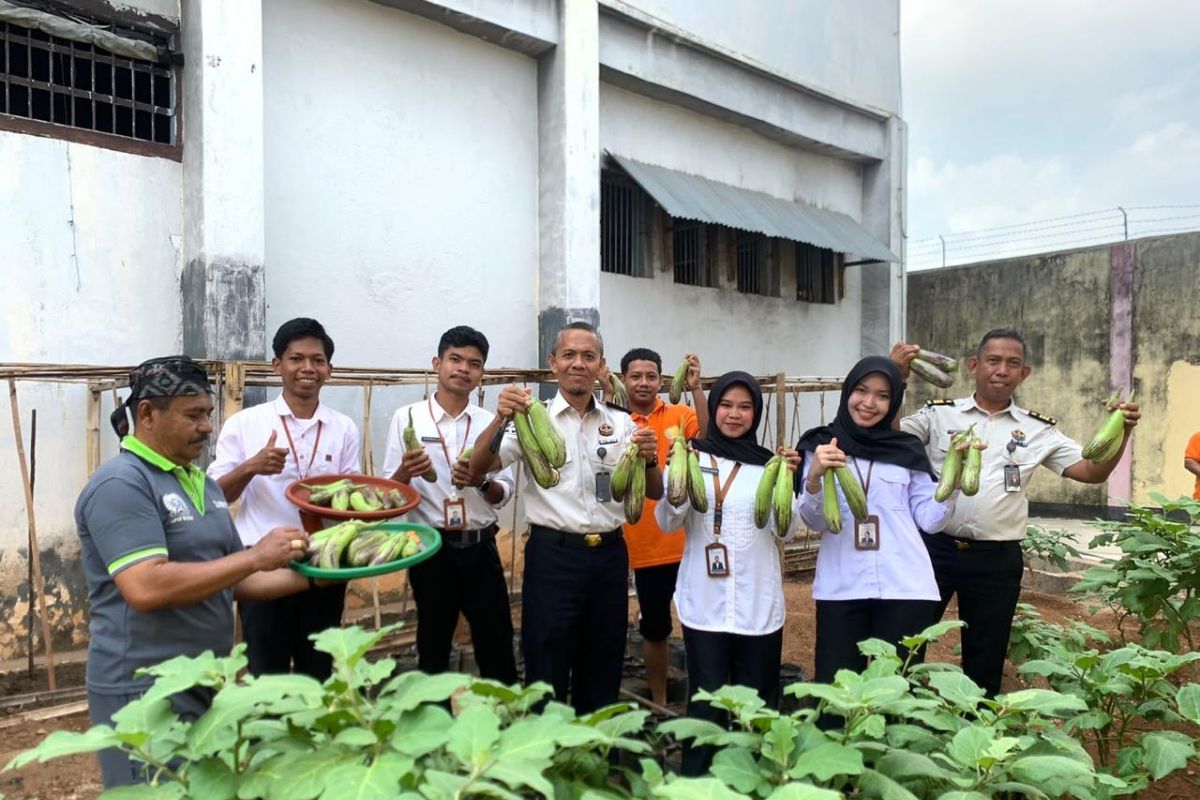
Making use of available resources, Indonesia’s correctional institutions are playing an active role in supporting national food security through agriculture, livestock, fisheries and plantation programmes in prisons and remand centres.
These inmate empowerment programmes are expanding rapidly. Inmates take part in every stage, from preparing the land and planting to crop maintenance, harvesting and distributing the produce.
Through these programmes, inmates gain new skills and a sense of empowerment, while making a tangible contribution to the country’s food security.
The commitment was demonstrated at the Correctional Food Security Harvest Festival held at the Class I Cirebon Correctional Institution in West Java on 15 January 2026.
The institution harvested 7,000 kilograms of Inpari 32 rice from 13,740 square metres of land, as well as one tonne of tilapia from ponds covering 637 square metres.
Nationwide, the Ministry of Immigration and Corrections’ simultaneous harvest, carried out by correctional technical units in various regions, was expected to yield a total of 123,557 kilograms of agricultural, plantation, livestock and fisheries commodities. The produce from the harvest was used for social activities and to assist communities affected by disasters.